
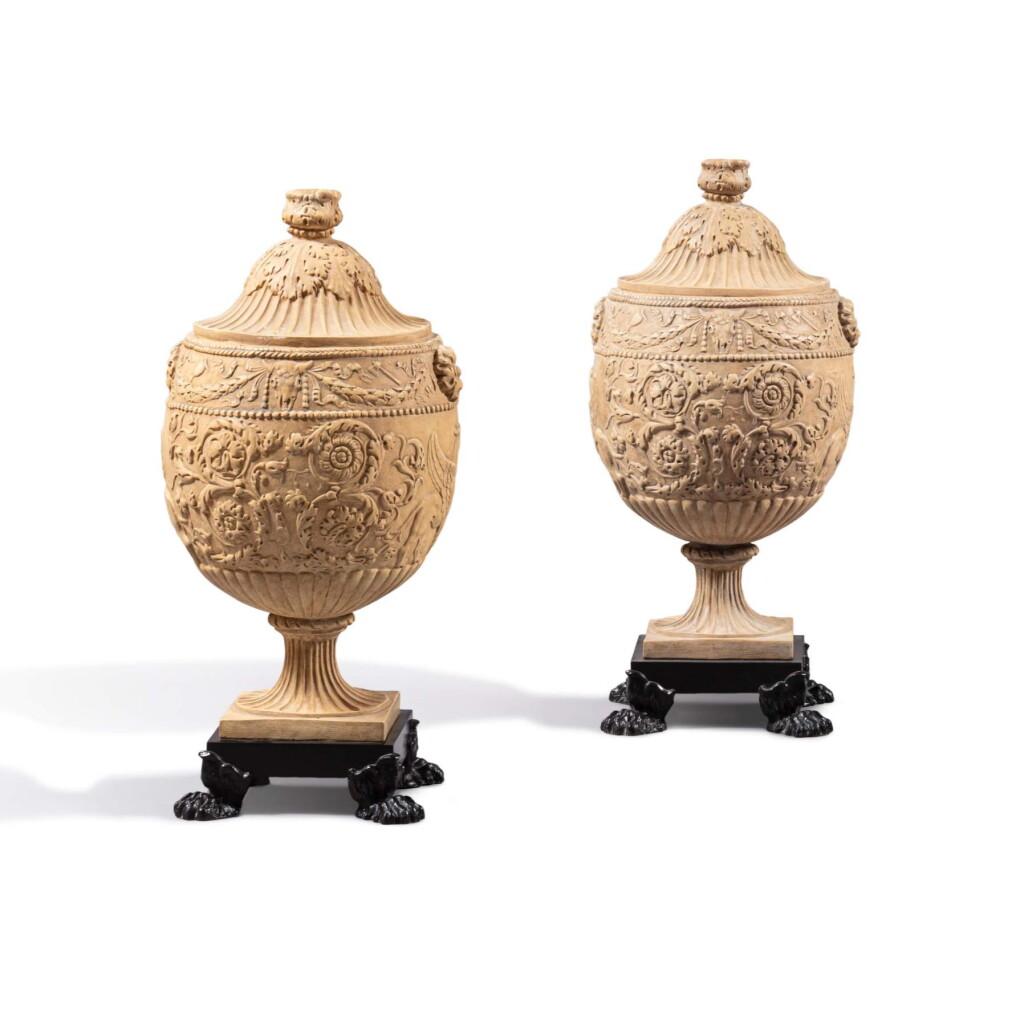
A pair of patinated terracotta covered urns mounted as lamps, Manifattura di Signa, Florence, early 20th century, after the cinerary urn of Aurelius Victor in the Museo Pio Clementino
No reserve
Estimate
5,000 - 7,000 EUR
We may charge or debit your saved payment method subject to the terms set out in our Conditions of Business for Buyers.
Read more.Lot Details
Description
of ovoid form, the ribbed cover with acanthus leaves and budding finial, the neck decorated with a frieze of swags and flanked by two rosettes, the body centred by a beaded cartouche inscribed with a Latin epitaph, between two incense-burning candelabra and two leogryphs, the lower part with a frieze of foliate scrolls above a gadrooned bowl, the fluted stem on a square plinth with the mark MANIFATTURA DI SIGNA within a laurel wreath and the number 496, on a later blackened-metal base with four lion's paw feet; (electrified)
(2)
Height 27 1/2 in., diam. 12 5/8 in. ; Haut. 70 cm, diam. 32 cm
Arco Art Advisory, June 2010
Our urns take up the model of the cinerary urn of Aurelius Victor, preserved in the Vatican Museums, in the Galleria dei Candelabri of the Museo Pio Clementino.
This model was disseminated through engraving under the title "Vaso Antico nel Museo Pio Clementino", in Carlo Antonini's (1740-1821) Manuale di varj ornamenti componenti la serie de' vasi antichi sì di marmo che di bronzo esistenti in Roma e fuori, published in three volumes in Rome in 1821 [vol. I, pl. 41]. An engraver and architect, Antonini illustrated there antique vases preserved in Rome, notably in the Museo Pio-Clementino and the Museo Chiaramonti. He had already published, between 1777 and 1790, another Manuale di varj ornamenti for the use of painters, sculptors, architects, stuccatori, silversmiths and cabinetmakers.
In the late 19th and early 20th centuries, several Italian manufactories took up this model. The Manifattura di Signa, founded near Florence in 1895 by Camillo Bondi and specialising in the reproduction of antique and Renaissance models, produced versions in patinated terracotta, including ours.
You May Also Like


