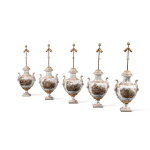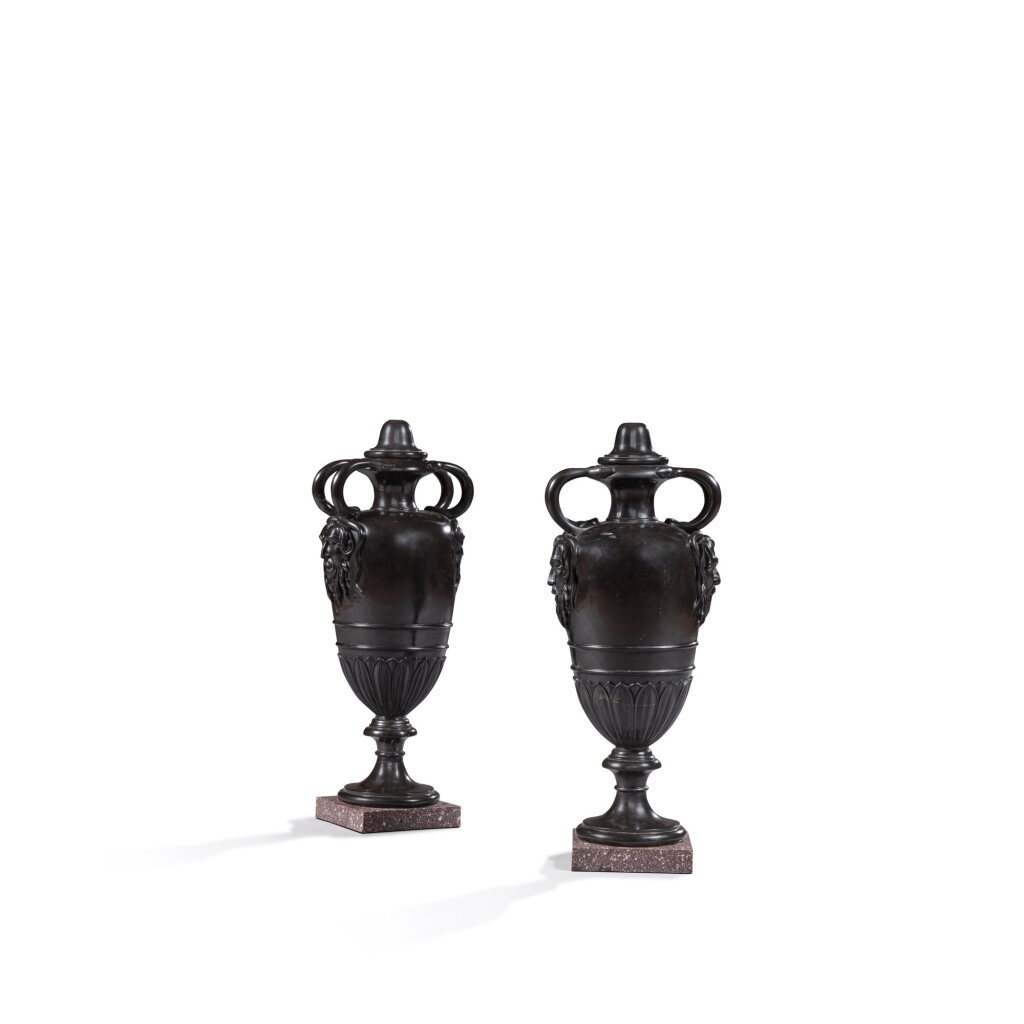
A pair of Nero del Belgio and porphyry vases mounted as lamps, Italy, circa 1800
No reserve
Auction Closed
November 6, 06:14 PM GMT
Estimate
10,000 - 15,000 EUR
Lot Details
Description
with double intertwined serpent-ring handles and bearded mascarons; (pierced for electricity)
(2)
Height 29 7/8 in., width 12 1/4 in., depth 9 1/2 in. ; Haut. 76 cm, larg. 31 cm, prof. 24 cm
Private collection, Belgium;
Koller, Zurich, 25 March 2010, lot 1177.
RELATED LITERATURE :
G. Faldi, Galleria Borghese, Le Sculture dal secolo XVI al XIX, Rome, 1954, p. 11
R. Gnoli, Marmora Romana, Rome, 1988, p. 195
A. Sironi, "Nero del Belgio", in G. Borghini, Marmi antichi, Rome, 1997, p. 256
The use of black marble in the decorative arts is attested as early as the Roman period with nero antico, quarried in North Africa and recognisable by its deep black surface, punctuated by inclusions and white veins.
From the Renaissance onwards, black marbles quarried in the Namur region, notably at the quarries of Mazy and Golzinne, became widely distributed throughout Europe. Valued for the depth and uniformity of their colour when polished, they were known in Italy as paragone di Fiandra and used in hardstone compositions at the Opificio delle Pietre Dure in Florence. Their trade and use in Italy are documented from the late 16th century and continued throughout the 17th century.
Our pair of vases is inspired by the pair of amphorae commissioned in 1638 by Prince Marcantonio Borghese from the sculptor Silvio Calci, with ‘their double-serpent handles’, after a design by Alessandro Algardi, now preserved in the Galleria Borghese, Rome (inv. CCXIX).
You May Also Like