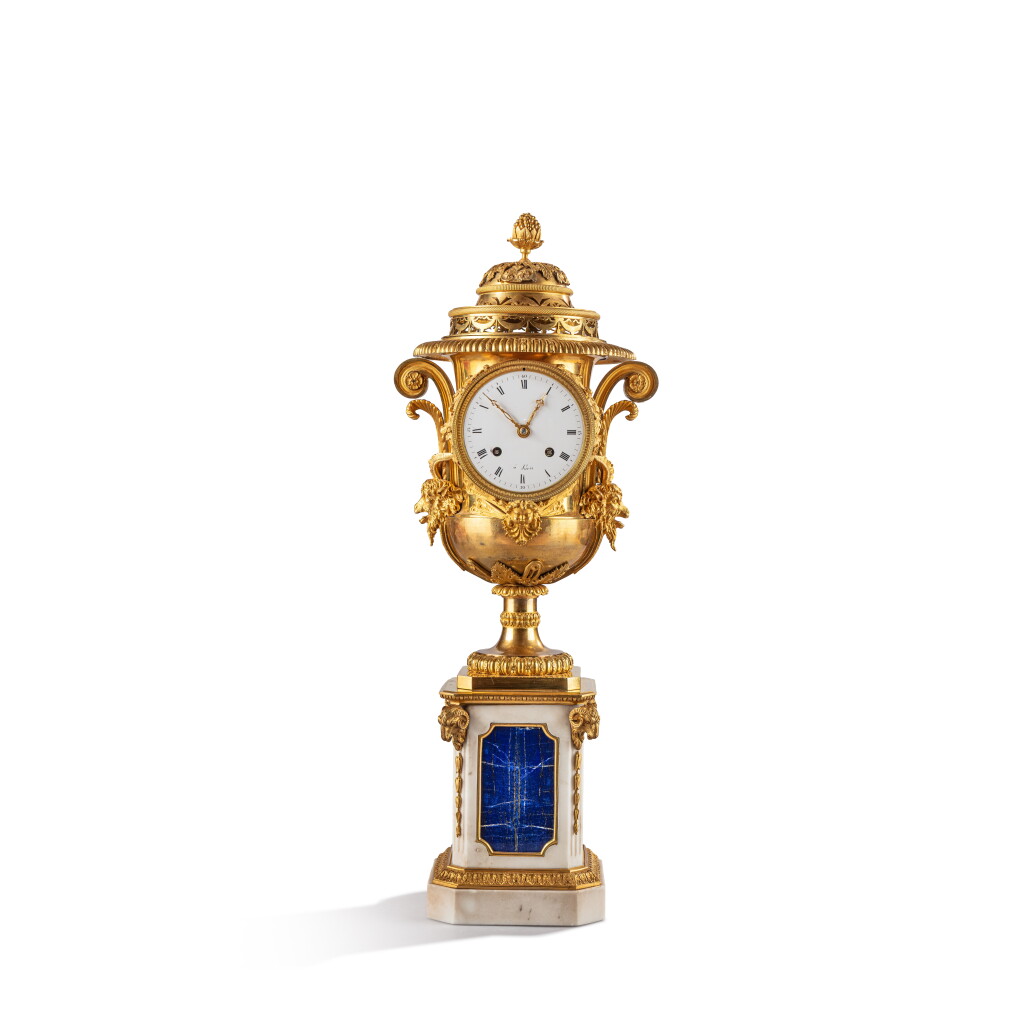
A Directoire gilt-bronze mounted marble and lapis lazuli clock, circa 1800, after a model attributed to Claude Galle or Pierre-Philippe Thomire
No reserve
Estimate
10,000 - 15,000 EUR
Lot Details
Description
In the form of an openwork pot-pourri vase, surmounted by a pine-cone finial, with scroll handles rising from goat heads, on a circular foot resting on a square base decorated at the corners with ram heads and inset with lapis lazuli plaques, the white enamel dial, with Roman numerals for the hours and Arabic numerals for the minutes, signed "A Paris," supported by the head of a cherub with butterfly wings
Height 24 3/4 in., width 9 in., depth 7 7/8 in. ; Haut. 63 cm, larg. 23 cm, prof. 20 cm
Private collection, Rome;
Koller, Zurich, 26 March 2009, lot 1167.
RELATED LITERATURE
H. Ottomeyer and P. Pröschel, Vergoldete Bronzen - Die Bronzearbeiten des Spätbarock und Klassizismus, Munich 1986 ; II, pp. 704-709
J.P. Samoyault, Pendules et bronzes d'ameublement entrés sous le premier Empire, Paris, 1989, p. 81, n°47
P.Kjellberg, Encyclopédie de la pendule française, Paris, 2005, p327, fig. C
This type of vase-form clock was a fairly common model in the early 19th century, illustrated by Pierre de La Mésangère in Collection de meubles et objets de goût, vol. 1, plate 22, and frequently produced by Claude Galle and Pierre-Philippe Thomire.
Its general shape recalls Thomire's caryatid clocks, such as the one in the Musée François Duesberg, Mons (illustrated in P. Kjellberg, Encyclopédie de la pendule française, Paris, 2005, p. 327, fig. C), and a similar model delivered to Fontainebleau for the appartement doré, no. 1, cour ovale, described as: "...a Medici-vase-shaped clock, bronze body, richly decorated with various ornaments, the vase featuring handles with female figures (...) 800" (J.-P. Samoyault, Pendules et bronzes d'ameublement entrés sous le Premier Empire, Paris, 1989, p. 81, no. 47).
The clock is also very close to works by Claude Galle, notably the incense burner held at the Victoria & Albert Museum, London (inv. M 577/1911), illustrated in H. Ottomeyer and P. Pröschel, Vergoldete Bronzen, Munich, 1986, vol. 1, p. 363, fig. 5.12.5.
You May Also Like