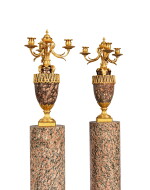
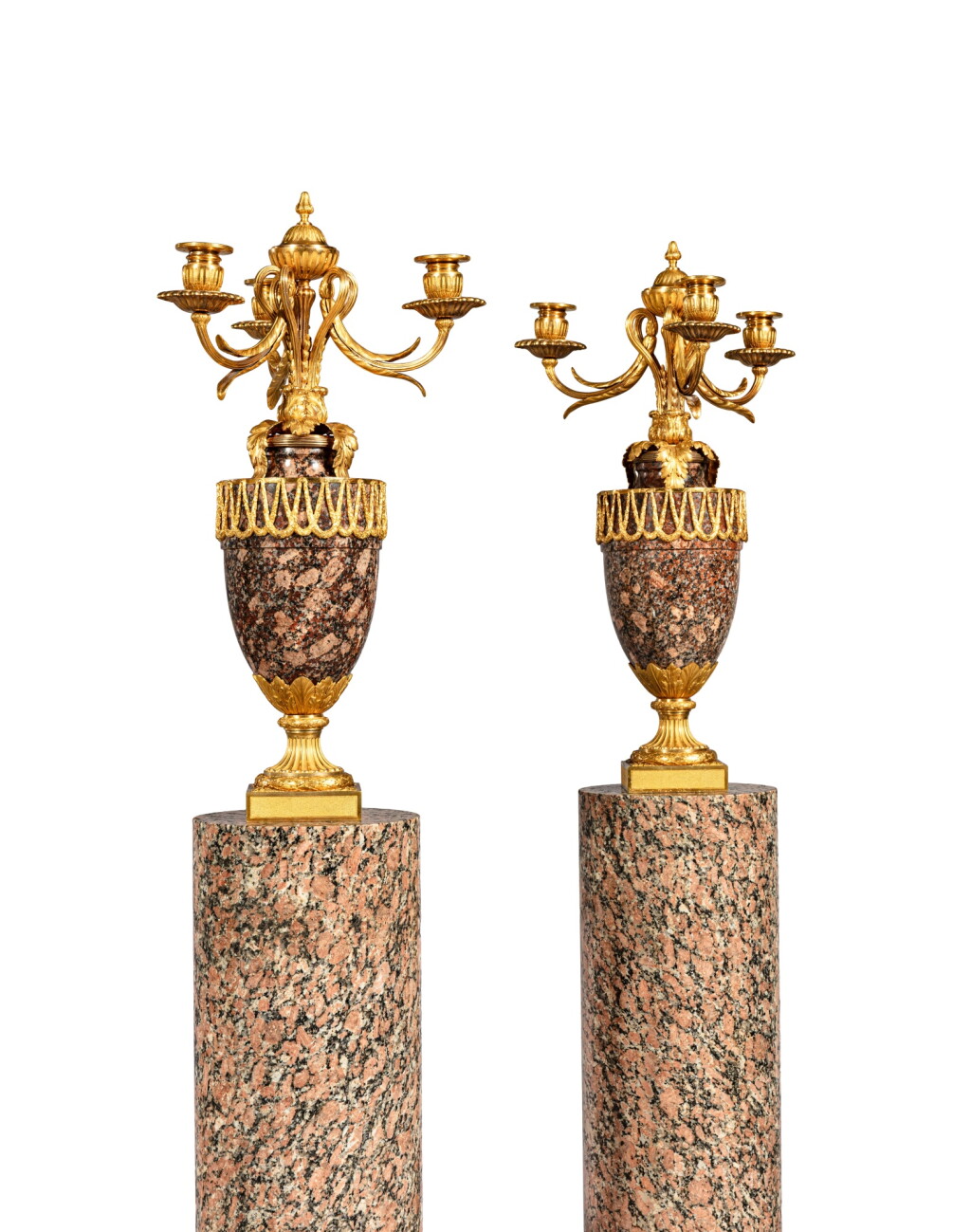
A pair of Louis XVI gilt-bronze mounted and granite three-light candelabra, possibly Russian, circa 1770
Estimate
40,000 - 60,000 EUR
Lot Details
Description
each with an urn-form body applied with laurel swags, issuing interlaced leaf-wrapped scrolling arms, one inscribed in black ink 7844 to the underside of the base
(2)
Height 23 3/4 in., width 13 1/3 in. ; Haut. 60,5 cm, larg. 34 cm
Collection of Countess Yvonne de Ganay, Paris, until 1930;
Collection of the Marquise de Rosanbo, New York;
Sotheby's, New York, The Marquise de Rosanbo, 13 November 1964, lot 269;
Christie's, New York, 20 May 1998, lot 45;
Christie's, New York, 21 June 2012, lot 1183.
RELATED LITERATURE:
J.-F. de Neufforge, Recueil élémentaire d'architecture, Paris, 1757-1768, p. 317
N. Mavrodina, The Art of Russian Stone Carvers, 18th-19th Centuries, Saint-Pétersbourg, 2007, p. 79, cat. n° 62, p. 180, cat. n° E7 et n° K49
Combining richly figured pink granite with finely chased gilt-bronze mounts, these neoclassical candelabra reflect the taste for hardstone and mounted ornamental objects that flourished across Europe in the 18th century. Their design draws upon the French goût à la grecque design vocabulary associated with the most sophisticated Parisian ornamentalists and bronziers of the late Louis XV / early Louis XVI period, but the character of the stone suggests a possible Russian origin overall.
The present candelabra belong to the broader late 18th century fascination with antique-inspired vases and urns that became among the most celebrated expressions of the neoclassical taste. The extraordinary development of the Parisian gilt-bronze industry during the reign of Louis XV and Louis XVI encouraged the creation of luxurious mounted objects in precious marbles and hardstones, inspired by celebrated ancient prototypes. Particularly prized were antique materials such as Egyptian porphyry and granite, imported from Italy by leading collectors and connoisseurs. The rarity and expense of sourcing ancient stone, however, prompted several European countries to exploit domestic resources. France turned to granite deposits in the Vosges, while Russia developed quarries in the Urals and elsewhere within the Empire. Granite, esteemed for its association with permanence, antiquity and archaeological authenticity, consequently became one of the preferred materials of the goût grec and reached the height of its popularity during the neoclassical period.
The overall conception of these candelabra, composed of lights above a vase, is closely aligned with the French decorative arts of the late Louis XV-early Louis XVI period. Comparable examples include two pairs of candelabra formerly in the collection of Laurent Grimod de La Reynière, one executed in grey granite and sold at Christie's Paris, 19 December 2007, lot 804, and another in green granite sold at Sotheby's Paris, 28 November 2017, lot 63. In particular, the elegant upper section, with its fluid and organically scrolling branches, recalls the ornamental lighting designs of Jean-Louis Prieur and Jean-Charles Delafosse, two of the most influential designers of the late 18th century. The dynamic movement of the branches finds a parallel in Prieur's celebrated chandelier in the grand salon of the Musée Nissim de Camondo (inv. CAM 245). A further example, a wall applique at the Château de Versailles (inv. GML5278.2), showcases a similar type of branch, first issuing upwards from foliage then scrolling to terminate higher up with the drip pan and bobèche. Finally, parallels may be found in the vase designs in Recueil élémentaire d'architecture (p.317) by Jean-François de Neufforge (1714-1791), where closely festooned garlands similarly encircle the upper section of the vase.
Despite their distinctly French ornamental language, several features suggest a possible Russian origin. The granite itself supports such an attribution. It is distinguished by large pink oval crystals dispersed within a finer-grained ground of pale grey, red and black mineral inclusions, producing the characteristic mottled appearance of rapakivi granite. Comparable stone is found within the Wiborg (Vyborg) Rapakivi Batholith, extensively quarried around Virolahti in southeastern Finland, then part of the Russian Empire. The use of this distinctive material, combined with the adaptation of French neoclassical models, is entirely consistent with the production of luxury hardstone objects in Russia during the late 18th and early 19th centuries, when imperial workshops sought to rival their French counterparts through the exploitation of native ornamental stones.
A Russian labradorite vase of comparable form, incorporating a raised band beneath the rim, is preserved in the collections of the State Hermitage Museum, St Petersburg (ill. Natalya Mavrodina, The Art of Russian Stone Carvers, 18th-19th Centuries, 2007, p. 79, cat. no. 62). Another vase in the same collection exemplifies the taste for enriching the upper rim with finely chased mounts (Mavrodina, op. cit., p. 180, cat. no. E7).
Interestingly, in Russian imperial interiors, vase forms surmounted by candle branches were often incorporated into monumental floor-standing candelabra. A well-known example is the pair in Korgon porphyry and gilt-bronze sent to Great Britain as a gift to the Duke of Wellington in 1826 and now at Apsley House (Mavrodina, op. cit., p. 180, cat. K49).
You May Also Like