
Bernard Boutet de Monvel
Orchidée
Estimate
100,000 - 150,000 EUR
Lot Details
Description
Bernard Boutet de Monvel
Paris 1881 - 1949 Açores
Orchidée
Oil over traces of pencil on canvas
Signed lower right BERNARD DE MONVEL
100,7 x 90,4 cm ; 39⅝ by 35⅝ in.
With Barry Friedman Ltd;
Private collection, 2015.
New York, Barry Friedman Ltd, Boutet de Monvel, 1 November 1994 — 7 January 1995, no. 13.
S.-J. Addade, Bernard Boutet de Monvel, Paris 2001, p. 240, repr. p. 242;
S.-J. Addade, Bernard Boutet de Monvel, Paris 2016, p. 280, repr. p. 291.
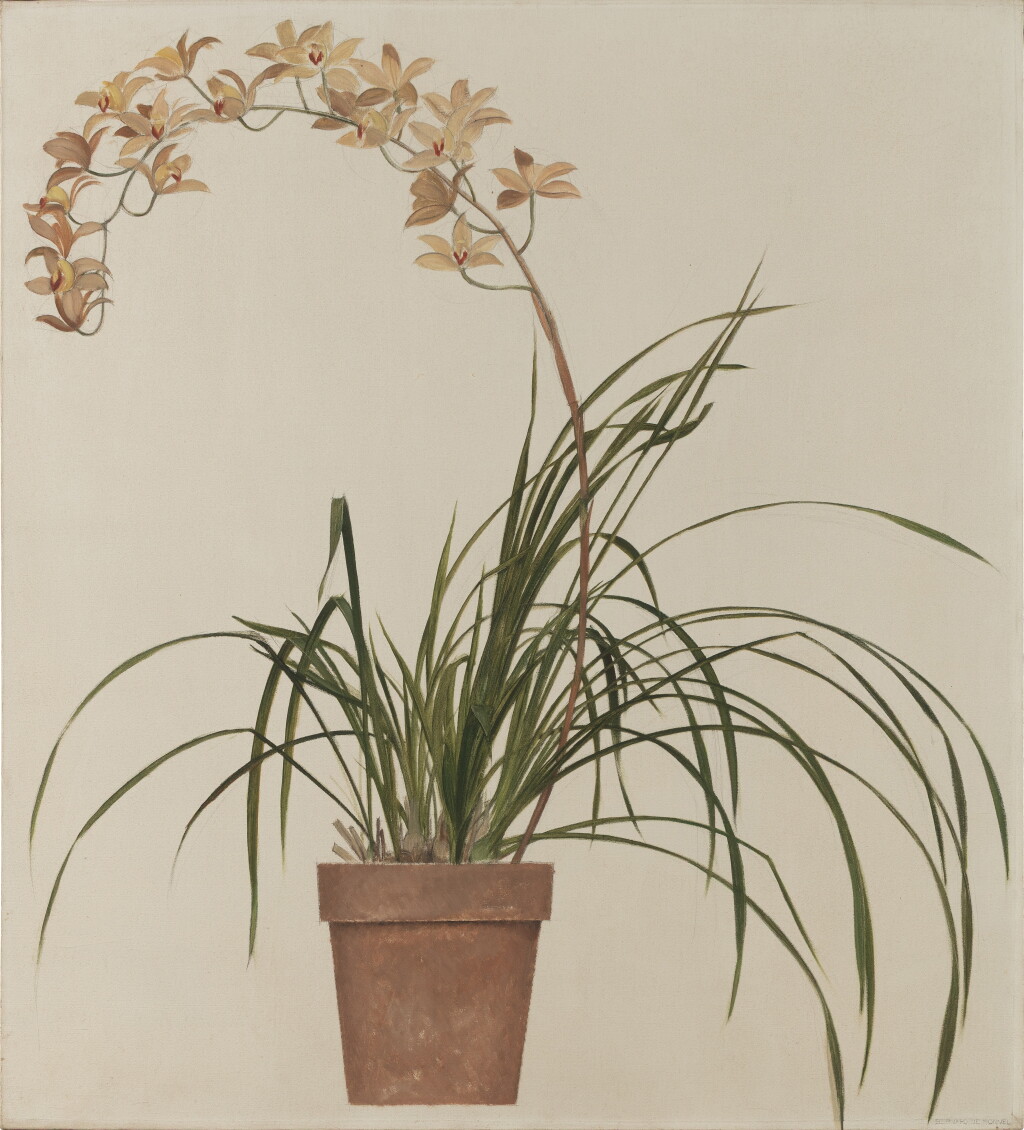
Remarkable for its dimensions, unconventional composition and exuberance, this painting, executed in 1936, depicts a multi-flowered orchid spreading upwards and outwards across an almost square canvas. The delicate, ribbon-like foliage occupies the lower part of the composition, while the long stem rises in an arc reaching the upper edge. The substantial terracotta pot contrasts its rectilinear contours and warm ochre-brown colour with the abundant curves and cool green tones of the vegetation. Slightly offset to the left, it rests on no visible support and appears to float weightlessly.
Beneath the delicately applied colours, the pencil lines of the preparatory drawing remain visible, revealing pentimenti and the numerous compass-drawn circles surrounding the flowers. These deliberately exposed traces of incompletion lend the work a sense of liveliness and spontaneity. The decision not to conceal his explorations aimed at structuring, simplifying and geometrising his compositions was a frequent practice of Boutet de Monvel.
His still lifes, strictly frontal and generally set against a light, empty background, are painted with such delicacy and technical perfection that they approach a form of hyperrealism, distancing them from reality itself. Recognised for their modernity, they are often compared with the work of the American artist Charles Sheeler (1883–1965), for example Zinnias and Nasturtium Leaves (1918), and, above all, with the photographs of Robert Mapplethorpe (1946–1989).
It was probably while executing the children’s portraits he was commissioned to paint from 1927–1928 onwards that Boutet de Monvel began to depict flowers and plants for their own sake. In order to soften the austere frontality of his portraits of children, he would add a botanical element which gradually became the principal subject of a series of paintings. Relatively few in number within his oeuvre, his still lifes often feature a simpler composition than Orchidée, the artist enjoying the geometric qualities of flowers, which he would enclose within a circle, and of vases, which he reduced to cylindrical or trapezoidal forms.