Italian, circa 1830, after Antonio Canova (1757 - 1822)
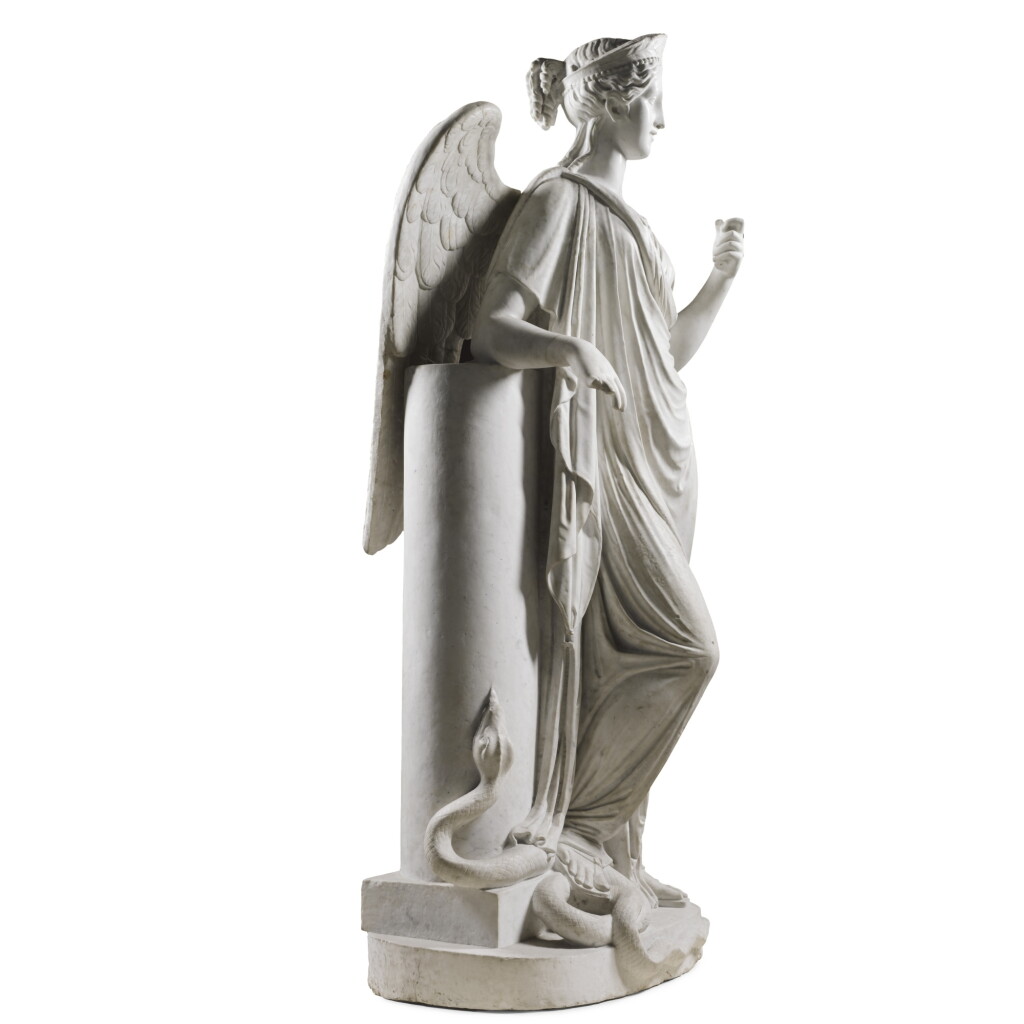
Allegory of Peace
Estimate
30,000 - 50,000 EUR
Lot Details
Description
Italian, circa 1830, after Antonio Canova (1757 - 1822)
Allegory of Peace
white marble, on a modern limestone base
the removable wings with a metal fastening system
186 by 84 by 48cm., 73¼ by 33 by 19in.
wings: 89 by 30cm., 35 by 11¾in. each
base: 120 by 98 by 71.5cm., 47¼ by 38⅝ by 28⅛in.
(2)
Collection of Gianni Versace, Villa Fontanelle, Moltrasio;
His sale, Sotheby's London, 18 March 2009, lot 410.
In 1811, Nikolai Petrovich Rumyantsev (also spelled Rumyantsev or Romansov), Chancellor of Russia and a great advocate of peace in Europe, commissioned Canova to create an allegorical statue of Peace, a subject on which the sculptor had already been working since 1805. An initial unfired clay bozzetto is preserved at the Museo Gypsotheca e Casa Antonio Canova in Possagno (inv. 225); two further plaster studies represent the final composition (ibid., inv. nos. 227 and 228). Hostilities between Russia and France slowed the progress of the work, and the marble was not completed until 1815, before being delivered to Saint Petersburg in 1816. By a curious twist of fate, the marble Peace commissioned by Chancellor Rumyantsev is today in Kyiv, at the Khanenko Museum (inv. 204).
As early as 1815, Canova adapted the figure of Peace into a bust, which is among the sculptor’s Teste ideali (Ideal Heads). Long believed to have been lost, the marble bust of this iconic subject, probably given by Canova to his loyal British patron and friend John Campbell, 1st Baron Cawdor, recently resurfaced when it was sold by Sotheby’s, in London, on 4 July 2018 (lot 25). This marble bust still holds the auction record for a work by Canova.
RELATED LITERATURE
G. Pavanello, L’opera completa del Canova, Milan, 1976, pp. 123, cat. 254-258.
You May Also Like