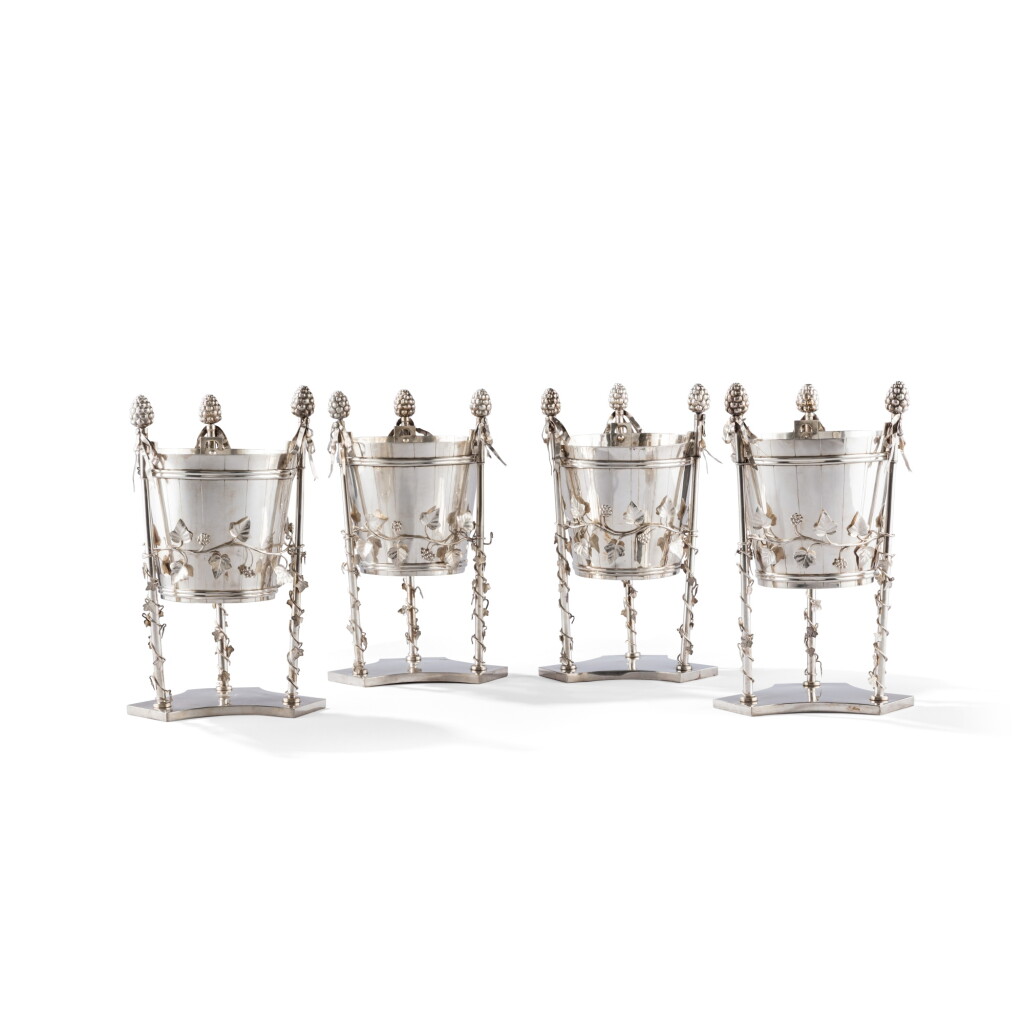
A set of four German silver wine coolers, Johann Heinrich Stolzheise, Bückeburg, after a design by Count Ernst zu Münster, circa 1815
Estimate
120,000 - 180,000 EUR
Lot Details
Description
on tri-form bases engraved with a coat-of-arms, the bodies modelled as buckets on three thyrsi entwined with fruiting vine ornament, surmounted by bunches of grapes, numbered inside and with metal plates at the bases, marked on the base with town and maker's mark
38cm. 15in. high
17,770gr., 571¼oz total
Count Ernst Friedrich Herbert zu Münster (1766-1839) and his wife Wilhelmine von Schaumburg-Lippe, whom he married in 1814, to their son;
Count Georg Herbert zu Münster (1820-1902);
S.J. Phillips, London, 1996;
Sotheby's, New York, Property from the Collections of Lily & Edmond J. Safra, 18-21 October 2011, lot 839
The coat-of-arms is that of Ernst Friedrich Herbert, Count of Münster (1766–1839) and his wife Wilhelmine Charlotte, née Countess of Schaumburg-Lippe (1783–1858).
These wine coolers are almost certainly those referenced in the last will and testament written by the Countess on October 16, 1856, for her eldest son, Georg Herbert:
Auch vermache ich meinem Sohne meine 4 Bouteillenkümpe, wozu sein Vater selbst die Zeichnung gemacht hat und die ich zu meiner Aussteuer habe machen lassen
("As well I leave to my son my 4 bottle bowls, for which his father did the design and which I had commissioned for my dowry.") (Niedersächsisches Landesarchiv – Hauptstaatsarchiv Hannover, Nachlaß der Grafen/Fürsten Münster von Derneburg, Dep. 110, E Nr. 1.02). She also left him a silver-gilt vase and a portrait set with precious stones, a gift from his godfather, King George IV, for his christening in 1821.
The fact that these coolers are described as having been designed by the Count himself shows that Ernst-Friedrich was an accomplished artist and that he wished to create very special pieces for his future married life with his wife.
It is interesting to note that even though these coolers came from the Countess's dowry, they nevertheless bear the coats-of-arms of both spouses, evidence of a strong and even happy union.
Aesthete Patrons
The Countess wrote her husband's biography for her children (Wilhelmine von Münster, Das Leben des Grafen Münster (1766-1839). Aufzeichnungen seiner Gemahlin Gräfin Wilhelmine, geb. Fürstin zu Schaumburg-Lippe, Hrsg. Carl Haase (Veröffentlichungen der Niedersächsischen Archivverwaltung, Bd. 43), Göttingen 1985), in which she highlights the couple's shared passion for the arts. She recounts, in particular, their painting lessons taken together by the renowned painter Johann Heinrich Wilhelm Tischbein, which allowed them to get to know each other better. Tischbein had been welcomed to Hanover by the Count of Münster after fleeing Naples during the Napoleonic invasion of 1799.
Wilhelmine Charlotte was the second daughter of Philipp Ernst zu Schaumburg-Lippe (1723–1787) and Juliane Wilhelmine Luise, née Landgravin of Hesse-Philippsthal (1761–1799). During her time at the court, the young woman lived with her family in Hanover with her tutor, Johann Ludwig Graf von Wallmoden-Gimborn. This allowed her to meet Hanoverian high society, including the Münster family and Ernst, who had just returned from Italy.
Ernst Friedrich came from a family connected to the court; his father, Georg Hermann Heinrich von Mönster zu Surenburg (1721–1773), was the major-domo to Prince-Archbishop Friedrich August of Osnabrück, the second son of King George III. From a young age, he was encouraged to take drawing lessons, and his talent developed thanks in particular to Prince Leopold III Friedrich Franz of Anhalt-Dessau, who introduced him to architecture and the arts.
He pursued his education in Göttingen, where he befriended the three sons of King George III of Great Britain and Hanover. He studied classical art, archaeology, ancient sculpture (thanks to the Heyne Collection), and painting.
In 1793, George III ordered him to bring his son, Prince Augustus, back to Great Britain from Italy. Consequently, Ernst Friedrich spent several months at Windsor Castle with the royal family before setting off with Prince Augustus on a Grand Tour that would last five years. This experience enabled the Count to develop a keen artistic sensibility. Fascinated by classical art, he joined the Deutschrömer—a circle of German artists in Rome—and befriended painters such as Friedrich Rehberg, Johann Christian Reinhart, Friedrich Bury, and Angelica Kauffmann. In Naples, he met Johann Heinrich Wilhelm Tischbein, Jakob Philipp Hackert, and Christoph Heinrich Kniep; he would eventually acquire 46 of their paintings for his estate at Derneburg.
Upon returning to Hanover, the Count served as George III’s ambassador to St. Petersburg from 1801 to 1804. His son recounted that his father "became a highly esteemed member of the diplomatic corps, and was united by the most friendly ties to many of the cleverest men of the time" (George Herbert, Count Munster, Political Sketches of the State of Europe, from 1814–1867, Edinburgh, 1868). In 1805, the King appointed him Minister for Hanoverian Affairs in London. He participated in the Congress of Vienna in 1814, where the Prince Regent granted him an annuity of 6,000 thalers and the hereditary title of Land Marshal. During the negotiations, he succeeded in restoring Hanover’s status as a kingdom.
While at the Congress of Vienna, he reunited with Wilhelmine von Schaumburg-Lippe, who had arrived with her brother, Prince Georg Wilhelm. After a brief courtship, the couple married in Vienna on November 7, 1814. Following stays in various European cities, they arrived in the Countess's hometown of Bückeburg in September 1815. It was likely at this time that Wilhelmine was finally able to commission and assemble her dowry and trousseau, most probably taking her husband's designs to the silversmith Johan Heinrich Stolzheise for the creation of the wine coolers. Unfortunately, no document confirms this specific order, though it is known that the Countess's family did commission pieces from this silversmith (NdsStA Bückeburg, F 1 A XXXV 27).
Although the couple appreciated their Derneburg estate, they spent most of their time in London at their home at 32 Grosvenor Place. It was there that Sir Thomas Lawrence painted the Count’s portrait, commissioned by George IV as part of a series depicting the victors over Napoleon (RCIN 404939). The Count and Countess expanded their collection, purchasing works by Correggio and Guido Reni, among others, and receiving paintings from the royal collections, including a Holbein and a Velázquez. The inventory drawn up after the Count’s death lists oil paintings, watercolors, sepia drawings, engravings, antique statues and busts, and 192 objets d’art. His son described him thus: "High Tory," he was in reality, as all true aristocrats are, very liberal-minded... He had, as the faithful servant of his king, done all in his power to make Hanover a great kingdom" (Munster 1868).
He retired from political life in 1831 following the death of King George IV, leaving the Kingdom of Hanover to diverge from Great Britain, a separation that was formalized in 1838 upon the coronation of Queen Victoria. He died in 1839, and his wife survived him until 1858. As stipulated in his will, the wine coolers passed to his eldest son, Georg, who served as the Prussian ambassador to London from 1873 to 1885 and to Paris from 1885 to 1890.
You May Also Like