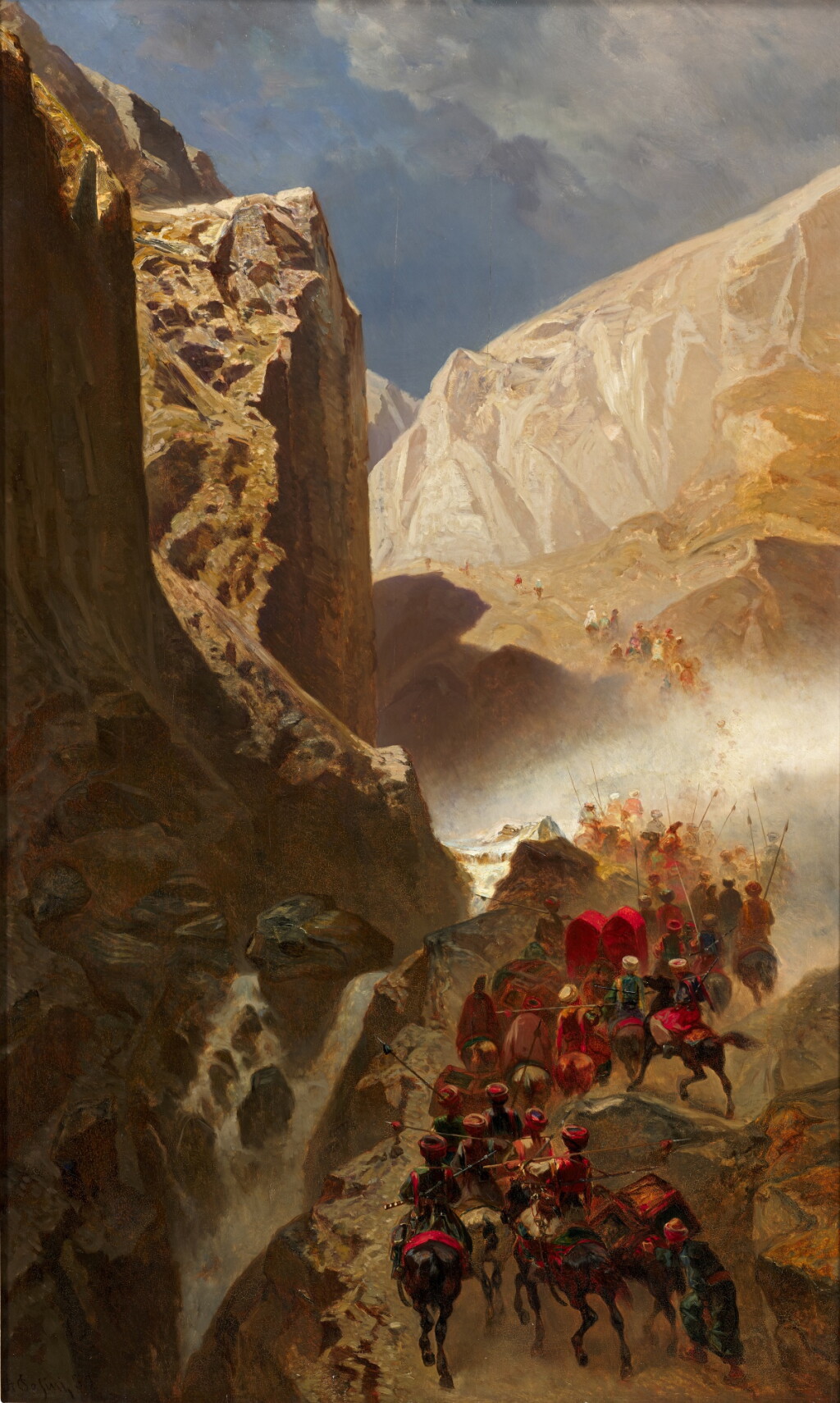
Alberto Pasini
Caravan traversing a mountain pass
Auction Closed
April 28, 02:55 PM GMT
Estimate
80,000 - 120,000 GBP
Lot Details
Description
Alberto Pasini
Italian
1826 - 1899
Caravan traversing a mountain pass
signed and dated A Pasini, 59 lower left
oil on panel
Unframed : 144.1 by 86.9 cm., 56¾ by 34¼ in.
Framed: 170 by 112 cm., 66⅞ by 44⅛ in.
Galleria Fogliato, Turin, circa 1975
Turin, Galleria Fogliato, 1948, no. 35
Vittoria Botteri Cardoso, Pasini, Genoa, 1991, p. 250, illustrated no. 164
After studying at the Academy of Parma, Pasini gained admittance to the workshop of the famous Théodore Chassériau in Paris. The outbreak of the Crimean War afforded the young Pasini the opportunity of a lifetime when, in 1855, Chassériau recommended Pasini to take his place as official artist in the entourage of the French plenipotentiary minister Nicolas Prosper Bourée to Persia. Pasini accompanied him, returning through the north of Persia and Armenia before reaching the port of Trebizond. The sketches he made in the Caucasus inspired numerous highly detailed paintings upon his return to Paris. In this monumental work, an armed column of soldiers or courtiers escorts a caravan across a high mountain pass.
The painting shows a kajawah, the twin enclosed panniers or litters made of a wooden frame covered with cloth or leather, hung in pairs over a horse’s back to transport ladies in purdah. Kajawah is a Persian word. They were common in Persia and Central Asia and in parts of north India. There is a similar camel version. This raises the possibility that the troops are an escort taking a bride somewhere with her maid. The colour red is usually a sign of someone or something of importance in court circles, so possibly a royal bride. The escort is impressive. The swords appear to have Persian hilts and the rifles are Persian. The voluminous turbans are quite distinctive, suggesting the travellers may be Kuban Cossacks, who were resettled to the Northern Caucasus and Black Sea areas in the late 18th century.
You May Also Like