
The Property of a Religious Institution
Vincenzio Corsi, after Gentile da Fabriano
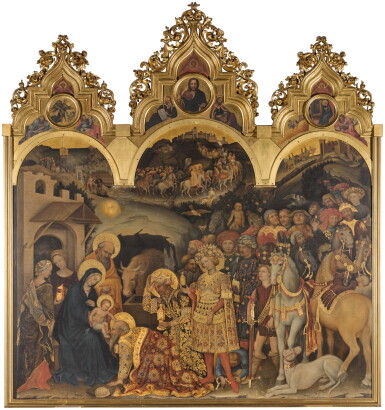
The Adoration of the Magi
Auction Closed
July 2, 12:45 PM GMT
Estimate
40,000 - 60,000 GBP
Lot Details
Description
The Property of a Religious Institution
Vincenzio Corsi, after Gentile da Fabriano
Florence 1810–1869
The Adoration of the Magi
oil on panel, in an engaged frame
unframed: 175.5 x 226 cm.; 69⅛ x 89 in.
framed: 245.2 x 237.2 cm. ; 96½ x 93⅜ in.
Commissioned by Alexander William Crawford Lindsay, 25th Earl of Crawford, 8th Earl of Balcarres (1812–1880), Haigh Hall, Wigan, in 1867;
Thence by descent to David Alexander Robert Lindsay, 28th Earl of Crawford, 11th Earl of Balcarres (1900–1975), Haigh Hall, Wigan;
By whom gifted shortly after the Second World War to the Diocese of Liverpool, and installed in the Parish Church of St Paul the Apostle, Croxteth.
H. Brigstocke, 'Lord Lindsay as a collector', in Bulletin of the John Rylands University Library of Manchester, vol. 64, 2, 1982, p. 290;
H. Brigstocke, A Poet in Paradise: Lord Lindsay and Christian Art, exh. cat., Edinburgh 2000, pp. 26 and 33, n. 6, reproduced fig. 9.
Commissioned in 1867 by Alexander William Crawford Lindsay, 25th Earl of Crawford, 8th Earl of Balcarres (1812–1880), this monumental work is a faithful replica of Gentile da Fabriano's celebrated Adoration of the Magi of 1423 in the Uffizi, Florence, which is considered one of the defining masterpieces of the International Gothic style. Executed by the Florentine painter Vincenzio Corsi (1810–1869), with whom Lindsay maintained a long and productive relationship spanning more than three decades, the work formed part of an ambitious educational enterprise through which the Earl sought to assemble a comprehensive visual history of Christian art.
An influential art historian, author of the pioneering Sketches of the History of Christian Art (1847), and one of the foremost collectors of his generation, Lindsay conceived his collection not as an assemblage of masterpieces alone but as a private museum intended to illustrate the development of human civilisation through art, literature, and science. As he explained in 1849, his goal was to create a gallery tracing ‘the progress of Painting from the earliest times till now’,1 selecting works and commissioning copies such as this one that would demonstrate the evolution of artistic practice and religious imagery.
Vincenzio Corsi occupied a central role in this endeavour. Beginning in the 1840s, Lindsay commissioned from him a succession of full-scale replicas after some of the most important works in Florence, including paintings by Perugino,2 Raphael, Fra Angelico, Masaccio and, ultimately, Gentile da Fabriano. The present work belongs to this distinguished series and reflects Lindsay's conviction that such copies could serve both as instruments of scholarship and as enduring records of masterpieces that might otherwise remain inaccessible to British audiences. Installed at Haigh Hall, Wigan, alongside original paintings, books and antiquities, these reproductions formed part of a carefully constructed didactic collection intended to educate future generations and illustrate the history of Christian art.
This painting remained in the Crawford family until shortly after the Second World War, when it was presented by the 28th Earl to the Diocese of Liverpool. Thereafter it served as the principal altarpiece of St Paul the Apostle, Croxteth, where it remained until today.
1 Brigstocke 1982, p. 298.
2 See for example the full-scale replica of Perugino’s celebrated Lamentation in the Galleria Palatina, Florence, sold at Sotheby’s, London, 11 April 1990, lot 213; https://photocollections.courtauld.ac.uk/sec-menu/search/detail/e75f4c75-0bb9-b17d-5dd4-8c1921d0bb95/media/393d4df6-2af6-13b7-6844-8d1ec3d75819


