
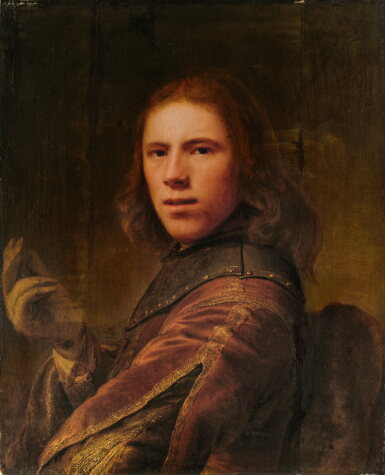
Ferdinand Bol
Portrait of a Young Man Wearing a Gorget
Auction Closed
June 2, 05:22 PM GMT
Estimate
60,000 - 80,000 USD
Lot Details
Description
Ferdinand Bol
Dordrecht 1616 - 1680 Amsterdam
Portrait of a Young Man Wearing a Gorget
oil on panel
panel: 26 ¼ by 21 in.; 66.7 by 53.3 cm
framed: 36 by 32 in.; 91.4 by 81.3 cm
Mr. Edward Rogers Wood (1866-1941) and Mrs. Euphemia Wood (1867-1950), Canada;
Thence by inheritance to their nephew and by descent to the present collectors.
Ferdinand Bol is believed to have first trained with Benjamin Gerritsz. Cuyp, whose portrait style was deeply shaped by the early work of Rembrandt. At around the age of twenty, Bol moved to Amsterdam and entered Rembrandt’s studio, likely motivated by admiration for the ambitious portrait style the master was then developing in the capital city. Bol worked under Rembrandt between circa 1635 and 1641 and remained in his circle until approximately age twenty-five, when he established himself as an indepent master. His earliest signed and dated portraits are from 1642, and by about 1644 he had begun producing a series of male tronies—anonymous figures dressed in exotic costume. In several of his male portraits, including possibly the present example, the boundary between formal portraiture and tronie becomes intentionally ambiguous.
Portrait of a Young Man Wearing a Gorget ranks among the strongest works in this group, highlited by the sitter’s direct gaze, assertive pose with arm akimbo, and the sophisticated rendering of his satin costume. After the painting resurfaced, Werner Sumowski discussed it in 2001 (written communication) and ethusiastically endorsed the attribution to Bol based on a color transparency. He dated the work to circa 1645–1650 and compared it to Bol’s celebrated Self-Portrait of 1646 in the Dordrechts Museum, as well as Young Man in the Window of 1647 in the Robarts Collection, London.
While the painting’s early provenance remains unclear, by the late nineteenth or early twentieth century it had entered the collection of Edward Rogers Wood (1866–1941) and his wife Euphemia (1867–1950). Edward Wood and his brother Frank P. Wood were leading Canadian financiers and collectors whose holdings of Old Master paintings became among the earliest and most significant such collections in Toronto. Frank P. Wood remains one of the most important benefactors of the Art Gallery of Ontario, donating major works by Rembrandt, Frans Hals, Anthony van Dyck, Thomas Gainsborough, Titian, and Jacob van Ruisdael. Following the deaths of Edward and Euphemia Wood, the painting descended through the family by inheritance over several generations.