
Property from the Estate of Stanley Moss, Sold Without Reserve
Follower of Carlo Maratta
Allegory of Time
No reserve
Auction Closed
June 2, 05:22 PM GMT
Estimate
8,000 - 12,000 USD
Lot Details
Description
Property from the Estate of Stanley Moss, Sold Without Reserve
Follower of Carlo Maratta
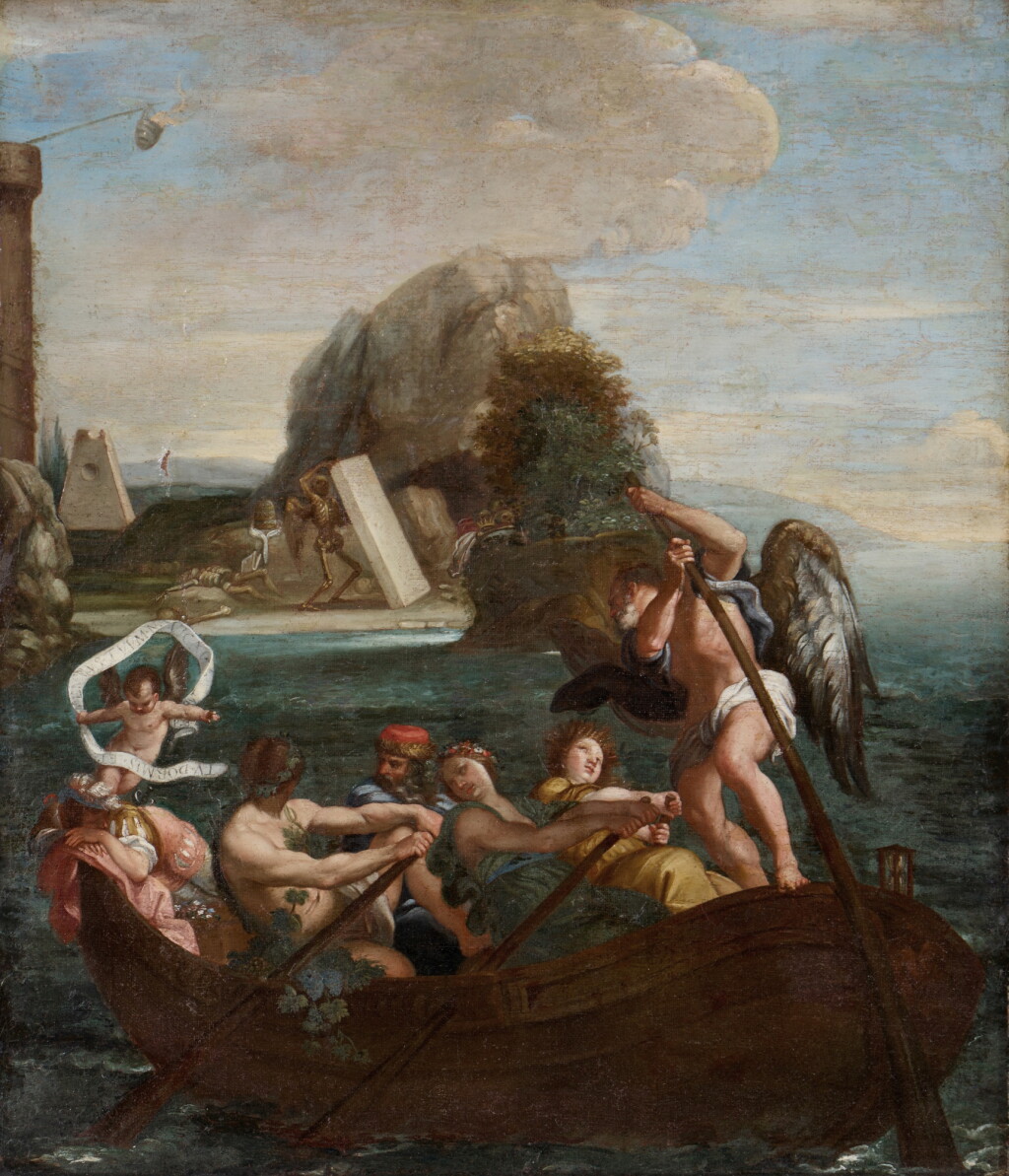
Allegory of Time
oil on canvas
canvas: 27 ½ by 23 ⅝ in.; 69.9 by 60.0 cm
framed: 32 by 28 in.; 81.3 by 71.2 cm
This unusual and richly allegorical composition derives from a celebrated invention by Carlo Maratta created for the painted face of a notturno da mensola, or night clock. The scene represents an allegory of the passage of time and the inevitability of death; Time, personified as a winged old man steering Charon’s boat, ferries the four Seasons and a sleeping youth across the River Styx toward the barren shore of Death, where skeletons and abandoned emblems of worldly ambition—including a cardinal's hat and papal tiara—serve as reminders of life’s transience. Above the sleeping boy, a putto unfurls a scroll inscribed “TV DORMIIS ET TEMPVS TVVM NAVIGAT” (“You sleep, and your time sails on”), a phrase derived from Saint Ambrose. The composition was especially suited to the function of a night clock, a mid-seventeenth century invention designed to operate silently and to be softly illuminated from within by a lamp inside the painted copper clockface, allowing the hour to be read at night.
The subject is known through an engraving by Bernard Picart and preparatory studies by Maratta, including a drawing in the Musei Civici e Gallerie d’Arte, Reggio Emilia, as well as a small autograph oil sketch in a private Roman collection.1 The composition was originally devised for a remarkable clock commissioned from the celebrated Roman clockmaker Giuseppe Campani by Cardinal Antonio Barberini and presented as a diplomatic gift to Louis XIV. The original clock incorporating Maratta’s allegory survives today in a private collection in London, formerly with Colnaghi, while another related example with the same decoration is preserved in the church of Santa Maria delle Grazie.2
1 See S. Rudolph and S. Prosperi Valenti Rondinò, Carlo Maratti (1625–1713) tra la magnificenza del Barocco e il sogno d'Arcadia, Rome 2024, p. 516, cat. no. 73, reproduced.
2 Colnaghi, Objects for a“Wunderkammer”, Alvar Gonzalez-Palacios (ed.), exhibition catalogue, London 1981, cat. no. 49.