
Property of a Gentleman
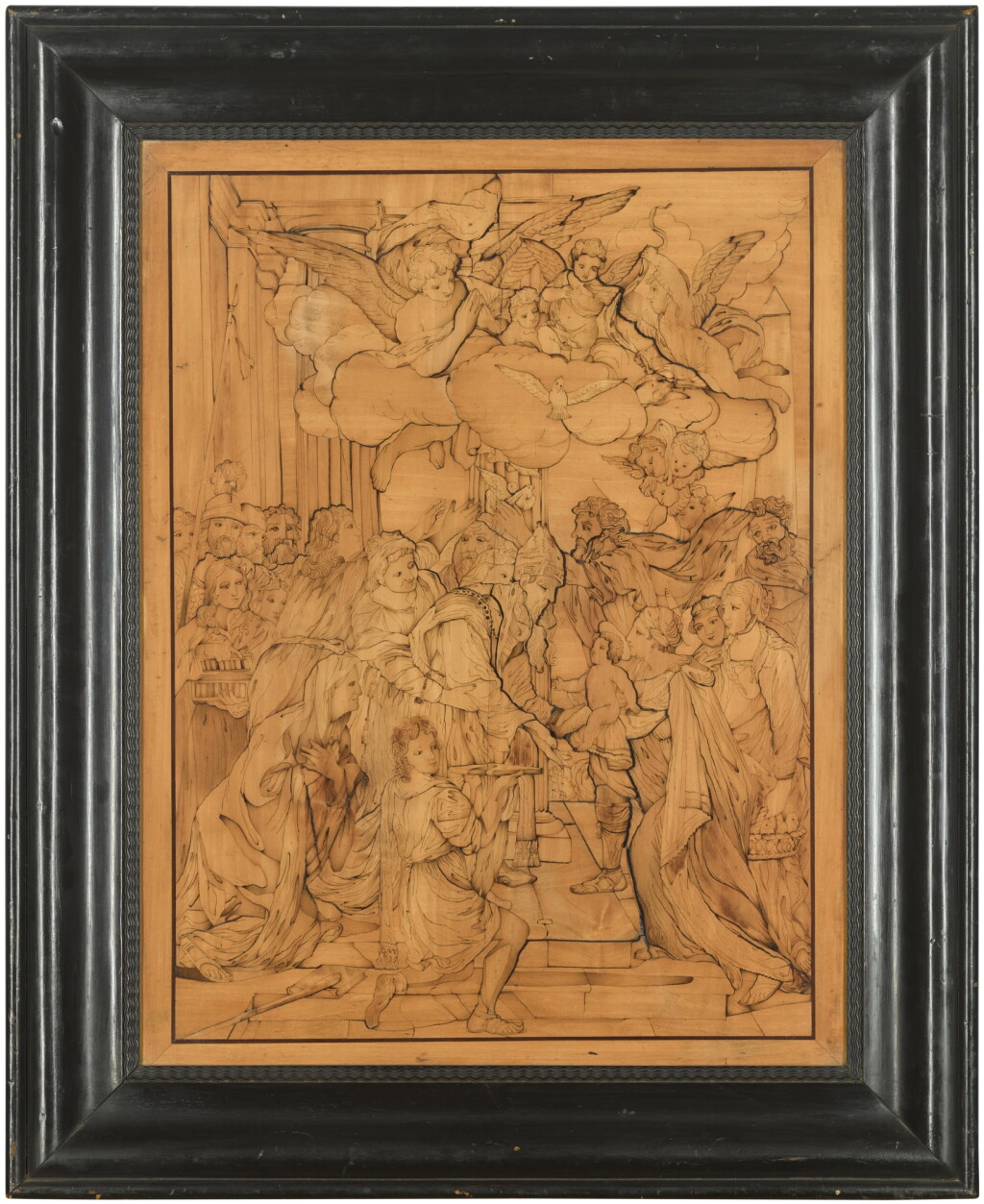
An Italian intarsia panel of 'The Presentation in the Temple' after Charles Mellin (1597-1649), circa 1800
No reserve
Lot Closed
June 9, 02:49 PM GMT
Estimate
4,000 - 6,000 GBP
We may charge or debit your saved payment method subject to the terms set out in our Conditions of Business for Buyers.
Read more.Lot Details
Description
the frame in ebonised wood, glazed both to the front and back
panel only 53.5 x 41 cm; 21 x 16 ⅛ in.
framed 69 x 56 cm; 27 ⅛ in. x 22in.
Please note Sotheby's has changed the sheet of cracked glass depicted in the images.
Related literature
P. Malgouyres, Charles Mellin, un Lorrain entre Rome et Naples, exhib. cat., Caen, Musée des Beaux-Arts, and Nancy, Musée des Beaux-Arts, 2007.
This intarsia panel is an intriguing record of an important painting by Charles Mellin (1597-1649), The Presentation in the Temple, commissioned in 1643 for the church of the Santissima Annunziata in Naples, and destroyed in the fire of 1757. More broadly, it reflects the long and distinguished Renaissance tradition of Italian intarsia, perfected by masters such as Fra Damiano da Bergamo, Giovan Francesco Capoferri, and Benedetto Virchi, whose virtuoso wood inlays transformed choir stalls and interiors into richly illusionistic scenes of remarkable depth and painterly complexity.
The composition and development of this lost painting is known from two engravings, six autograph drawings and two copies.1 Of all the surviving drawings, the present seems to be the closest to the final painted version, as recorded in the two known engravings. The first of those prints, a near-contemporary work, in the past believed to be executed by Pietro del Po (active in Naples 1644-47), credits the design of the composition to Poussin (Malgouyres, p.196, 29a), while the second, a much later aquatint by Francesco Rosaspina (1762-1841), is dated 1784 and claims to reproduce a drawing by Guido Reni (Musée des Beaux-Arts in Nancy, inv. TH.99.15.1150). An aquatint by Francesco Rosaspina from 1784, with the same composition as the latter features in addition a dedication to Cardinal Andrea Joanetto of Bologna (1722-1800), see British Museum, London, inv. U,3.11.
Jacques Thuillier was the first to recognize the link between these engravings and the painting in the Neapolitan church of the Santissima Annunziata, on the basis of a written description of the altarpiece by Charles-Nicolas Cochin, who saw it in 1750 during his Neapolitan sojourn; Cochin correctly credited Mellin with the execution of the painting in his published account of his travels, Voyage d'Italie ou recueil de notes...2
As Malgouyres has described the evolution of the composition can be traced through the six surviving preparatory drawings. Just as in a number of other projects, for which Mellin struggled to achieve a satisfactory solution, he produced many intermediary studies. He extensively altered the positions of the main and secondary figures, and here he moves the pivotal figure of the Virgin backwards and forwards from left to right.3 The first of the six drawings, which clearly shows a less developed version of the composition, is the one in the Fogg Art Museum, Cambridge, Mass (inv. 1941.13, Malgouyres, 2007, p.291, D44). Next in the sequence comes a drawing in a private collection and formerly in the collection of Antoine Joseph Dezallier d'Argenville (Malgouyres, p. 291, D 45). In both these versions the Virgin is standing to the left of the composition. In the next two sheets however (one in the Metropolitan Museum, New York, inv. 1981.15.5, and one formerly in the Dhikeos collection, see Malgouyres, p. 199, D 47), the Virgin is instead kneeling to the right. Then comes a drawing the École des Beaux-Arts, Paris (Malgouyres, p. 200, D 48), where she remains kneeling, but now back on the left. Finally, a drawing sold at Sotheby’s, New York 28 January 2015, lot 67, the composition is largely as in the printed versions, though St. Joseph holds a basket of doves, rather than releasing the birds into the air.
1 P. Malgouyres, Charles Mellin, un Lorrain entre Rome et Naples, exhib. cat., Caen, Musée des Beaux-Arts, and Nancy, Musée des Beaux-Arts, 2007, respectively: engravings p. 268, nos. 29a, 29b, reproduced p. 194, p. 195; drawings: 291-292, D 44-D 49, reproduced pp. 197-201; copies pp. 291-292, D 46a, D 48a.
2 Published Paris, 1758, vol. I, p. 168; cited Malgouyres, op. cit., 2007, p. 199.
3 For more detailed information on all changes see Malgouyres, op. cit., 2007, pp. 199-201.