
Property from the Manny Davidson Collection
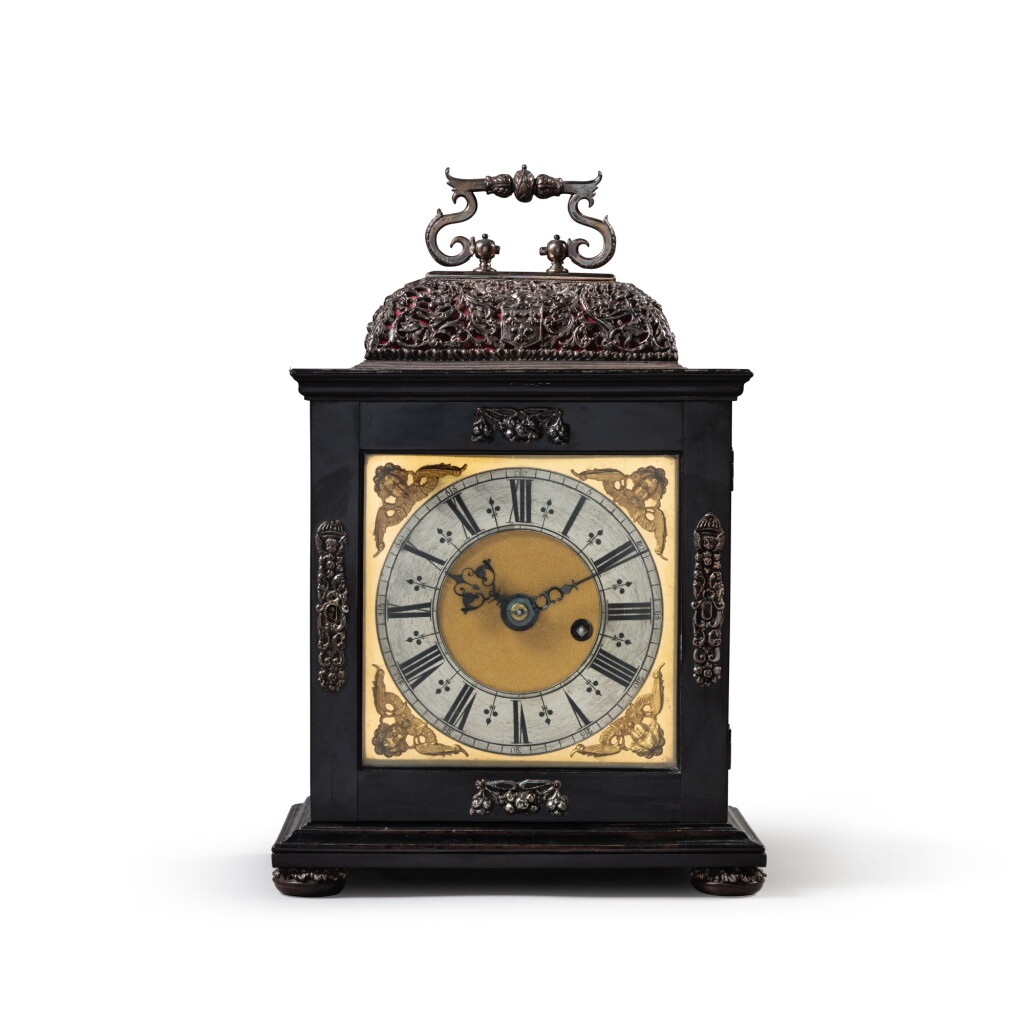
A William & Mary silver mounted ebony quarter repeating table timepiece, Samuel Watson, Coventry or London, circa 1690
Lot Closed
June 9, 02:12 PM GMT
Estimate
12,000 - 18,000 GBP
We may charge or debit your saved payment method subject to the terms set out in our Conditions of Business for Buyers.
Read more.Lot Details
Description
6-inch dial with winged cherub spandrels, matted centre, single fusee movement with six knopped and ringed pillars, verge escapement, pull quarter repeat on two bells, the backplate finely engraved with tulips and scrolls and signed Samuel Watson, the case with a finely cast silver basket top pierced with foliate scrolls and with fleur-de-lys and arms, silver escutcheons and bun feet
Height 13in.; Haut. 33cm
The arms are of the Birch family of Birch Hall, Rusholme, Lancashire.
The Golden Age of Clockmaking
The years 1650 to 1750 are widely regarded as the golden age of English clockmaking. Closely controlled by the Worshipful Company of Clockmakers, the city’s horological workshops produced some of the finest clocks ever made. The square mile contained many innovative and exceptional makers but, most famous of all was Thomas Tompion. Born in relative obscurity in Bedfordshire in 1639, Tompion, the son of a blacksmith, moved to London in circa 1670 and rapidly made a name for himself in watch and clockmaking circles. Indeed, it was the extremely fine quality of his work that saw him associating with the most famous scientists of the day and eventually brought him to the attention of King Charles II. From circa 1680, Tompion began numbering his clocks and watches, a series which continued long after his death with his business partner and eventual successor, George Graham. Thomas Tompion became Master of the Worshipful Company of Clockmakers in 1703 and died in 1713.
This sale include three clocks formerly in the collection of Manny Davidson, who certainly understood and appreciated the wonderful quality of the work by clockmakers such as Tompion. Spanning the heart of the Golden Age, these clocks epitomise the very finest horological craftsmanship of the period and perfectly demonstrate how technical innovation and aesthetics can be combined. Alongside the clocks by Tompion, there are fine examples, by other important London makers, that were especially selected for their rare silver mounts or other unique features. Of particular note is the quarter striking table clock by Joseph Knibb, an important and innovative maker.