
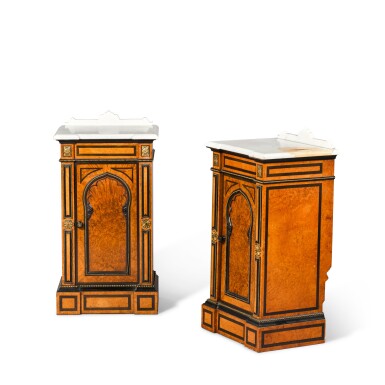
From Corby Castle, Cumbria
A pair of Anglo-Moresque thuya, ebony-strung and gilt-brass-mounted marble-topped bedside cupboards by Morant, Boyd & Blandford, circa 1875
No reserve
Lot Closed
June 9, 03:28 PM GMT
Estimate
5,000 - 8,000 GBP
We may charge or debit your saved payment method subject to the terms set out in our Conditions of Business for Buyers.
Read more.Lot Details
Description
with white marble stops, each door opening onto one shelf
82.5cm high, 43.5cm wide, 34.5cm deep;
32 ½ in., 17 ⅛ in., 13 ⅝ in.
Please note that this lot will not be included in the exhibition in our New Bond Street galleries. We would be happy to facilitate a viewing for you, though – please contact cameron.dileo@sothebys.com to arrange this.
Corby Castle, Cumbria.
This inventive suite of furniture is a product of the cosmopolitan tastes of the sophisticated cultured classes in High Victorian Britain, particularly after the Aesthetic Movement had brought a new level of rigorous appreciation for the art and ornament of various global civilisations throughout history. The labels identify it as the work of Morant, Boyd & Blandford, a prominent furniture firm in the 1870s and 1880s.
The overall decorative scheme for this distinctive suite is best described as ‘Anglo-Moresque’, reflecting the terminology used in the art criticism in the period. Notably, Owen Jones wrote a whole chapter on the ‘Moresque style’ in his totemic 1856 cross-cultural study of decorative art traditions, The Grammar of Ornament.1 The scalloped edges of the arches in this suite are the clearest direct link to the architecture of Islamic masterpieces such as the Alhambra, which was so well-known to Victorian eyes that this decoration was sometimes even called simply the ‘Alhambra style’. It is worth noting, though, that it is quite unusual to see this particular Islamic style absorbed into the production of furniture in Britain in an ‘Anglo-Moresque’ style, making a suite of this size and quality quite a rarity. Eclectic ‘Aesthetic’ taste of this period more often decorated with objects that had been made within the Islamic world itself, such as the omnipresent octagonal folding table that can be seen in key reference images like the portrait of Mrs Luke Ionides in the V&A (E.1062:1, 2-2003). The choice of thuya wood banded with ebony is certainly more ‘Anglo’ than ‘Moresque’: Adam Bowett notes that these woods were particularly characteristic of 1870s and 1880s furniture in either the Louis Seize or “attenuated Aesthetic” styles, and his illustrated examples are similarly of furniture in more consciously ‘European’ styles than the present suite.2 The combination of the honey-toned thuya and ebony also recalls the furniture made by George Bullock and his contemporaries during the Regency period in Britain, a style which was also receiving greater attention during the Aesthetic period and was collected by the artists and tastemakers like James McNeill Whistler and Dante Gabriel Rossetti.3
The firm of Morant, Boyd & Blandford numbers among the highest ranks of luxurious ‘art furniture’ makers of their period; they were active under those names between 1870 and 1884, a development of an earlier firm under the Morant family name.4 They are generally believed to have been the designers of the ‘Resolute desk’, a famous desk gifted by Queen Victoria that stands in the Oval Office.5 Much of their work is well-documented in the paraphernalia of the Great Exhibitions at which they were present, including those in London in 1851 and 1862 and in New York in 1853 (under earlier versions of the Morant company name).6 Their work is versatile and they show an evident faculty for producing furniture in a wide range of styles; the present suite appears to be the only documented example with this sumptuous Anglo-Moresque decoration.
1 O. Jones, The Grammar of Ornament, London, 1986 facsimile, chapter X, pp.65-74 and pl.XXXIX-XLIII.
2 A. Bowett, Woods in British Furniture-Making, Wetherby, 2012, pp.311-313.
3 See the 1882 watercolour of 16 Cheyne Walk, Rossetti’s London residence, where Regency convex mirrors are prominent (NPG 3022).
4 ‘Morant & Co.; Morant and Boyd; Morant, Boyd and Morant; Morant, Boyd & Blandford (sometimes Blanford) (1851-1915)’, BIFMO, 17 July 2023. Available at <https://bifmo.furniturehistorysociety.org/entry/morant-co-morant-and-boyd-morant-boyd-and-morant-morant-boyd-blandford-sometimes-blanford>
5 The Encyclopaedia Britannica notes that the desk is “is believed to have been designed by the firm Morant, Boyd, and Blanford”, and this attribution is often repeated (see L. Payne, ‘Resolute Desk’, Encyclopaedia Britannica, 21 October 2025. Available at <https://www.britannica.com/topic/Resolute-Desk>). However, when the design for the desk was published in Frank Leslie's lllustrated Newspaper on 11 December 1880, there was no mention of Morant (see Library of Congress, LC-USZ62-123892. Available at <https://www.loc.gov/pictures/item/99471788/>)
6 J. Meyer, Great Exhibitions: London – New York – Paris – Philadelphia, 1851-1900, Woodbridge, 2006, pp.29, 77, 122.