
Willamette Meteorite
A Historic Piece of the Most Important American Meteorite, Coming Directly From the Family of the Founder
Auction Closed
July 14, 07:13 PM GMT
Estimate
5,000 - 8,000 USD
Lot Details
Description
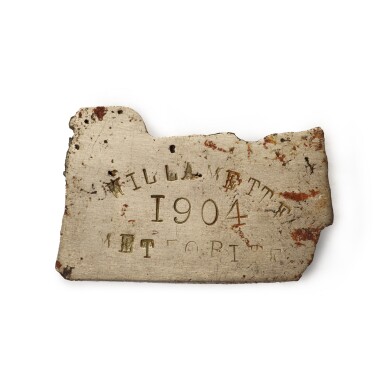
Willamette Meteorite — A Historic Piece of the Most Important American Meteorite, Coming Directly From the Family of the Founder
Iron – IIIAB
Clackamas County, Oregon (45°22' N, 122°35' W)
53 x 35 x 6.5 mm (2⅛ x 1⅜ x ¼ inches). 39.68 grams (198.4 carats).
Incused on the cut side of this end piece, "Willamette Meteorite 1904".
Formerly in the collection of the founder of the Willamette meteorite, Ellis Hughes (1860-1942), and consigned directly to Sotheby's by his family.
A HISTORIC PIECE OF THE MOST IMPORTANT AMERICAN METEORITE, COMING DIRECTLY FROM THE FAMILY OF THE FOUNDER
The Willamette Meteorite is the largest and most important American meteorite ever found, and one of the most famous meteorites in existence. This historic end piece, cut from the main mass a couple of years after the meteorite's discovery and stamped "Willamette Meteorite 1904," was originally in the collection of the founder of the meteorite, Ellis Hughes, and has remained in his family's possession until being consigning directly to Sotheby's for this sale.
Meteoriticist Dick Pugh estimated that approximately 100 pieces of the Willamette Meteorite were cut from the main mass between its discovery in 1902 and when it left Oregon for the American Museum of Natural History in the fall of 1905. That being said, vanishingly few of these pieces have ever been publicly identified, and the vast majority are probably lost to history. Of the small number of pieces that have been accounted for, most can be found in important museum collections such as the Smithsonian, the Field Museum, and the British Museum.
This piece was almost certainly intended as a souvenir, evident both from the stamp, "Willamette Meteorite 1904," as well as the fact that the end piece was cut to resemble the shape of Oregon, the state in which the meteorite was found. Given that the Willamette Meteorite was already embroiled in legal controversy by 1903, this souvenir would have been created at a time when Ellis Hughes was well aware that he could lose possession of the meteorite, which was indeed the case, as the Oregon State Supreme Court rejected his ownership claim on July 17, 1905. It was thus, in every sense, one of Ellis Hughes' final souvenirs of his time as the owner of the main mass of the Willamette Meteorite.
The story of the Willamette Meteorite is well known, although it bears repeating here. Weighing approximately 31,000 pounds, the massive iron meteorite was discovered in the fall of 1902 by Ellis Hughes, a Welshman living south of Portland, Oregon who discovered the enormous piece of a former asteroid as he was walking home from work through the woods. Over the succeeding months, Hughes crafted a plan to move the meteorite from its resting place on land owned by the Oregon Iron & Steel Company and onto his adjoining plot three quarters of a mile away. Eventually, by the fall of 1903, Hughes had succeeded in the Herculean feat of moving the iron mass onto his farm, using nothing more than a homemade wooden wagon, some basic tools, a horse, and a skeleton crew of acquaintances and family members.
Once the meteorite was safely on Hughes' land, he began charging 25 cents admission to witness the extraterrestrial marvel. The attraction brought attention, however, both welcome and unwanted: while paying customers came from near and far to see the meteorite, newspaper stories eventually brought national attention, and with it interest from a lawyer for the Oregon Iron & Steel Company. A protracted legal battle ensued, the result of which was a ruling by the Oregon State Supreme Court that has since become the legal basis for meteorite ownership in the United States:
Chief Justice Charles Wolverton: "Meteorites, though not embedded in the earth, are real estate, and consequently belong to the owner of the land on which they are found." – July 17, 1905
After the Oregon Iron & Steel Company retained ownership of the meteorite, they floated it down the river to Portland, where it was promptly displayed at the Lewis and Clark Centennial Exposition, informally known as the 1905 Portland World's Fair. During the Exposition, the meteorite was purchased by philanthropist Mrs. William E. Dodge II and was subsequently donated to the American Museum of Natural History, where it resides today as the "crown jewel" of the Museum's meteorite collection.
REFERENCES:
Meteoritical Bulletin Entry for Willamette