
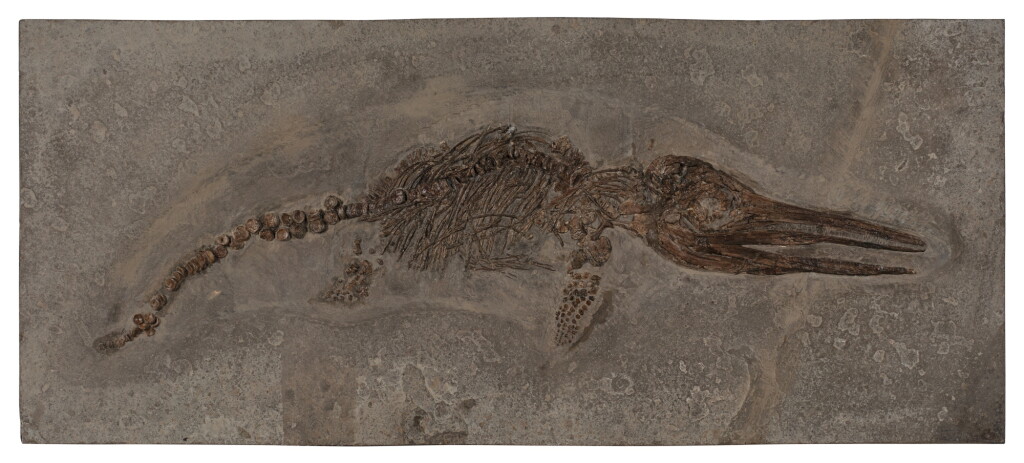
Marine Reptile Fossil (Ichthyosaur) — Juvenile Specimen
Early Jurassic, Toarcian Stage (approx. 180 million years ago), Holzmaden, Germany
Auction Closed
July 14, 07:13 PM GMT
Estimate
30,000 - 50,000 USD
Lot Details
Description
Marine Reptile Fossil (Ichthyosaur) — Juvenile Specimen
Stenopterygius sp.
Early Jurassic, Toarcian Stage (approx. 180 million years ago)
Holzmaden, Germany
Ichthyosaur fossil measures 33½ x 9¼ inches (85.1 x 23.5 cm), 39¼ x 17 inches (99.7 x 43.2 cm) in matrix. 50 pounds (22.7 kg).
This mostly complete fossil skeleton belongs to an extinct marine reptile – Stenopterygius sp. It is preserved mostly in articulation in its original sedimentary rock. The skeleton is prepared with the right side exposed in very fine detail. Based on its overall size, disproportionately large skull, and bone development, this suggests that this specimen belonged to a juvenile. The skeleton shows loosely articulated bones due to the immaturity of the individual where articular surfaces have not fully formed or fused. The skull is preserved with bones articulated and teeth in their intact position. The eye bones (sclerotic) are also articulated within the orbit. The left lower jaw is positioned lower than the right. The bones of the front and back paddles, ribs and gastralia are visible.
A RARE JUVENILE EXAMPLE OF AN ICHTHYOSAUR FROM THE FAMOUS POSIDONIA SHALE OF HOLZMADEN, GERMANY
The first complete ichthyosaur fossil skeleton was discovered by the Anning family — including Mary Anning, the "mother of paleontology" — on the southern coast of England in 1811. Since that time, these creatures have been unearthed on every continent, although some of the finest Jurassic specimens are known to come from the Posidonia Shale in Holzmaden, Germany. Notable features of ichthyosaurs include long jaws, cone-shaped teeth, large eyes, and paddles, all evident on this mostly complete juvenile specimen.
You May Also Like


