
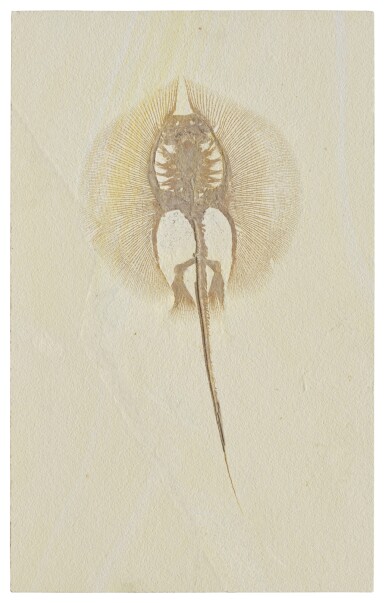
Fossil Stingray
Early Eocene (approx. 52-48 million years ago), Green River Formation, Lincoln County, Wyoming, USA
Auction Closed
July 14, 07:13 PM GMT
Estimate
5,000 - 8,000 USD
Lot Details
Description
Fossil Stingray
Heliobatis radians
Early Eocene (approx. 52-48 million years ago)
Green River Formation, Lincoln County, Wyoming, USA
Plate measures 26½ x 16⅝ x ¾ inches (67.3 x 42.2 x 1.9 cm), stingray measures 20½ inches (52.1 cm) in length.
The specimen represents a fine example preserving in exquisite detail the cartilaginous skeleton. The flattened body outline is well-defined. The articulated skeleton is complete with its vertebrae including the tail and pelvic fins intact.
Heliobatis radians is one of two species of extinct freshwater stingray found in the Green River Formation's Fossil Lake, along with the more primitive Asterotrygon maloneyi. A rare species of fish, only slightly more than 1,000 examples of Heliobatis have been excavated. Named by famous Yale paleontologist O.C. Marsh in 1877, the Heliobatis holotype that Marsh recovered can now be found at Yale's Peabody Museum of Natural History.
Heliobatis is characterized by barbed "stings" at the end of a long, whip-like tail that can comprise up to half its total body length. As a bottom feeder, its teeth were adapted to prey on benthic creatures including mollusks, crayfish, and shrimp.
Approximately 50 million years ago, Heliobatis thrived in the Green River Formation, an area that comprised more than 25,000 square miles (65,000 sq. km) of interconnected subtropical lakes spread across the current states of Wyoming, Utah, and Colorado. Today, the Green River Formation's Fossil Lake boasts some of the most abundant and well-preserved freshwater fossils anywhere in the world.
![[Apollo 11]](https://sothebys-md.brightspotcdn.com/dims4/default/141e45d/2147483647/strip/true/crop/2000x1606+0+0/resize/150x120!/quality/90/?url=http%3A%2F%2Fsothebys-brightspot.s3.amazonaws.com%2Fmedia-desk%2Fwebnative%2Fimages%2F4b%2F1c%2Fbafdbdb04cb8a9b7d1736ae7ed25%2Fn12421-bfmxj-t3-02-a.jpg)
