
Ensisheim
A Historic 15th-Century European Meteorite With Provenance from the Natural History Museum, London
No reserve
Auction Closed
July 14, 07:13 PM GMT
Estimate
4,000 - 6,000 USD
Lot Details
Description
Ensisheim — A Historic 15th-Century European Meteorite With Provenance from the Natural History Museum, London
Chondrite – LL6
Alsace, France (47° 51' 10"N, 7° 22' 34"E)
Witnessed Fall on November 7, 1492
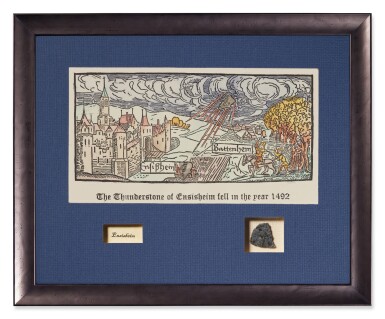
Partial meteorite slice measures 34 x 34 x 3 mm (1⅜ x 1⅜ x ⅛ inches) and weighs 11.06 grams (55.3 carats), in presentation frame measuring 20½ x 16¾ x ⅞ inches. Woodblock print depicting the Fall of Ensisheim in 1492 (Artist: Paul Olson), numbered 56/500 and measuring 14⅜ x 7¾ inches (36.5 x 19.7 cm), all under mat with dimensions 14⅝ x 18⅜ inches (37.1 x 46.7 cm).
Formerly in the collection of the Natural History Museum (London, United Kingdom).
Ensisheim is among the most historic of all meteorites. It is not only the oldest European witnessed fall, but also Europe’s heaviest at 127 kilograms (279 pounds). Samples are extremely difficult to obtain and are typically deaccessioned from museums, which was the case here.
Shortly after Ensisheim fell on November 7, 1492, the stone was brought into the walled city of Ensisheim and tethered to a chain in a dungeon in an effort to prevent it from flying away. A 16th century document describes the descent:
“In the year of Our Lord 1492, the Wednesday before the feast day of Saint-Martin, the seventh day of November, a strange miracle occurred. On that day, between the eleventh and the twelfth hour of noon, came a great thunder clap, then a long noise that was heard far around, then a stone fell from the air on the village of Ensisheim. It was surely a sign from God, such as had never been seen before, or read or written about.”
Austria’s Emperor Maximillian is said to have divined that the fireball was a sign for him to declare war on France (which turned out well as he captured both new territory and his wayward daughter, who had taken up with the French King).
Had this meteorite fallen in parts of Spain, the witnesses to the event may have been put to death as the notion that rocks could fall from the sky was considered heresy in some parts of the world at this time. In fact, the extraterrestrial origin of meteorites did not gain wide acceptance until 300 years after the Ensisheim phenomenon, from which is now offered this spectacular partial slice featuring Ensisheim’s characteristic fine blue-gray brecciated matrix with large inclusions of iron sulfide.
REFERENCES:

