
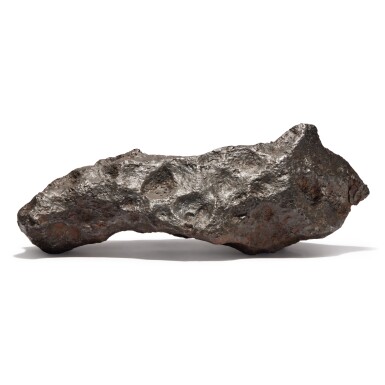
Campo del Cielo Meteorite
A Massive Iron Meteorite From Argentina's "Field of the Sky"
Auction Closed
July 14, 07:13 PM GMT
Estimate
25,000 - 35,000 USD
Lot Details
Description
Campo del Cielo Meteorite — A Massive Iron Meteorite From Argentina's "Field of the Sky"
Iron – IAB-MG
Gran Chaco, Argentina (27° 28'S, 60° 35'W)
445 x 241 x 165 mm (17½ x 9½ x 6½ inches). 125 pounds (56.7 kg).
A MASSIVE IRON METEORITE FROM ARGENTINA'S "FIELD OF THE SKY"
Campo del Cielo fell from the sky between 4,000 and 5,000 years ago, landing in what is now the Chaco Province of Northern Argentina. There it lay until native peoples found fragments of the more than 50 tons of iron meteorites scattered for miles in the remote region, which they used to craft iron weapons. The natives believed that the pieces of metal had fallen from the sky, and the place where they fell was translated by the Spanish as "Campo del Cielo," or "Field of the Sky." Commissioned by a regional governor in 1576, Capitan Hernan Mexia de Miraval was tasked with finding these iron pieces, which he eventually did, believing they marked the beginning of an underground iron mine. After de Miraval's expedition, and his subsequent official description of the search for the iron (in 1584), the next great expedition occurred in 1774, when Don Bartolome Francisco de Maguna found a number of pieces of metal which he reported consisted of 80% iron and 20% silver. Although it was later determined that the samples contained no silver, another expedition was sent in 1783 to evaluate the irons, led by Lieutenant Rubin de Celis.
De Celis assumed – as did most educated people of the time – that rocks did not fall from the sky, and he instead posited that they were deposited by volcanic activity. He sent samples to important scientific institutions in Europe, where they analyzed the metal, finding that it was mostly iron alloyed with a small percentage of nickel.
However, by the early 19th century, the notion that rocks could fall from the sky had gained significant traction, at which point Rubin de Celis was deemed to be the founder of the meteorite. This remained the case until Mexia de Miraval's official 1584 report on the meteorite was uncovered in the Seville archives in the early 1920s. Eventually, the discovery date was acknowledged to be 1576, the year of Mexia de Miraval's original expedition.
REFERENCES:
Meteoritical Bulletin Entry for Campo del Cielo
Marvin, Ursula B. “Meteorites in History: An Overview from the Renaissance to the 20th Century.” The History of Meteoritics and Key Meteorite Collections: Fireballs, Falls and Finds, The Geological Society, London, 2006, pp. 28–30.