Christopher Wood
The Bathers, with Ship
Estimate
30,000 - 50,000 GBP
Lot Details
Description
Christopher Wood
1901 - 1930
The Bathers, with Ship
oil on board
unframed: 24 by 19 cm. 9½ by 7½ in.
framed: 38 by 33 cm. 15 by 13 in.
Executed in 1925.
We are grateful to Robert Upstone, author of the forthcoming catalogue raisonné of Christopher Wood, for his kind assistance with the cataloguing of the present work.
Lefevre Gallery, London
The Redfern Gallery, London, where acquired by F.B.C. Bravington Esq., 10 March 1938
Acquired by the present owner, 1983
London, The New Burlington Galleries, Christopher Wood: Exhibition of Complete Works, 3 March – 2 April 1938, no. 279
Eric Newton, Christopher Wood 1901–1930, London, 1938, no. 89
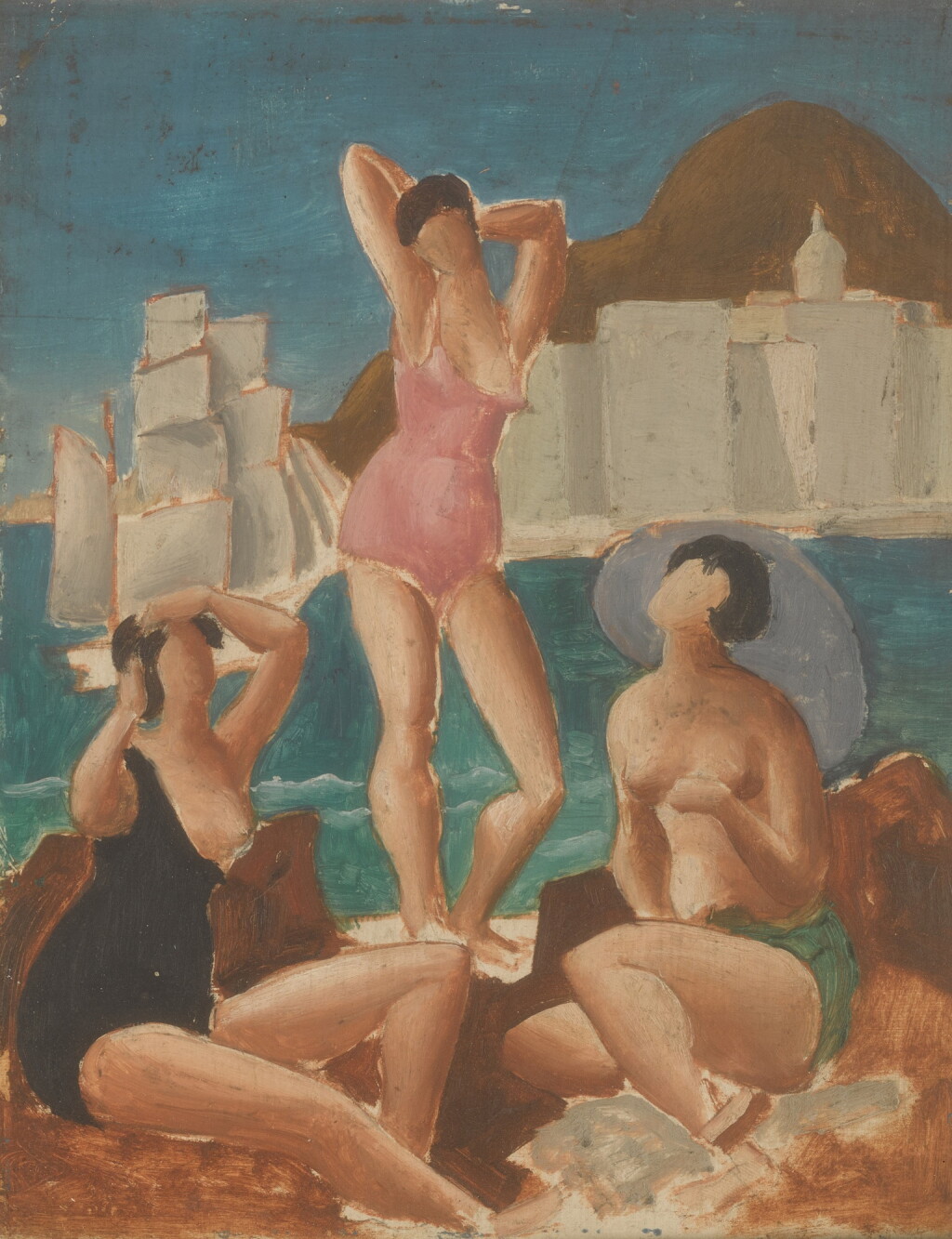
The Bathers, with Ship belongs to a small and exceptionally important group of paintings of bathers made by Christopher Wood in 1925, at the moment when his experience of the European avant[1]garde, his friendship with Pablo Picasso and his fascination with Serge Diaghilev’s Ballets Russes converged with the glamour and sensuality of the Côte d’Azur. Modest in scale but remarkably ambitious in conception, the painting appears to stand close to the beginning of a sequence which would culminate later that year in Wood’s great six-fold Beach Scene with Bathers, Pier, Ships, etc., the largest and most complex painting of his career.
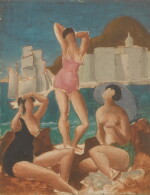
Three female bathers dominate the foreground. The central figure, standing in a rose-pink bathing costume, raises both arms around her head; to the left, a seated woman in a dark costume repeats almost the same gesture. At right, a third woman turns towards the spectator beneath a broad brimmed hat. Two of the women are partly undressed, introducing an unmistakable note of sensuality into the otherwise conspicuously modern imagery of seaside leisure. Beyond them a sailing vessel crosses the intensely coloured water, while a succession of pale buildings rises against the immense dark form of a mountain. Wood reduces figures, architecture and landscape alike to broad, lucid shapes, creating a composition of striking directness in which the fashionable world of the Riviera acquires an unexpectedly timeless grandeur.
The background of The Bathers, with Ship can now be identified with considerable confidence as Monte Carlo harbour, seen from the direction of Monaco-Ville and Fort Antoine. Period views from this position show the same conjunction of harbour, tiered pale architecture and the enormous mountain rising immediately behind the town. Particularly distinctive is the small cupola with its elongated finial towards the right of Wood’s architectural group, which can plausibly be identified with the Hôtel Beau-Rivage on the Montée de la Costa. The steep ascent, broad shoulder and descending profile of the mountain behind correspond equally closely with the historic topography. Wood has not transcribed the view mechanically. Balconies, windows, roads, villas and architectural ornament disappear, and Monte Carlo is distilled instead into a sequence of luminous geometric planes set against the massive dark form of the mountain. Yet enough is retained to preserve the identity of the place. This selective simplification is characteristic of Wood at his most sophisticated: apparent naïveté conceals a highly deliberate process of reduction.
The modest dimensions of The Bathers, with Ship, together with the specificity of its setting, raise the intriguing possibility that the painting was made during the Monte Carlo visit itself. Alternatively, it may have been painted shortly afterwards, when Wood and Gandarillas had returned to Paris and the experience of the Riviera remained fresh. His letters prove that he was painting there in watercolour; the present oil, with its unusually precise sense of place, seems in either case to stand particularly close to the immediate experience of the April journey.
This gives the painting a particular importance within Wood’s development during 1925. Here the imagined Mediterranean world of Picasso and Le Train Bleu is fused with an actual place Wood had just experienced. The statuesque bodies and fashionable bathing costumes belong to the modern mythology of the Ballets Russes; the harbour, hotels and mountain belong to Monte Carlo itself. In this painting, theatre and experience have become almost indistinguishable.
This catalogue note is by Robert Upstone, author of the forthcoming catalogue raisonné of Christopher Wood.
You May Also Like