
John Craxton R.A.
Athenian Horsemen
Auction Closed
October 15, 11:26 AM GMT
Estimate
60,000 - 80,000 GBP
Lot Details
Description
John Craxton R.A.
1922 - 2009
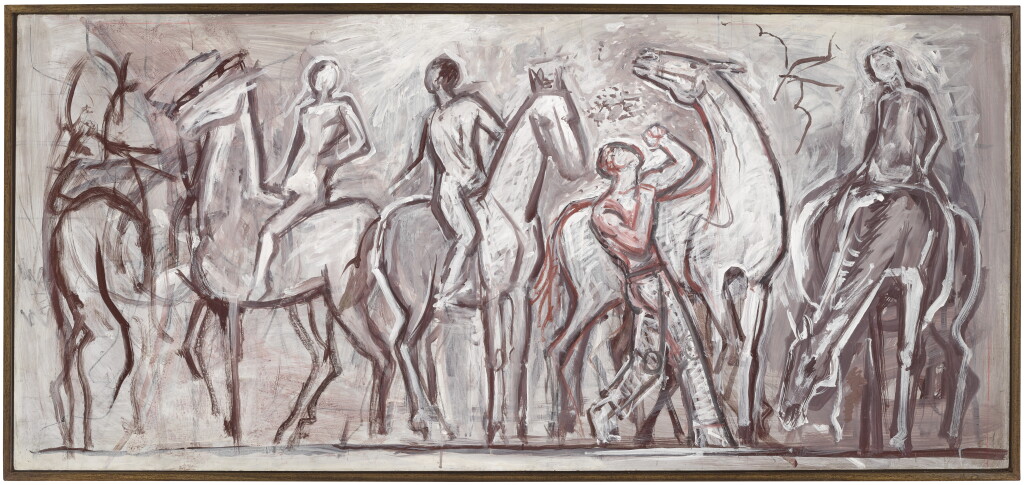
Athenian Horsemen
oil on board
unframed: 67 by 147 cm. 26¼ by 58 in.
Executed in 1971.
We are grateful to Ian Collins for his kind assistance with the cataloguing of the present lot.
Harold Craxton Memorial Trust
London-born John Craxton (1922-2009) had always wanted to live and work in Greece. He finally escaped in the spring of 1946 and, for the rest of his long life, his art became an explosion of brilliant line, light and colour drawing on ancient and modern Aegean themes. He was one of those fortunate people who get what they want and are not disappointed, but his personal odyssey was at times rocky and stormy.
In January 1967 a Craxton retrospective at the Whitechapel Gallery was not well received. The artist thought he was done with Britain forever, but that Easter his adopted world fell apart when a clique of colonels staged a coup in Athens and Greece came under martial law. An anarchic spirit who had mocked authority once too often was summarily ejected from his harbourside house and studio in a crumbling Venetian palazzo on Crete. As a friend put it: 'Johnny had to leave Greece when his jokes ran away with him.'
An astonished and desolated exile wandered around and beyond the Mediterranean. From North Africa to southern Italy he often found himself wretched among ancient Greek ruins. In nine years of expulsion, when fearful that separation might last forever, he eventually settled grumpily in Edinburgh ('They call it the Athens of the North. I call it the Inverness of the South.') He drove Dovecot Weavers to distraction as they worked on his masterly and monumental Landscape with the Elements tapestry - a tribute to all things Greek - for the University of Stirling.
In 1971, while lingering in London, Craxton pined in the British Museum, musing specifically on the Parthenon marbles. The great temple to Athena on the Acropolis hill was the centrepiece of fifth century BC Athenian reconstruction overseen by the statesman Pericles after Greco-Persian Wars wreckage. Much of the surviving sculptural adornment was (in)famously removed by Lord Elgin during the Napoleonic Wars. John Craxton now felt common cause with such displacement.
He produced a series of sketches in situ, then small oil studies and this large-scale near-monochrome painting which is all the more ghostly and poignant and potent given the artist's normally joyful preoccupation with bright colour. It is a testament to loss, but also to resilience. The assembly still pulsates with the arteries and sinews of life.
Craxton was no recorder of conflict - almost all his pictures are love affairs - and so the mythic Parthenon battles involving gods, giants and centaurs are not a spur for him, however much he admired them. He is inspired here by the temple's interior frieze depicting the annual Panathenaic procession in homage to Athena. Young men mount horses and a cavalcade picks up speed and purpose as the scene unfolds. The impact is impressive and uplifting - galvanising the philhellenic artist in his dream of a homeward journey.
In Greece John Craxton was the unparalleled portraitist of people, cats and goats in a landscape stretching from mythological to modern times. This unique human and equine panorama reveals a love and yearning for Greece at its most essential.
Ian Collins
Writer and curator Ian Collins is the author of John Craxton: A Life of Gifts, Yale University Press.
You May Also Like


