Property from a Dutch Private Collection
English, probably Nottingham, 15th century
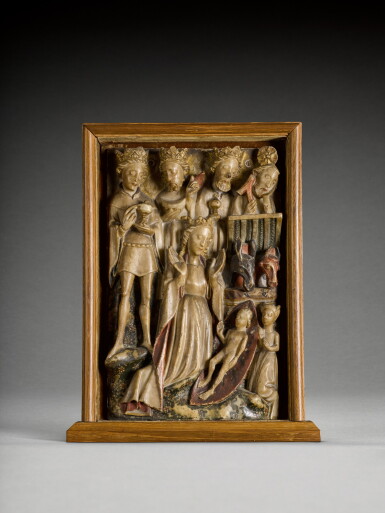
The Adoration of the Magi
Auction Closed
July 1, 03:00 PM GMT
Estimate
18,000 - 25,000 GBP
Lot Details
Description
English, probably Nottingham, 15th century
The Adoration of the Magi
partially gilt and polychromed alabaster, in a later wood frame lined with brown velvet
relief: 42 by 26cm., 16½ by 10¼in.
frame: 46.5 by 32.2cm., 18 ¼ by 12⅝ in.
Sotheby's London, 23 May 1974, lot 100
F. Cheetham, Alabaster Images of Medieval England, Woodbridge, 2003, p. 85, no. 55, ill. no. 57
During the fourteenth and fifteenth centuries, carved alabaster altarpieces consisting of a series of scenes and figures were produced in the areas surrounding Nottingham, England. Alabaster panels were carved individually, and then painted and mounted into wooden frameworks. The most popular subjects for these altarpieces were The Life of Christ and The Life of the Virgin.
The present alabaster depicts the Adoration of the Magi according to the pattern established by the visionary account of St Bridget of Sweden in 1370. As Cheetham has noted, this model became highly influential in later medieval iconography as the account transformed the traditional artistic composition of the Nativity (Cheetham, 1984, p. 178). The Virgin was no longer represented reclining on a bed after childbirth, but was instead shown kneeling in open palmed reverence of the Christ Child, reflecting a developing theological emphasis on the miraculous and painless nature of the Nativity.
The Adoration of the Magi was one of the most popular subjects of fifteenth-century English alabaster carving. Numerous variants of the scene survive, differing in the number and arrangement of the Magi and, in some cases, the inclusion of subsidiary figures such as midwives in the background (ibid., nos. 105–106). The closest comparison to the present relief is one published by Philip Nelson in 1927, and recorded as no. 58 in Cheetham’s catalogue, formerly on loan to the Ashmolean museum (Nelson, p. 120, pl. VII; Cheetham, 2003, p. 85, no. 58). Both the reliefs have the three kings, Gaspar, Balthasar, and Melchior in the background, all pointing to the star with their left hands while holding their respective gifts in the right: a cup, a navette, and a covered vessel.
RELATED LITERATURE
P. Nelson, ‘Some Additional Specimens of English Alabaster Carvings’, The Archaeological Journal, vol. 84, 1927, pp. 114–124; F. Cheetham, English Medieval Alabasters, Oxford, 1984, pp. 178-179; F. Cheetham, Alabaster Images of Medieval England, Woodbridge, 2003, p. 85, no. 55
You May Also Like