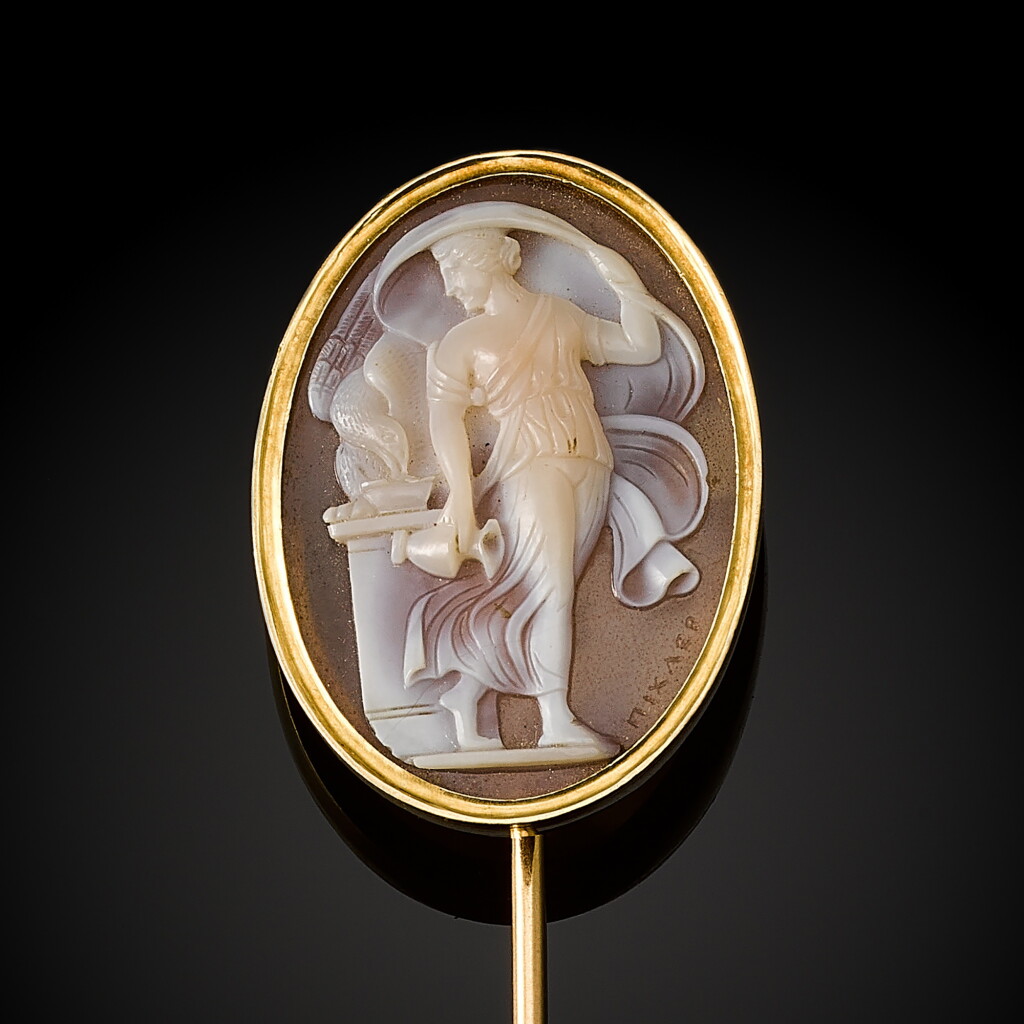
Giovanni Pichler
Cameo with Hebe
Auction Closed
July 1, 03:00 PM GMT
Estimate
8,000 - 12,000 GBP
Lot Details
Description
Giovanni Pichler
Naples 1734 - 1791 Rome
Cameo with Hebe
signed: ΠΙΧΛΕΡ
agate, mounted as a stick pin
cameo: 28mm., 1⅛in.
G. Pichler, Catalogo d'impronti cavati da gemme incise dal cavaliere Giovanni Pichler, incisore di Sua Maesta' cesarea Giuseppe II., Rome, 1790, no. 63 [probably] ['EBE, dando il Nettare a Giove in Aquila. Da una Pittura moderna.* In Corniola.']
H. Rollet, Die drei Meister der Gemmoglyptik Antonio, Giovanni und Luigi Pichler: Eine biographisch-kunstgeschichtliche Darstellung, Vienna, 1874, p. 26, no. 48 ['wegschreitend vom trinkenden Adler. Bez: ΠΙΧΛΕΡ. - Achat Japis']
This beautiful cameo engraved with Hebe offering nectar to Jupiter in the form of an eagle, is almost certainly the signed agate/ jasper cameo of Hebe described by Rollet in his 1874 biography and catalogue of the Pichler dynasty of gem engravers, listed in Giovanni Pichler's oeuvre. The model was published by Giovanni himself in 1790, although he describes the stone as carnelian (which is perhaps explained by the present cameo's reddish hue). The model relates to another cameo by Giovanni Pichler depicting Eurydice bitten by a snake (Paoletti MR 26890; Rollet, op. cit., p. 26, no. 43). The present cameo, with its delicate billowing drapery, compares closely with other gems by Giovanni Pichler. Compare with the cameo of Apollo which was likely gifted by Samuel Whitbread to Lady Elizabeth Grey, and which was sold in these rooms on 7 December 2021, lot 62.
Giovanni Pichler was born in Naples and trained by his father Antonio Pichler in the art of gem engraving in Rome. In 1769 he was appointed gem engraver to Emperor Joseph II in Vienna. Pichler's fame rapidly increased and he became a favourite of Grand Tourists. He also trained a number of the most famous engravers of the next generation including Filippo Rega and Antonio Berini. Upon his death in 1791 his workshop was inherited by his half brother Luigi Pichler. He went on to work for the Habsburg Imperial family in Vienna and so impressed the French court jeweller François-Régnault Nitot that the latter tried to persuade him to move to Paris. Luigi received many distinctions later in life including a diploma from the Academy of St Luke and membership of the Academy in Venice, as well as, in 1839, Knight's Cross of the Order of St Gregory the Great and, in 1842, of the Order of St Sylvester.
RELATED LITERATURE
L. Pirzio Biroli Stefanelli, La collezione Paoletti: Stampi in vetro per impronte di intagli e cammei, Rome, 2012, p 46, no. 256