
The Shapes of Cartier
Cartier, Paris
Pebble | New York retailed: A very rare yellow gold wristwatch with geometric off-set dial, Circa 1945
Auction Closed
June 15, 08:08 PM GMT
Estimate
15,000 - 20,000 USD
Lot Details
Description
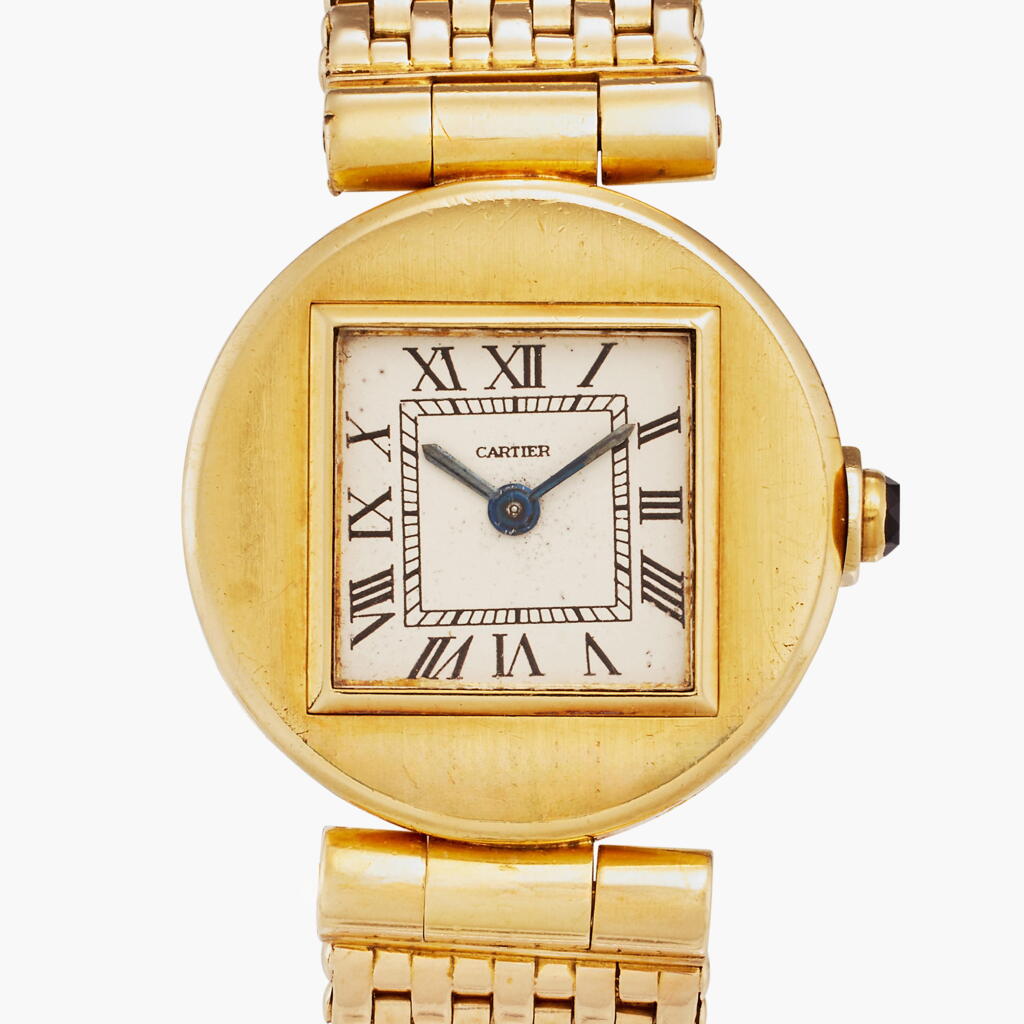
Dial: matte white dial, stretched black radial Roman numerals, inner chemin-der-fer minute ring, blued steel epée hands
Caliber: 9¼’’’ circular LeCoultre movement signed European Watch and Clock Co. Inc., damascened Côtes de Genève decoration, lever escapement, 18 jewels, bi-metallic balance with timing and poising screws, adjusted to temperatures and two positions, flat hairspring
Movement number: numbered to backplate 100'450
Case: 18k yellow gold case, upper body with vertical satin finish, polished chamfered bezel, cylindrical t-bar Vendôme lugs
Case number: hand stamped 33'879, outside case back engraved To Daddy from P.B.F. 1952, stamped 18k, underside of bezel hand stamped 879, flag-form Edmond Jaeger punch mark with 18k on the side of the case, inside case back signed European Watch & Clock Co., Made in France
Closure: 14k gold brick-link bracelet signed Kreisler, U.S.A., numbered 24'442, U.S. Pat. 2.453.993
Size: 24 mm diameter, bracelet circumference approximately 165 mm
Box: no
Papers: no
Nicknamed the “Pebble” for its smooth, rounded edges, this watch artfully balances contrasting symmetries: an 18ct yellow gold circular case with T-bar Vendôme lugs encloses a square dial, framed by a matching square bezel that secures the crystal. The interplay between soft curves and defined angles creates a visually striking design, blending elegance with geometric precision.
Introduced by Cartier Paris around 1943, this design foreshadows another iconic model introduced in 1972 by Cartier London under Jean-Jacques Cartier’s direction. Produced in Cartier’s Wright & Davies workshop, the 1972 model similarly featured a circular case and a square bezel and dial, but with a distinct twist—the square was rotated 45 degrees, creating a lozenge shape with the hour markers placed at the diamond-shaped peaks of 12, 3, 6, and 9 o’clock. This lozenge configuration has an earlier precedent in Cartier’s 1912 Nain Jaune model, which also featured a square bezel and dial set within a square case, rotated 45 degrees to create an off-set, diamond-like effect. This innovative use of geometry and rotation across the decades underscores Cartier’s enduring commitment to creative, avant-garde watch design. The gold brick-link bracelet was supplied for the watch in the U.S. by the Kreisler jewellery firm.