
The Shapes of Cartier
Cartier, London
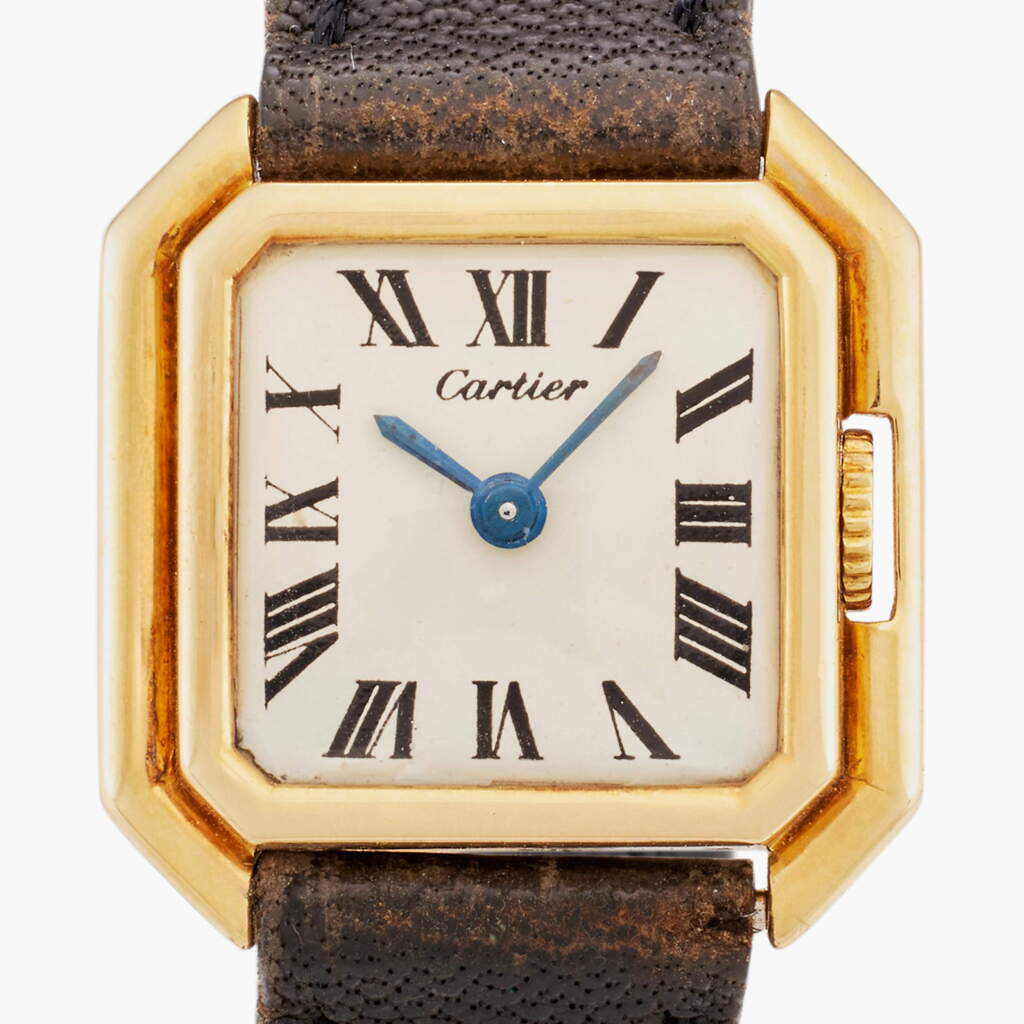
Ceinture | A lady’s yellow gold wristwatch with stepped bezel and original gold deployant buckle hallmarked London 1969-70
No reserve
Auction Closed
June 15, 08:08 PM GMT
Estimate
10,000 - 15,000 USD
Lot Details
Description
Dial: cream dial signed Cartier, stretched black radial Roman numerals, blued steel épée hands
Case: 18k yellow gold octagonal case, flat octagonal bezel, octagonal case sides with rounded edges and recess integrating flat notched winding crown, case back secured by four screws to corners of case sides
Case number: outside case back stamped 9'191 and faintly G 24'429, inside case back with London hallmarks for 18k gold, date letter ‘o’ for 1969-70, [JC] Jean-Jacques Cartier punch mark, hand stamped 9'191
Caliber: 7’’’ movement signed Jaeger-LeCoultre, damascened Côtes de Genève decoration, lever escapement, annular balance, flat hairspring, Kif Flector shock absorber
Movement number: numbered to main plate 1'997'947
Closure: 18k gold deployant buckle with London hallmarks for 18k gold, date letter ‘o’ for 1969-70, hand stamped 9'191
Box: no
Papers: no
François Chaille & Franco Cologni, The Cartier Collection: Timepieces, Paris: Flammarion, 2006. See p. 404 for a Paris Ceinture dated 1946 which it is noted was sold to Mr Agnelli. See also p. 467 for the 1973 edition.
Made in 1969–70, this London-made Ceinture was produced during Cartier London’s most experimental phase, a period in which the Maison created some of its most distinctive and unconventional wristwatches. However, while Jean-Jacques Cartier and his chief designer, Rupert Emmerson, were introducing iconic models such as the Crash, Maxi Oval, and Pebble, Cartier London continued to offer a range of traditional designs to order, including the Ceinture. Nevertheless, these watches were usually given a distinctive Bond Street aesthetic, featuring bold Roman numerals on creamy white dials, normally without minute tracks. One of Cartier’s most instantly recognizable and famous models, the Ceinture was first introduced in 1927.