
The Shapes of Cartier
Cartier, Paris
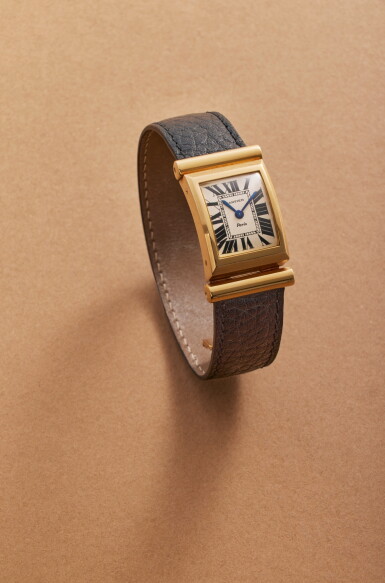
Driver | New York retailed: An unusual yellow gold deeply curved rectangular driver’s rear-wound wristwatch with integrated gold deployant buckle and Paris dial, Circa 1973
Auction Closed
June 15, 08:08 PM GMT
Estimate
30,000 - 50,000 USD
Lot Details
Description
Dial: white dial signed Cartier Paris, stretched black radial Roman numerals, inner chemin-de-fer minute track, blued steel épée hands
Caliber: 5¼’’’ circular rear-wound movement signed Jaeger-LeCoultre, grained decoration, lever escapement, annular balance with poising screws, flat hairspring, Kif Flector shock absorber
Movement number: main plate numbered 2'201'709
Case: 18k yellow gold curved rectangular case, chamfered bezel, hooded lugs, the lower lugs integrating the deployant clasp’s closure, curved case back, flat notched winder to case back, case back secured by four screws to case sides
Case number: case back interior hand stamped 64'365, case back exterior with French eagle’s head assay mark, Edmond Jaeger punch mark and with New York Subsidiary Stock No. 034'242
Closure: 18k gold deployant buckle integrated into the lower lug and formed to the curvature of the case back, with French eagle’s head assay mark and Edmond Jaeger punch mark
Size: 32 x 20 mm
Box: no
Papers: no
George Gordon, Cartier - A Century of Cartier Wristwatches, Hong Kong: Timeless Elegance, 1989, pp. 178-179, fig. 109. The present watch is illustrated but erroneously dated to 1958.
Driver’s wristwatches, among the earliest examples of purpose-made tool watches, are a fascinating blend of watchmaking ingenuity and motoring culture. Designed to meet the specific needs of automobile enthusiasts, these watches allowed drivers to read the time without taking their hands off the wheel – an elegant yet practical solution for an era when motoring was not only a means of transport but also a symbol of sophistication and adventure.
One of the watch’s most ingenious design features is the integration of a curved deployant buckle into the case itself. The lugs beneath the 6 o’clock position serve a dual purpose, cleverly forming part of the hinged closure for the deployant clasp, which is discreetly nestled into the curvature of the case back. This design maintains the watch’s clean, streamlined aesthetic, allowing it to ‘float’ seamlessly on its leather strap. Without the pronounced curvature of the case back, such a design would not have been possible. Such is the significance of this model within Cartier’s storied history that it was reintroduced in the late 1990s as part of the prestigious Collection Privée Cartier Paris (CPCP), a series dedicated to reviving the brand’s historic designs with high-quality mechanical movements.