
The Shapes of Cartier
Cartier, London
Tank J.J.C. | A yellow gold rectangular wristwatch with gold deployant buckle | Made in 1963-64
Auction Closed
May 10, 02:36 PM GMT
Estimate
16,000 - 24,000 CHF
Lot Details
Description
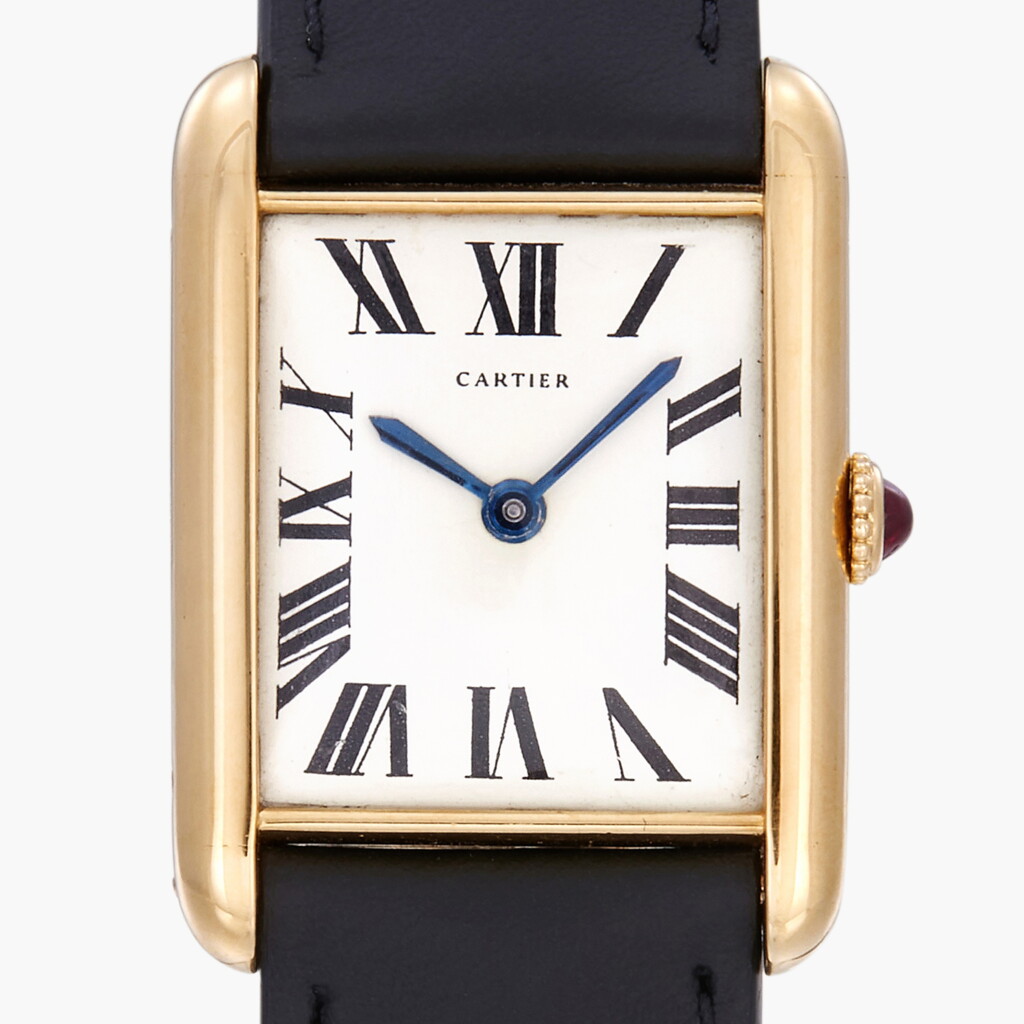
Dial: cream dial signed Cartier, stretched radial Roman numerals, blued steel epée hands
Calibre: 9’’’ Jaeger-LeCoultre calibre K821/1 signed Cartier Inc., lever escapement, damascened Côtes de Genève decoration, lever escapement, 18 jewels, annular balance with poising screws, adjusted to temperatures and three positions, flat hairspring, Kif flector shock absorber
Movement number: main plate numbered 1'449'980
Case: 18k yellow gold rectangular case with polished finish, rounded brancards, beaded cabochon ruby-set crown, case secured by 4 screws to case sides, gold screw-set lug bars,
Case numbers: gold case back hand stamped 6737, • 9681 •, inside case back with London hallmarks for 18ct gold, date letter ‘h’ for 1963-64, hand stamped • 9681 • and [JC] Jean-Jacques Cartier punch mark
Closure: 18k gold deployant clasp with London hallmarks and date letter ‘h’ for 1963-64, hand stamped 0608
Size: 23 x 31 mm (width x length including lugs)
Box: yes
Papers: no
Accessories: Cartier presentation box
Jack Forster, Cartier Time Art: Mechanics of Passion, Milan: Skira Editore, 2011. See p. 71 for an original advertisement.
Introduced in 1951, the J.J.C. Tank by Cartier was developed by Jean-Jacques Cartier as a distinct interpretation of the original Louis Cartier model. Defined by its softly rounded brancards, it reflects the more expressive and unconventional design language of the London workshop.
The present example, dating from 1963–64 and bearing London hallmarks, is a refined expression of this lineage. Cased in 18k yellow gold, it retains the classic proportions of the Tank while showcasing a cream hand painted enamel dial with bold, elongated Roman numerals and, notably, no chemin de fer minute track, one of the earliest executions of this now characteristic Cartier London feature.
Further enhancing its rarity, the watch is fitted with a ruby set winding crown, an uncommon choice compared to the more typical blue sapphire. Paired with blued steel épée hands, the result is a strikingly pure and characterful interpretation of one of Cartier’s most iconic designs