
The Shapes of Cartier
Cartier, Paris
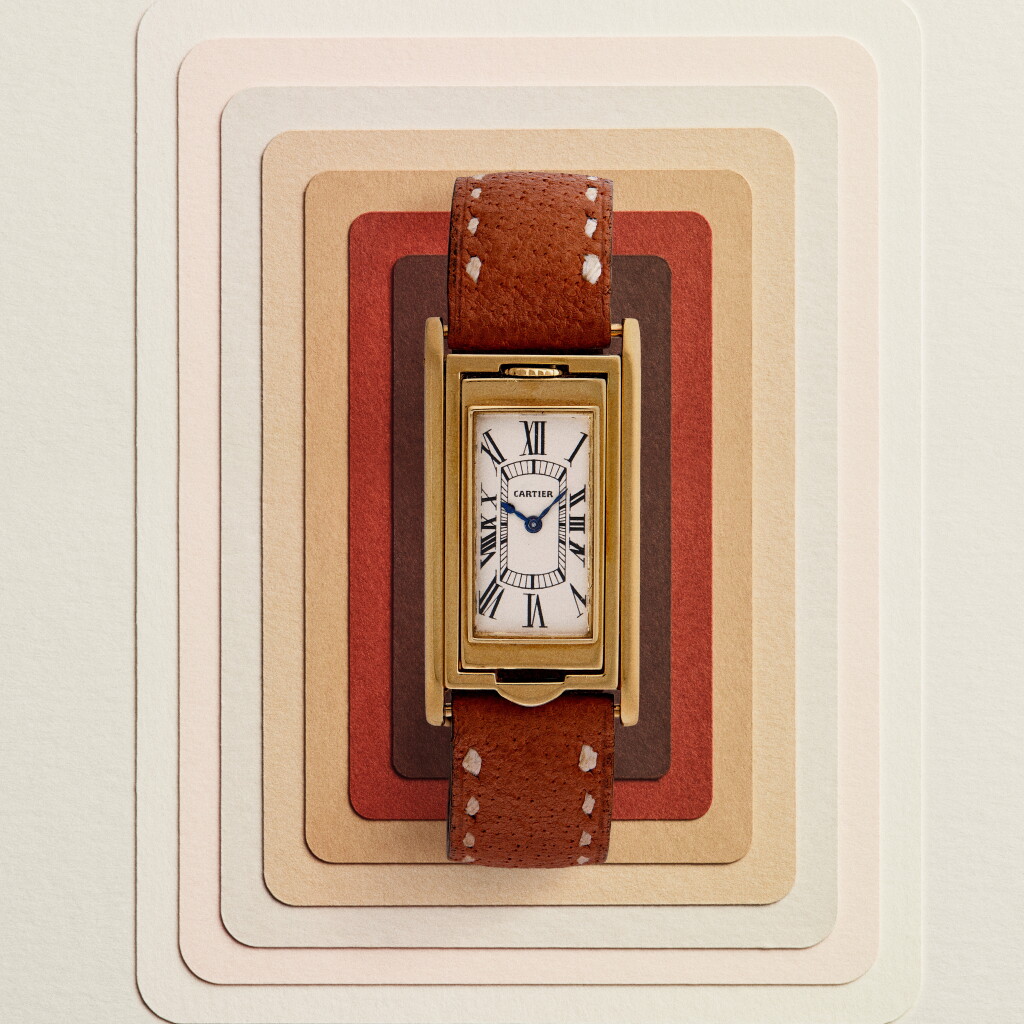
Retailed by Cartier New York: Tank Basculante | A rare and early yellow gold reversible wristwatch with gold deployant clasp | Circa 1933
Auction Closed
May 10, 02:36 PM GMT
Estimate
30,000 - 50,000 CHF
Lot Details
Description
Dial: silvered dial signed Cartier, stretched black radial Roman numerals, inner baguette-form chemin-de-fer minute ring, blued steel spade hands
Calibre: 5’’’ calibre 610 baguette-form LeCoultre movement signed European Watch and Clock Co. Inc., damascened Côtes de Genève decoration, lever escapement, 19 jewels, bi-metallic compensation balance with timing and poising screws, 8 adjustments, flat hairspring
Movement number: beneath dial 15415
Case: 18k yellow gold, the long brancards terminating in eagle’s beak form lugs, hinged inner framework, the watch case pivoting within and revolving to reveal a plain polished gold back, back of inner case secured by 4 screws to upper and lower case sides, gold screw-set bar lugs, crown above 12 o’clock, lip to the pivoted framework below 6 o’clock for releasing and allowing rotation of the inner case, back of outer case frame with engraved monogram RL and hand stamped 06185, case with French eagle’s head assay mark
Case number: New York Stock No. 06185
Closure: 18k gold deployant buckle, with French assay mark and numbered 24021
Size: 20 x 38mm (width x length including lugs)
Box: yes
Papers: yes
Accessories: Cartier presentation box and letter from Obsidian signed by Harry Fane detailing research carried out with the assistance of Cartier Geneva. On 20 June 2021, Cartier Geneva confirmed to Obsidian that this watch is listed in the Cartier archives as a Basculante and dates to the early 1930s.
Barracca, Jader, Negretti, Giampiero, Nencini, Franco, Ore d’Oro 2, Wrist Watches, Investment and Passion, Milan: Wrist Editoriale S.r.l., 1987. See p. 129 for black and white archive images.
Introduced in 1932, the Cartier Tank Basculante stands among the most innovative creations of Cartier. Developed in collaboration with Edmond Jaeger, the design was patented on 1 July 1932, granting Cartier exclusivity for this ingenious mechanism.
Originally known as the Cabriolet Réversible, it only later adopted the name Basculante in 1991. The present example is among the earliest surviving executions of this groundbreaking model.
Conceived during a period when sporting pursuits such as polo were gaining popularity among high society, the Basculante offered an elegant solution to the need for protection. Its distinctive case pivots vertically within an articulated frame, allowing it to rotate and conceal the dial beneath a solid metal back. Unlike the Jaeger-LeCoultre Reverso, which rotates horizontally and is limited to 180 degrees, the Basculante can complete a full 360 degree rotation, reflecting Cartier’s unique approach to mechanical ingenuity.
This architecture also necessitated the repositioning of the crown to 12 o’clock, preserving the clean lines of the case while ensuring protection. Beyond its functional purpose, the reversible design allowed for personalisation through engraving, and even offered the ability to rest midway as a small table clock, a subtle yet charming demonstration of Cartier’s blend of practicality and refined design.