
The Shapes of Cartier
Cartier, Paris
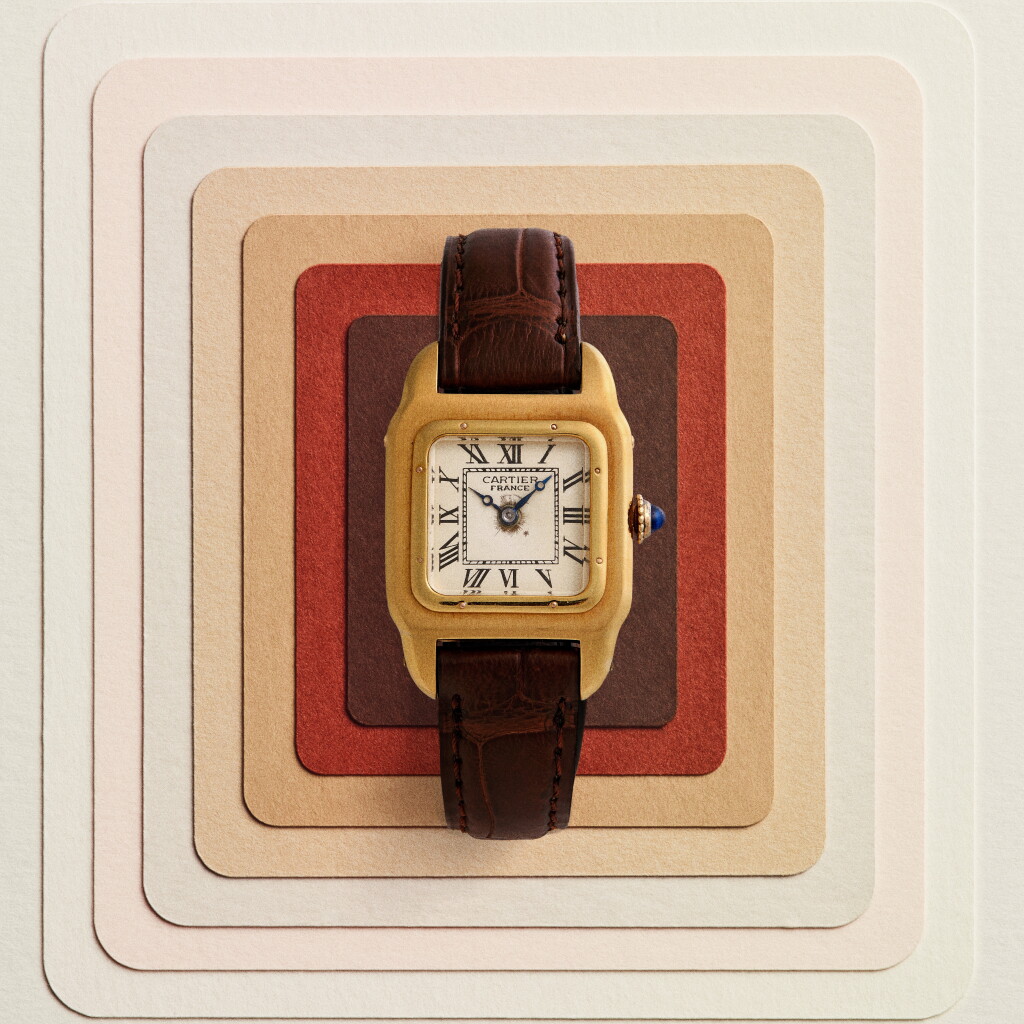
Santos | A lady’s yellow gold cushion-form wristwatch with a gold deployant buckle | Circa 1922
Auction Closed
May 10, 02:36 PM GMT
Estimate
24,000 - 32,000 CHF
Lot Details
Description
Dial: silvered dial signed Cartier France, stretched radial black Roman numerals, inner chemin-de-fer minute track, blued steel Breguet hands
Calibre: 9¼’’’ circular LeCoultre calibre movement signed E. W. & C. Co. Inc, damascened Côtes de Genève decoration, lever escapement, 19 jewels, bi metallic compensation balance with timing and poising screws, Breguet hairspring, adjusted to 8 positions
Movement number: 12'231
Case: 18k yellow gold case, polished cushion-form bezel with 8 contrasting pink gold screws affixed from the underside, the lugs with gold screw-set bars, 18ct yellow gold case back secured by 4 gold screws to case sides, sapphire cabochon-set beaded crown, inside case back signed E. W. & C. Co. Inc, France , case exterior with personalised engraving “W. A. Slater.” French eagle’s head assay mark, Edmond Jaeger punch mark and hand stamped numbering 9345, 12231
Case number: 9345
Closure: 18k gold deployant buckle with French eagle’s head assay mark, Edmond Jaeger punch mark, hand stamped numbering 13895
Size: 22.6 x 33 mm (width x length including lugs)
Box: no
Papers: no
Accessories: none
Jader Barracca, Giampiero Negretti, Franco Nencini, Le Temps de Cartier, Milan: Publiprom, Second Edition, 1993. See p. 52 for another example of a lady’s Santos dating to circa 1916.
In 1904, Louis Cartier created one of the first modern wristwatches for his pioneering aviator friend Alberto Santos-Dumont, enabling him to read the time while at the controls of his airship. This marked a decisive step in the evolution of the wristwatch from a decorative object into a practical instrument.
The design of the Cartier Santos broke with tradition. Its square case stood in contrast to the prevailing round forms of pocket watches, while the introduction of defined lugs allowed for the use of a proper leather strap secured by straight bars, enhancing both durability and coherence of design.
Equally significant is the watch’s industrial aesthetic. The bezel, secured with visible screws from beneath, evokes the riveted iron structures of the modern age, such as bridges and the Eiffel Tower, reflecting the fascination with engineering innovation at the time. Completing the design is the cabochon sapphire set crown, a subtle reminder of Cartier’s origins as a jeweller. When first commercialised in 1911, the Santos was offered in both gold and platinum, establishing what would become one of the most enduring designs in horology.