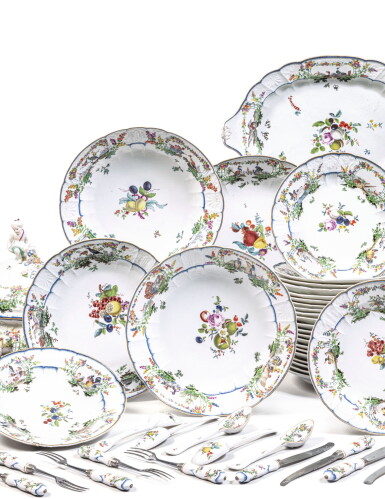
An important portion of the Meissen porcelain service made for Count Karl Wilhelm Finck von Finckenstein (1714–1800), probably a gift of Frederick II of Prussia (1712–1786), circa 1760
Auction Closed
June 24, 04:51 PM GMT
Estimate
30,000 - 50,000 EUR
Lot Details
Description
moulded in the ‘Dulong’ pattern, the rims divided into four reserves painted with birds in landscapes within trellis and floral frames; the wells painted with sprays of fruit, flowers, and foliage; the gilt-edged shaped rims enriched in blue, comprising:
1 large oval two-handled tureen, cover and stand, width of stand 20 1/8 in; 51 cm;
23 dinner plates, 9 ⅞ in; 25,2cm diam.;
1 large circular dish, 13 ⅞ in; 35,2 cm diam.
2 large circular dishes, 12 ⅞ in; 32,8 cm diam.;
2 large circular dishes, 11 ¾ in; 30 cm;
2 shell-moulded dishes, length 8 ½ in; 21,7cm;
1 sunflower dish, 9 ¼ in; 23,5 cm long;
1 peony dish, 7 ½ in; 19 cm long;
12 knives, 9 ½ in; 24 cm long;
12 forks, 8 ¼ in; 21 cm long;
12 spoons, 7 ⅞ in; 20 cm long;
a figural cruet ewer, height 7 ⅞ in; 19,8 cm;
a small ewer, with gilt-bronze mount, height 7 ½ in; 19 cm
crossed swords marks in underglaze-blue, impressed numerals
(73)
Daniela Antonin (ed.) Luxury, Love, Legendary Meissen, Fascinating Rococo, exh. cat., Hetjens Deutsches Keramikmuseum, Düsseldorf in partnership with Röbbig München, 2019, pp. 90-91.
The relationship between Karl Wilhelm Finck von Finckenstein and Frederick the Great was one of close political trust and long-term service, rooted in the functioning of Prussia’s centralized state during the 18th century. Finckenstein served as a senior minister in Frederick’s government, particularly in foreign affairs, as the Ambassador to the Courts at Stockholm, Copenhagen and St. Petersburg, and later he became the Prussian Minister of State and Envoy. Frederick valued competence and loyalty in his officials, and Finckenstein fit that model well—he was entrusted with sensitive diplomatic matters, especially during and after major conflicts such as the Seven Years' War.
This service reflects both the artistic excellence achieved at the Meissen manufactory by the middle of the 18th century and the important role of royal gift-giving within a wider political sphere. Meissen porcelain was among the most prestigious of luxury goods in 18th-century Europe, closely associated with royal courts and elite status. By commissioning and gifting such a service, Frederick II was doing more than offering a decorative object—he was signalling the high esteem in which he held his minister and reinforcing Finckenstein’s position within the inner circle of trusted officials.
Pieces from the service have only rarely appeared on the auction market. Most notably, a substantial group of seventy-six pieces was sold at Sotheby’s, London, on 22–23 February 1988, lot 382 (achieving a hammer price of £50,000). A plate from the service is illustrated by Dieter Hoffmeister in Katalog der Sammlung Hoffmeister, vol. I, Hamburg, 1999, cat. no. 219, which later sold at Bonhams, London, 25 November 2009, lot 98; and most recently, a pair of trencher salts sold at Lempertz, Cologne, 18 November 2022, lot 1126.
You May Also Like