
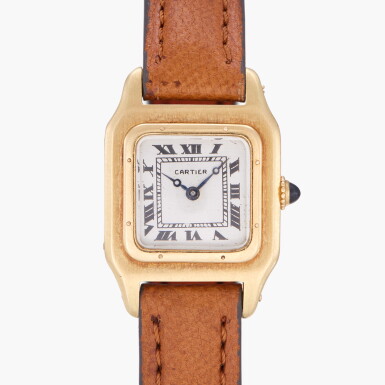
Cartier and European Watch & Clock Co.
Santos | A yellow gold wristwatch | Circa 1920
Lot Closed
May 13, 01:48 PM GMT
Estimate
10,000 - 15,000 CHF
We may charge or debit your saved payment method subject to the terms set out in our Conditions of Business for Buyers.
Read more.Lot Details
Description
Dial: silvered
Calibre: manual winding, 18 jewels
Case: yellow gold, case back secured by 4 screws with personal engraving on the back
Serial number: 18'846, 27'178
Closure: 18k yellow gold Cartier deployant clasp
Size: 22.5 x 32 mm (width x length including lugs)
Signed: dial signed Cartier, movement signed European Watch & Clock Co Inc, case hand stamped with Cartier reference numbers
Box: no
Papers: no
Accessories: none
In 1904 Louis Cartier (1875-1942) supplied his pioneering aviator friend, Alberto Santos-Dumont (1873-1932), with a wristwatch that could be used to consult the time while at the controls of one of his airships. Louis Cartier was passionately interested in watches and sought to develop a greater range of both pocket and wristwatches.
Firstly of course, rather than a circle, it is a square or cushion-form design which immediately set it apart from the traditional pocket watch. However, one of its most important elements is the introduction of defined lugs. These lugs extend outwards from the case, allowing thick straight bars to be fixed between them, which in turn allows a substantial stitched leather strap to be attached. By using straight bars extended away from the case, the leather strap terminates at the watch case with a straight edge that mimics the straight lines of the watch case; this is in direct contrast to the curved finish found on early circular watches, where simple curved wire bars are soldered to the watch case in order to affix a strap. The Santos also cleverly provides a nod to the might of the industrial age. The revolution in 19th century building design, particularly in the form of riveted iron constructions such as bridges and the newly completed Eiffel Tower, had amazed and captivated the world with exciting new architectural possibilities. tivated the world with exciting new architectural possibilities. There is surely no coincidence that Louis Cartier chose to screw the bezel of his Santos watch from the underside of the case top to give the appearance of a riveted construction. And, finally, there is the cabochon sapphire-set winding crown, a clear reference to the heritage of Cartier as first and foremost a jewellery brand. When first released commercially in 1911, the Santos was available in both gold or platinum versions.
This very elegant and early example is rightly fitted with a European Watch and Clock Co. Inc. movement and its case is also signed on the inside with the serial number, making it both a charming and highly collectible example.