Carlo & Arthur Giuliano
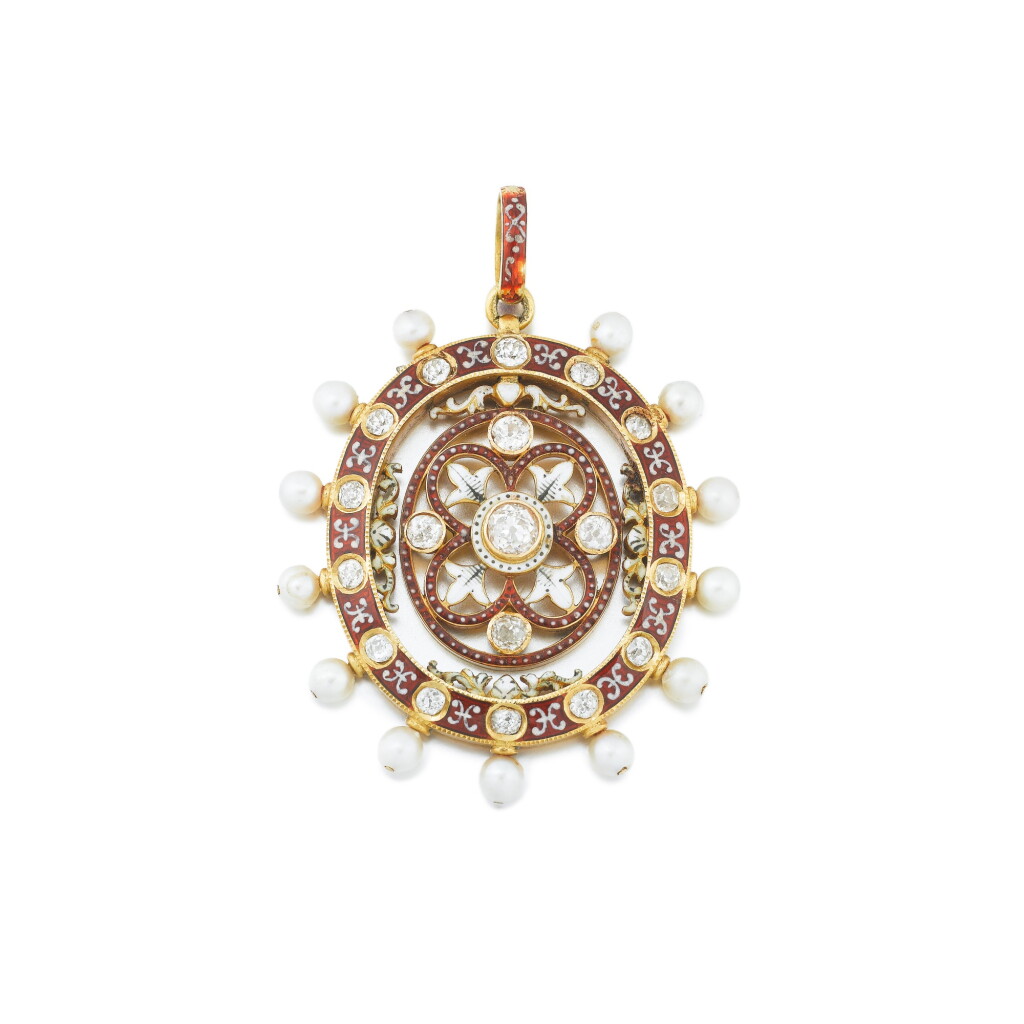
Emanel, pearl and diamond pendant
Session begins in
October 8, 08:30 AM GMT
Estimate
8,000 - 16,000 EUR
Bid
7,000 EUR
Lot Details
Description
Of Néo-Renaissance style, composed of two oval medallions, on suspended, embellished with red guilloché enamel and white enamel floral motifs, enhanced by a line of pearls and set with European old mine-cut diamonds.
- Dimensions approximatively 50 x 37mm
- Signed Carlo & Arthur Guiliano
- French import assay mark for 18 carat gold
- Circa 1896
- Gross weight 16.39 grams
- With a fitted case
From the outset of his career, Giuliano drew much of his inspiration from the Renaissance aesthetics and historic goldsmithing techniques. His work, however, was never intended as a simple reproduction of historical models. Instead, he sought to combine centuries-old design traditions with contemporary tastes, creating jewels that appealed to the clientele of the nineteenth century.
In 1867, Giuliano chose to exhibit his creations in Paris at the Exposition Universelle. By 1874, he had established a reputation both as a designer and a craftsman. He subsequently opened his shop at 115 Piccadilly, London, where his creations were typically signed with the simple monogram “CG”.
Among the most distinctive features of his work are the diamond-shaped pendants adorned with intricate enamelling. Giuliano was particularly renowned for the exceptional quality of his enamel work and the refinement of its execution.
His clientele soon included some of the most prominent figures of the period. In the late nineteenth century, he notably attracted the attention of the British Royal Family. In 1877, Queen Victoria commissioned a necklace for her goddaughter’s wedding, incorporating a gold profile of the Queen surrounded by gemstones and enamel. The pendant is now featured at the Victoria and Albert Museum.
According to a widely accepted belief, following the death of Prince Albert, Giuliano was also commissioned to create a mourning jewel featuring black and white enamel.
Upon his death in 1895, the firm became known as Carlo & Arthur Giuliano. Thereafter, the pieces produced by the house bore a mark incorporating the initials of Carlo Giuliano’s two sons.
Today, Giuliano's creations can be found in the collections of both the Metropolitan Museum of Art, New York, and the Victoria and Albert Museum, London.