Forty Highlights from the Stock of Richard C. Ramer Old & Rare Books
Andrade, Manoel Carlos de | The most important Portuguese book on equestrianism
Lot Closed
June 25, 06:03 PM GMT
Estimate
4,000 - 6,000 USD
We may charge or debit your saved payment method subject to the terms set out in our Conditions of Business for Buyers.
Read more.Lot Details
Description
Andrade, Manoel Carlos de
Luz da Liberal, e Nobre Arte da Cavallaria. Lisbon: por ordem de Sua Magestade regina officina typographica, 1790
Folio (330 x 225 mm). Frontispiece engraved portrait of Prince D. Joao of Brazil, woodcut engraved royal arms of Portugal pasted to title-page, initials, vignettes, 93 plates, 23 folding; small tear to lower margins of ****1, repair on V1 with no loss of text, plate 2 foxed with a few tears, open diagonal tear to 2C affecting a few letters, a few gatherings nearly detached from spine, dampstaining and light foxing predominately to margins not affecting text. Mid-nineteenth century tree sheepskin, smooth spine with gilt bands, gilt-lettered dark green morocco label and repat decoration in gilt, marbled endpapers, edges sprinkled brown; joints cracked but holding, cover with a few scuffs, wear to extremities, endpapers foxed and with dampstains to lower margins.
First edition of the most important Portuguese book on equestrianism.
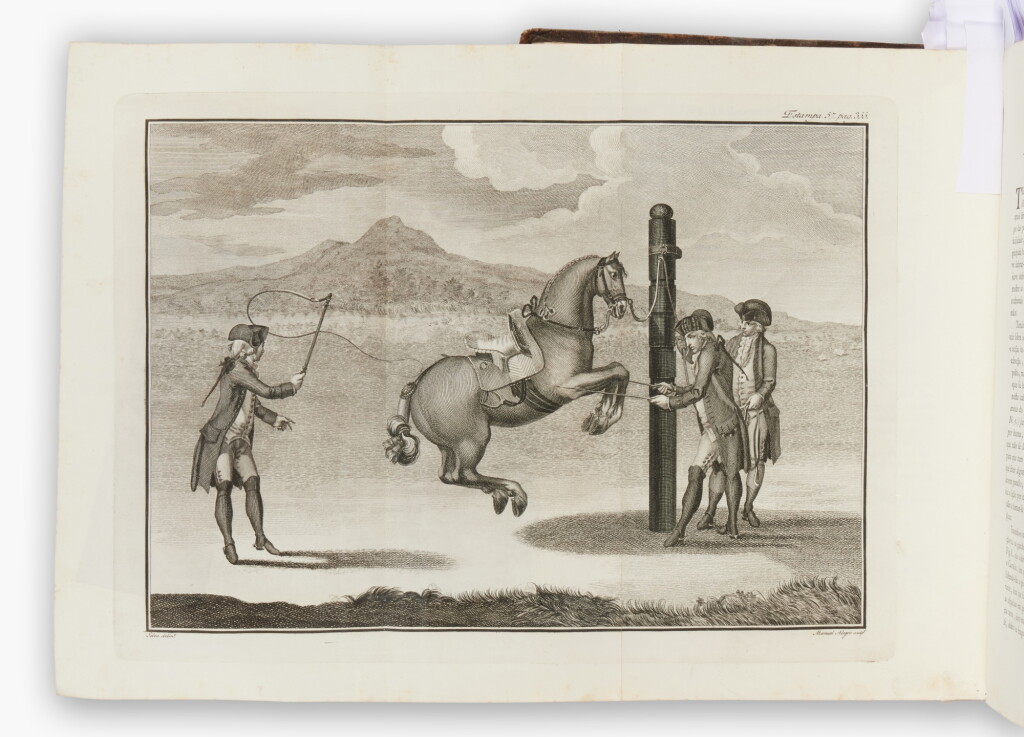
Commissioned by Queen Maria I of Portugal, Luz da Liberal was limited to 1,000 copies, of which 200 were offered for sale. Numerous plates depict future King João VI as a young prince and various courtiers tending, training, and exercising their horses in rich detail. This handsome work features the engravings of Joaquim Carneiro da Silva, Gaspar Fróis Machado, Manuel Alegre, Luiz Fernandez Piedra, Pietro Martini and Gregório de Queiroz. Luz da Liberal is visual treasure, not because of its intricate illustrations but of the text's use as a teaching aid — showing various stages of training and equipment.
There would be an elevated interest Portuguese equestrianism amongst the royal and noble classes during the 18th century. The Real Academia Equestre da Corte (Royal Equestrian Academy of the Portuguese Royal Court) would begin during the reign of King João V. It would be the 4th Duke of Marialva and resident trainer, who would establish a founding element of Portuguese equestrianism still practiced today: Arte Marialva (Marialva tradition). This tradition, known for its lightness is depicted within the present work in various plates. Authorship of the present work, has also been at times attributed to Marialva. The Real Academia would later become the Portuguese School of Equestrian Art, one of the foremost classical riding academies in the world.
REFERENCES
Ameal 108; Avila Perez 202; Brunet I, 264; Imprensa Nacional 416; Innocêncio V, p. 386; Palha 489; Soares, Historia da gravura artística em Portugal I, 304 and II, 575-87; Torrecilla, Bibliografia hipica, 25; "Arte de Marialva: One of the true treasures of Portugal." Cielo Azure Lusitanos, 26 June 2017,https://www.lusitanostud.com/blog/2017/6/26/arte-de-marialva-one-of-the-true-treasures-of-portugal. Accessed 13 May 2026.
You May Also Like