
Victor Servranckx
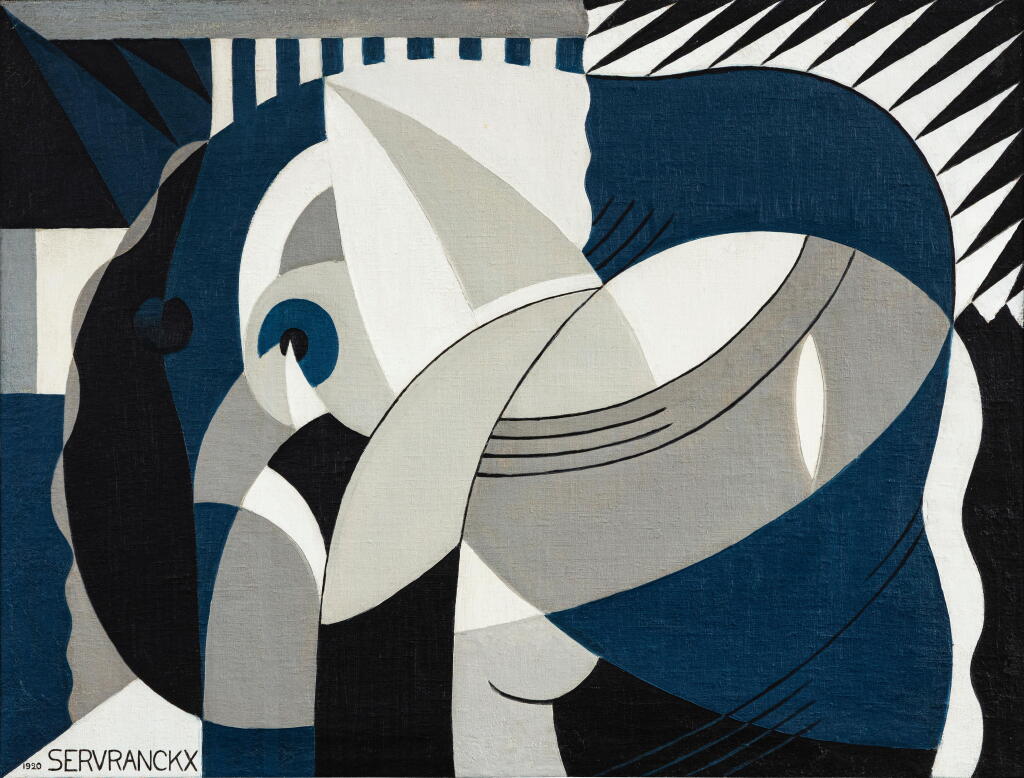
Opus 1b or Je caresse les chevaux des femmes
Auction Closed
June 3, 04:56 PM GMT
Estimate
100,000 - 150,000 EUR
Lot Details
Description
Victor Servranckx
1897 - 1965
Opus 1b or Je caresse les chevaux des femmes
signed SERVRANCKX and dated 1920 (lower left)
oil on canvas
50,8 x 66 cm; 20 x 26 in.
Executed circa 1920-22.
The present work will be included in the forthcoming catalogue raisonné of the paintings by Victor Servranckx currently being prepared by Xavier Tricot.
E.L.T Mesens, Brussels
Galerie 1900-2000, Paris
Acquired from the above
Antwerp, Cercle Royal Artistique, Ça Ira, 1923, no. 96
Brussels, Galerie Georges Giroux, Exposition de jeune peinture et jeune sculpture, 1923, no. 182
Brussels, Galerie Royale, Exposition Victor Servranckx, 1924, no. 16
Antwerp, Cercle Royal Artistique, Ça Ira, 1926, no. 23
In the early 1920s, the Belgian art scene underwent a profound period of transformation. Still rooted in figurative traditions, it gradually opened up to the abstract developments emerging across Europe. Within this context, Victor Servranckx established himself as one of the first artists in Belgium to embrace abstraction as a sustained commitment rather than a passing experiment. Alongside Jozef Peeters and Pierre-Louis Flouquet, he developed a new visual vocabulary shaped by a range of influences: the dynamism of Italian Futurism, the clarity of French Purism, the principles of Constructivism, as well as the decisive impact of Theo van Doesburg, whose lectures in Brussels in 1920 proved catalytic.
Trained at the Académie des Beaux-Arts in Brussels, Servranckx met René Magritte there, with whom he maintained a close dialogue in the early 1920s. Their collaboration continued when both worked as industrial draftsmen at the Peter Lacroix factory, culminating theoretically in the 1922 manuscript L’Art pur. Défense de l’esthétique. In it, they articulated a fundamental principle: painting should no longer rely on a recognizable subject, but on the rigorous organization of its elements. Emotion arises from “the arrangement of lines, forms and colours.” While Magritte would soon turn towards Surrealism, Servranckx pursued this logic further, developing a fully constructed and autonomous abstraction.
The present composition offers a particularly compelling example. Curvilinear forms and interlocking volumes are articulated with precision. The line, supple and continuous, structures the space without resorting to the strict orthogonality of De Stijl. Nothing refers directly to the visible world; everything follows an internal logic. Rather than translating reality, Servranckx constructs his own visual language, based on “the capture of forms that are not realistic but are perfect and true” (Joos Florquin, En Huize van... Gesprekken met Victor Servranckx, Louvain, Davidsfond, 1969, p. 207-22)
Within this framework, titles and dates function less as descriptive tools than as markers of artistic intent. The coexistence of the title Je caresse les chevaux des femmes, inscribed on the reverse, and Opus 1b reflects this duality. The former introduces a poetic, almost free association, while the latter aligns with Servranckx’s usual practice of neutral designations, intended to avoid directing interpretation. The work is not conceived to be understood through a subject, but to be apprehended through its formal organization.
The dating follows a similar logic. As with several works from this period, Servranckx later altered the inscribed year, backdating compositions executed around 1921–1922 to circa 1920. This deliberate reworking of his own chronology—likely motivated by a desire to assert a pioneering role in Belgian abstraction—has since complicated the precise dating of his oeuvre. The present work can nevertheless be situated with consistency between 1920 and 1922, at the height of his most innovative phase.
Formerly in the collection of E. L. T. Mesens, a major figure of the Belgian avant-garde, this work stands both as a synthesis of European influences and as the assertion of a singular voice. It reflects Servranckx’s ambition to construct an autonomous visual language, liberated from the visible yet grounded in a rigorous pursuit of balance and precision. Long under-recognized, this position is now fully acknowledged, as evidenced by the presence of his works in major international institutions such as the Museum of Modern Art in New York, the Centre Pompidou in Paris, and the Museo Thyssen-Bornemisza in Madrid.