
Victor Brauner
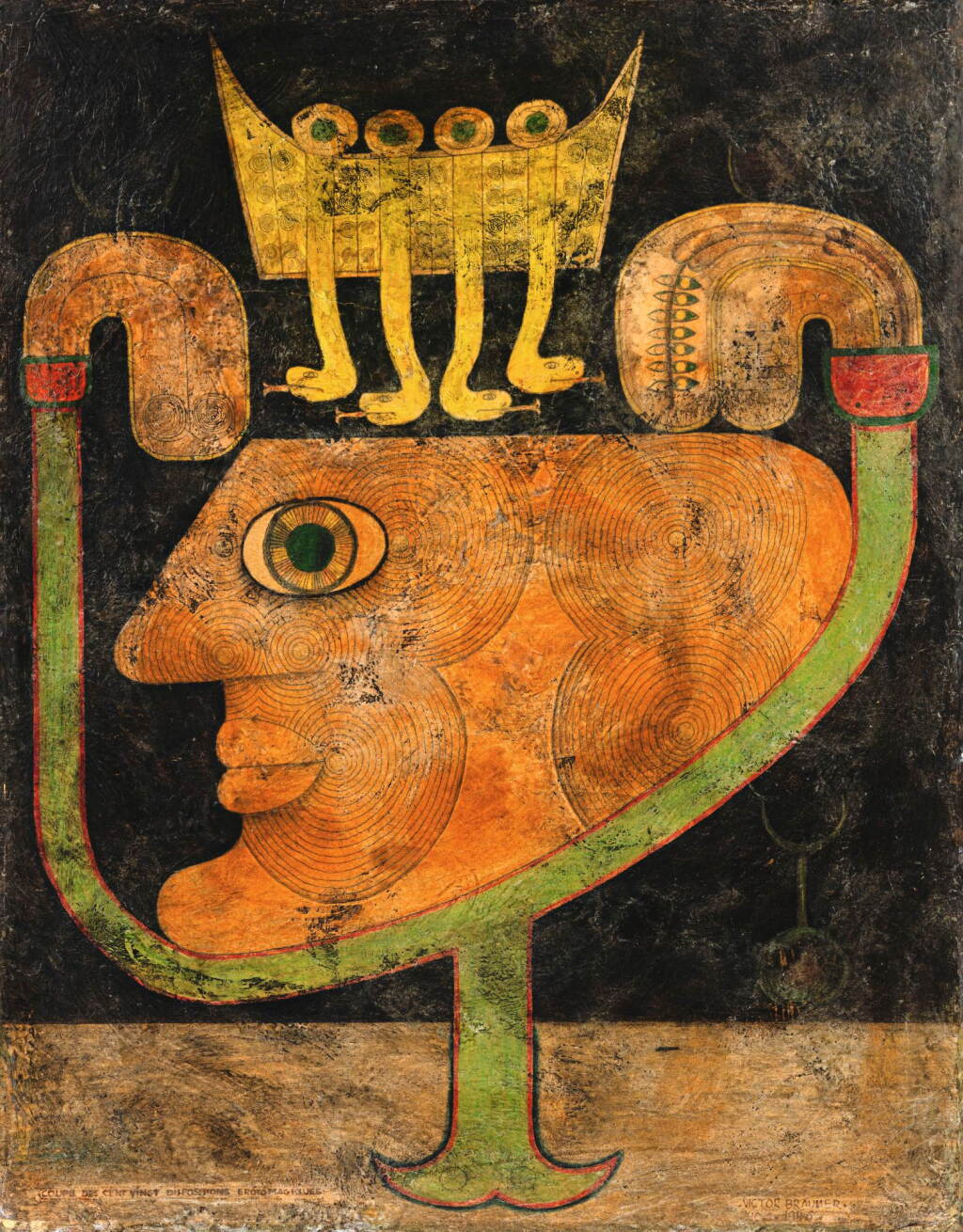
Coupe des cent-vingt dispositions érotomagiques
Auction Closed
June 3, 04:56 PM GMT
Estimate
350,000 - 450,000 EUR
Lot Details
Description
Victor Brauner
1903 - 1966
Coupe des cent-vingt dispositions érotomagiques
signed .VICTOR BRAUNER., dated .10.2.1946. (lower right); titled COUPE DES CENT VINGT DISPOSITIONS EROTOMAGIQUES (lower left); signed VICTOR BRAUNER and titled COUPE DES CENT VING DISPOSITIONS ERETOMAGIQUES (on the reverse)
wax on panel
68 x 53,5 cm; 26¾ x 21 in.
Executed on February 10th, 1946.
Samy Kinge has kindly confirmed the authenticity of this work.
Mrs. Stassar, Paris
Private Collection, Europe
Sotheby's, New York, 2 May 1996, lot 305 (consigned by the above)
Acquired at the above sale
Lausanne, Fondation de l’Hermitage, Victor Brauner ou l’enchantement surréaliste, 1999, no. 41, illustrated in colour on the cover of the catalogue and p. 71
Paris, Musée d'Art Moderne de la ville de Paris, Victor Brauner. Je suis le rêve. Je suis l'inspiration., 2020-21, no. 125, p. 243, illustrated in colour
Judith Benhamou-Huet,"Brauner: le surréaliste oublié" in Les Echos, 8 October 1999, accessed online (https://www.lesechos.fr/1999/10/brauner-le-surrealiste-oublie-777971)
Painted in 1946, Coupe des cent-vingt dispositions érotomagiques belongs to the series of wax works that Victor Brauner developed throughout the 1940s. Born in Romania, the artist left his native country at an early age to lead an itinerant life across Europe. He settled permanently in Paris in 1938, shortly before being forced to flee the capital during the Second World War. In this troubled context, Victor Brauner found himself in an especially precarious situation: an avant-garde artist, Jewish and foreign, he took refuge in the Hautes-Alpes in April 1942, where he lived in hiding for nearly three years. Unable to emigrate to the United States, unlike many of his contemporaries, he led a withdrawn existence under conditions of extreme austerity.
The shortage of traditional materials led him to experiment with alternative supports and media, notably candle wax and later beeswax, which opened up new formal possibilities within his practice. Marcel Jean described the process as follows: "Unable to obtain oil paint, he created wax paintings by spreading a thin layer of melted candle grease onto canvas or cardboard, then engraving a drawing into the surface, later accentuated with soot-black; the forms themselves were coloured with lightly glazed tones." (Marcel Jean, The History of Surrealist Painting, London, 1960, p. 333). Beyond their practical necessity, these materials allowed for unprecedented surface effects achieved through incision, evoking certain contemporary experiments by Jean Dubuffet. In this context of enforced withdrawal, the use of wax also acquired a spiritual and fantastical dimension, lending the work an almost alchemical quality. The result is a body of compositions with rich, vibrant, almost tactile textures.
This composition also demonstrates Brauner's assimilation of formal vocabularies derived from the arts of Indigenous American civilizations. The influence is particularly visible in the element adorned with four serpents in the upper section, as well as in the flattened representation devoid of perspectival depth, recalling Mesoamerican codices. Marcel Jean described this visual universe in the following terms: "more cabalistic than kabbalistic, and revealing (perhaps unintentionally) the 'spiritualist' memories of his childhood, Brauner's wax paintings borrow their themes from alchemy, tarot, Egyptian drawings and ancient Mexican codices." (ibid., p. 333).
From 1945 onwards, Victor Brauner returned to Paris and settled in the former studio of Henri Rousseau. Marked by years in hiding and persistently difficult living conditions, he enriched his work with techniques and themes drawn from his wartime experiences. Gradually, he reconnected with the Surrealists who had returned from exile, including André Breton, and took part in new group exhibitions.
Painted in 1946, Coupe des cent-vingt dispositions érotomagiques is dominated by a large profile head with graphic, stylized features characteristic of Victor Brauner's work in the 1940s: a full mouth, a pronounced chin, and an elongated skull. The face is surmounted by two long, raised arms, evoking the victorious posture of a boxer. Boxing, a particularly popular sport at the time, appears here as a metaphor for the artist as a free and emancipated figure. This image goes beyond a simple formal reference to assert itself as a statement of resistance and sovereignty, directly reflecting the artist's personal experience; a stance made all the more significant by the fact that Brauner was expelled from the Surrealist movement in 1948.
This iconography of the boxer, as a symbolic projection of the artist in struggle, would find a particularly striking echo several decades later in the work of Jean-Michel Basquiat. In Basquiat's work, the figure of the fighter becomes a recurring motif, employed as a metaphor for the struggle - personal, social, and artistic - that runs through his œuvre. In the work of both Victor Brauner and Jean-Michel Basquiat, this posture transcends a mere reference to sport to become the figure of a conquering and solitary creator, advancing like a scout in the darkness.
Victor Brauner's work thus follows a unique trajectory, marked by esotericism and the development of a language that is at once primitive, symbolic, and magical, in which the human figure serves as a vehicle for a projection that is both internal and universal.