
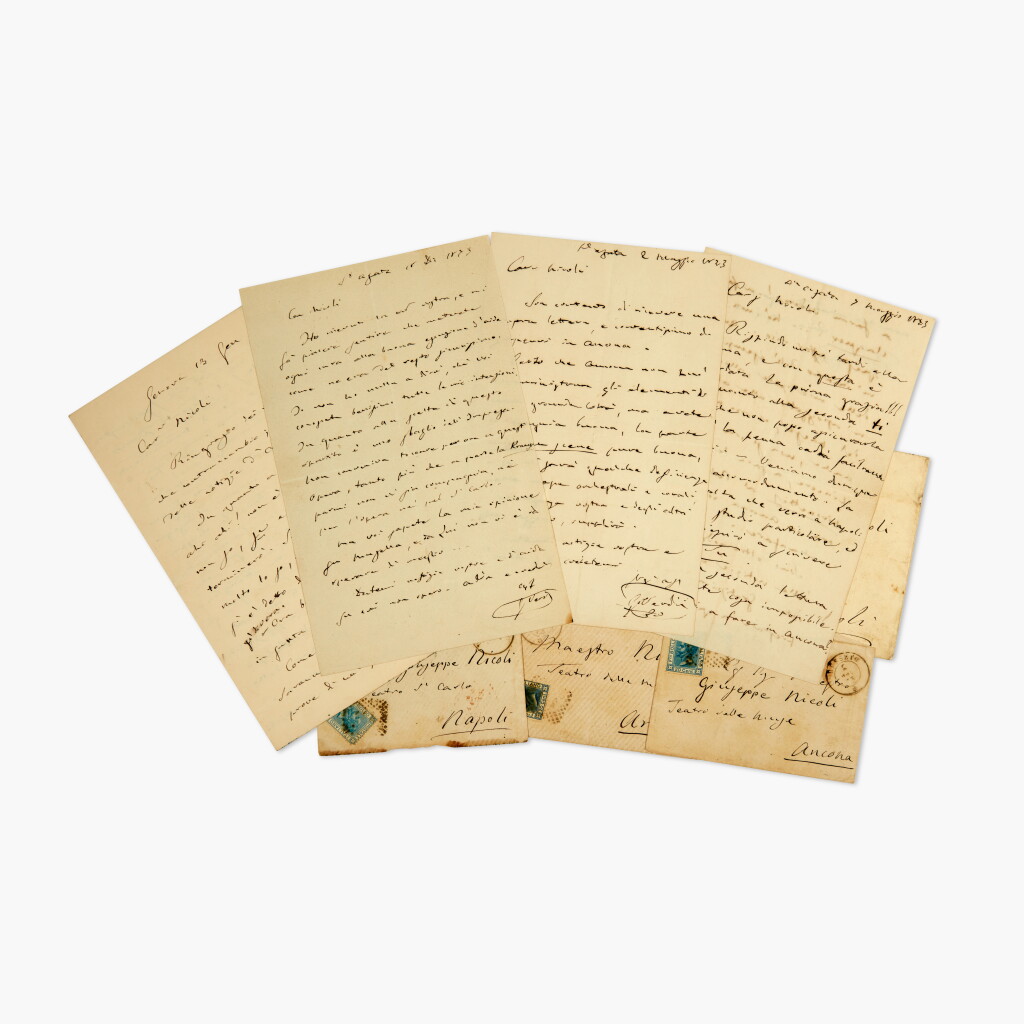
Giuseppe Verdi | Four autograph letters signed, to Giuseppe Nicoli, 1873-1886
Lot Closed
July 9, 01:36 PM GMT
Estimate
4,000 - 6,000 GBP
We may charge or debit your saved payment method subject to the terms set out in our Conditions of Business for Buyers.
Read more.Lot Details
Description
Giuseppe Verdi
Four autograph letters signed (“G Verdi”) to Giuseppe Nicoli, ABOUT AIDA AND OTELLO
i) observing that while Ancona cannot offer him what a great city can, he has a good company there now, and noting that if the size of the orchestra and chorus left something to be desired, his intelligence and that of others with make up for it
"…Certo che Ancona non può somministrare gli elementi d’una grande città, ma avete compagnia buona, la parte mise en scène pure buona, e se si sarà qualche deficienza nelle masse orchestrali e corali, l’intelligenza vostra e degli altri che veggono, supplirà…"
1 page, 8vo (20.2 x 12.2cm), integral blank, with autograph envelope, modern typed transcription and English translation, Sant’Agata, 2 May 1873, light creasing along folds
ii) MENTIONING AIDA, thanking him for the care he is giving it, humorously declining to come to Ancona to assist, protesting that it is not his way and that he would have nothing to do there (“…Cosa verrei a fare in Ancona? A farmi vedere!..a farmi claquer?...Nò: non è questo affar mio…”), 3 pages, 8vo (20.3 x 12.7cm), with autograph envelope, modern typed transcription and English translation, Sant’Agata, 7 May 1873, light creasing along folds
iii) CONCERNING THE STAGING OF AIDA, informing him that he has nothing to tell him concerning this as he is very familiar with his intentions, referring to the choice of the score as a mistake of the company, adding that he knows his opinion of Musella, and that they could not hope for something better of him, 1 page, 8vo (21 x 13.6cm), integral blank, with autograph envelope, modern typed transcription and English translation, Sant’Agata, 16 December 1875
iv) ABOUT OTELLO AND THE CURRENT STATE OF OPERA, revealing that the opera is no longer called ‘Iago’, explaining that it is not finished and that he does not know when he will complete it, noting that people talk a great deal about it, more than they should, observing that if somebody does not want to wake up he should be allowed to sleep in peace; in the body of the letter Verdi offers his opinion on the present operatic scene, stating that even if these current works are full of errors they have been written by men of talent who know how to make music, adding that they must listen to them without prejudice, and the artists perform them with all imaginable conscientiousness, concluding that if [the modern] genre is good then no amount of antipathy or opposition will check its progress, but that if it is bad we need to realize this fully in order to make a judgment and to know where we stand
"…Saranno forse incominciate le prove di un’opera, che secondo Voi appartiene (son vostre parole) al presente periodo artistico, irto di travimenti e negazioni? – Non discutiamo. Sieno pure traviamenti, è certo che sono produzioni d’uomini d’ingegno, e che sanno bene la musica. Noi non possiamo ancora giudicarli, noi non abbiamo a far altro, che ascoltarli con attenzione, e senza prevenzione…"
3 pages, 8vo (21 x 13.4cm), with autograph envelope, modern typed transcription and English translation, Genoa, 13 January 1886, creasing along folds
A good group of letters concerning two of Verdi’s greatest works. Verdi’s Aida was premiered at Cairo in 1871, its first performance in Italy taking place the following year. The 1873 staging of the work in Ancona represented part of the early, swift spread of the opera’s success in Italy. By January 1886 Verdi was in the closing stages of the composition of his great tragic operatic swansong, Otello, which would receive its first staging at La Scala, Milan, on 5 February 1887.
LITERATURE:
Not in the Copialettere