
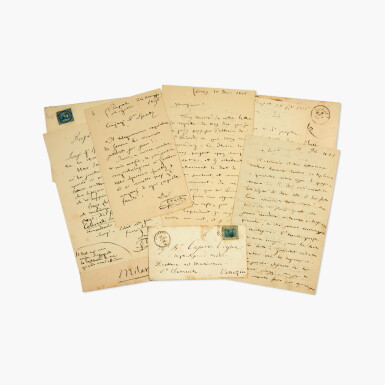
Giuseppe Verdi | Five autograph letters signed, including to Cesare Vigna, Hans von Bronsart and Giuseppe Spatz, 1875-1897
Lot Closed
July 9, 01:37 PM GMT
Estimate
5,000 - 6,000 GBP
We may charge or debit your saved payment method subject to the terms set out in our Conditions of Business for Buyers.
Read more.Lot Details
Description
Giuseppe Verdi
Five autograph letters signed (“G Verdi”), including to Cesare Vigna, Hans von Bronsart and Giuseppe Spatz
i) probably to his agent Mauro Corticelli
written in a characteristically sarcastic manner, remarking on the quite unnecessarily voluminous packet he had received, making him expect to find inside it a diploma or something equally grand, rather than such a useless letter, commending him on enriching the Italian Post Office by putting ten stamps in it, wishing rather that he employed his much-vaunted skills as a man of affairs in securing better deals with the doctor, local traders, the house staff, stable-boys etc, to all of whom he allows far too much leeway, so that they look quizzically at him asking "why do you let your manager act like this?"; Verdi asks him to reply by simply sending a telegram, informing him whether the works are suspended and if the weather is still cold, which would be more helpful than his last telegram saying "Letter received and understood"
"...tu sembri edificato dei tuoi frequenti viaggi, ma se tu avessi saputo fare per esso ribassare il prezzo al Cremonese, o le idee a Barattieri, allora ne vedrei anch'io l'utilità...perchè questa gente non può a meno di dire "Infine il uomo d'affari tratta come Lui?!"...Cosa it pare? Di questo riparleremo!..."
3 pages, 8vo (21 x 13.6cm), modern typed transcription and English translation, no place, 16 February 1875, light browning and very light spotting
ii) to Cesare Vigna, ABOUT A PRODUCTION OF AIDA IN VENICE
observing that the impresario Antonio Gallo has been losing money, opining that an impresario's job is one that requires "know how" and that the best time to have staged Aida in Venice was soon after its Italian premiere in Milan, pointing out that Gallo had the means to mount it then but lacked the courage to do so
"...Il momento di dare Aida a Venezia era subito dopo che venne eseguita a Milan. Allora era il momento, e Gallo poteva farlo! Io glielo consigliai, ma...aveva allora paura!..."
2 pages, 8vo (21 x 13.2cm), integral blank, with autograph envelope, modern typed transcription and English translation, stamped and postmarked, Busseto, 28 July 1876, staining to lower margin
iii) in French, to [Hans von Bronsart,] Intendant of the Opera House in Weimar
informing him that he cannot agree for one of his operas to be staged in Weimar because the performance rights belong to the Ricordi, who will not easily cede them to Bronsart and promising to approach the publisher on his behalf
"...En Italie les Editeurs payent assez cher mes operas, et ils achètent naturellement le droit de les exploiter partout, et comme il leur convient. Je ne voudrais pas que Mr Ricordi pût me faire une observation tres juste du reste 'sur ses droits'..."
2 pages, 8vo (21 x 13.4cm), with autograph envelope, stamped and postmarked ("Monsieur le General Intendant des Theatres etc…Veimar"), Genoa, 10 February 1888, splitting slightly along horizontal fold, slight staining to outer edge of integral
iv) to Giuseppe Spatz and his new wife ("Conjugi Ssri Spatz")
sending them his and his wife Giuseppina's sincere felicitations for their nuptials, congratulating the girl's parents, and wishing them all the best for their future happiness ("...le più sentite congratulazioni ai Genitori della Signorina Spatz, ed ai novelli sposi gli augurj di ogni possibile felicità..."), explaining that he has only just received their telegram forwarded from Genoa, 1 page, 8vo (17.8 x 11.4cm), integral blank, with autograph envelope, ("Conjugi Ssri Spatz, Hotel Milan, Milano"), modern typed transcription and English translation, Busseto, “Sa Agata", 24 May 1896, horizontal fold
v) to Giuseppe Spatz, asking to leave the enclosed certificate [not included here] with the concierge of the hotel, to be retrieved by the owner Oreste Colonelli ("...Scusi Sgr Spatz della noja che le reco. Uno dei soliti etc... m'ha scritto al Hotel Milan quand io ero partito, che bisogna restituire, senza che io sappia ove indirizzarlo..."), 1 page, 8vo (21 x 13.4cm), with autograph envelope, modern typed transcription and English translation, Busseto, 7 September 1897, some very light spotting
Mauro Corticelli was a theatrical agent, working for Adelaide Ristori, who became very friendly with Giuseppina Strepponi. She hired him as estate manager at Sant'Agata during 1867-1879, but the composer never respected or trusted him, and with good reason as it transpired. See F. Walker, The Man Verdi (1962), pp.273, 444 & passim.
Cesare Vigna and Antonio Gallo were Verdi's greatest supporters in Venice. The first edition of La Traviata was dedicated to Vigna, who had been involved in Gallo's successful second production of the opera at the Teatro San Benedetto on 6 May 1854, following its celebrated failure at La Fenice in 1853. By profession, Vigna was a physician specialising in mental illness.
Liszt’s pupil Hans von Bronsart (1830-1913) was General Intendant at the Court Theatre in Weimar from 1887-1895.
Giuseppe Spatz was the opera-loving director of the Grand Hotel, Milan. Verdi was a frequent resident and in fact died there on 27 January 1901.
LITERATURE:
Not in the Copialettere