
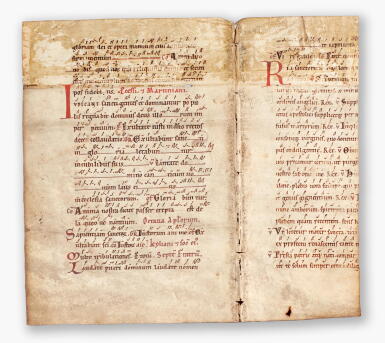
A partial bifolium from a Gradual (Sanctorale) with St Gall neumes, on vellum, in Latin, (Germany, possibly Franconia or Bavaria), mid-11th century
Lot Closed
July 9, 12:17 PM GMT
Estimate
2,000 - 3,000 GBP
We may charge or debit your saved payment method subject to the terms set out in our Conditions of Business for Buyers.
Read more.Lot Details
Description
A partial bifolium from a Gradual (Sanctorale) with St Gall neumes
on vellum, in Latin, (Germany, possibly Franconia or Bavaria), mid-11th century
304 × 272 mm; a partial bifolium from a Gradual (Sanctorale), written in a Carolingian minuscule in brown and black ink with interlinear neumes, 20 lines of text, three large red initials (3 lines high), and red rubrication denoting the different parts of the liturgy, 20 lines of text and adiastematic neumes (heightened); fragment cut to shape for use as a pastedown, the upper fifth discoloured from having been glued down.
AN ATTRACTIVE FRAGMENT FROM A GERMAN GRADUAL, PRESERVING CHANTS IN THE ST GALL TRADTION OF EARLY MUSICAL NOTATION
PROVENANCE
1. Made for a German monastery, probably in Franconia or Bavaria, in the mid-11th century, as suggested by the script, the St Gall type neumes, and the inclusion of the feasts of Saint Processus and Saint Martinianus and especially Saint Kilian, who was particularly revered in Würzburg, Franconia, eastern Francia, and the wider Bavarian ecclesiastical sphere.
COMMENTARY
This fragment is a fine witness to the proliferation of St Gall style neumatic notation within the wider eastern Frankish region, which included centres such as St Gall, Reichenau, Regensburg, Salzburg, Würzburg, and, later, Bamberg. Though clearly influenced by the St Gall tradition, the manuscript was almost certainly not produced in the St Gall scriptorium itself, but rather in a regional monastic centre in the sphere of influence of St Gall.
The notation is adiastematic, recording melodic rise and fall without fixing the exact pitch. The St Gall tradition is set apart from other early musical notational systems as it recorded not only basic neumes but additional information that conveyed nuances of rhythm, the sound of particular consonants, vocal inflection, and delivery. It was an ingenious system of capturing music before a standardised framework was agreed and bridged the gap between oral knowledge transmission and codification. This distinguished St Gall neumes from other regional neumatic scripts.
Medieval Europe did not have one single system of chant notation, but a plethora of local “dialects.” Some traditions — like the French notations, e.g. Messine, Breton, and Aquitanian — often broke melodic movement into more visibly distinct steps on the page. By contrast, St Gall notation tended to preserve neumes more compact, rather than separating them into graphical units. The result is a notation that appears fluid and calligraphic — a singer’s memory manifested on the page.
The neumes are regular and carefully formed, with fluid calligraphic curves and slightly right-leaning virgae, features characteristic of the St Gall family of notation. The long red horizontal separators are also typical of Germanic liturgical manuscripts. The musical notation is applied crisply and confidently, revealing the work of a practised and competent scribe belonging to a solid regional monastic production.
The text belongs to an abbreviated monastic Sanctoral gradual, or local excerpt collection, arranged for the celebration of particular saints’ feasts. Especially significant is the presence of St Kilian, whose prominence helps to localises the manuscript within the sphere of Franconia and eastern Francia. In doing so, the fragment offers valuable evidence both for regional chant transmission and for the adaptation of the St Gall notational model beyond its original institutional centre.
TEXT
The fragment encompasses portions of a Sanctorale Gradual containing chants for the feasts of Saint Processus and Saint Martinianus (2 July), the Octave of the Apostles, Saint Kilian and his companions (8 July), and the Seven Brothers (Septem Fratres).
SCRIPT AND MUSIC
The text is written in a regular Carolingian minuscule of the mid-11th century. The letterforms include a closed g, a consistently single-compartment a, and the use of both the Tironian note and the ampersand for et; u appears both in rounded form and as v. The script also preserves the e-caudata, a feature of chronological importance, since this form is generally replaced by the simple e in the 12th century. Together, these characteristics support a date in the mid-11th century.
The musical notation belongs to the adiastematic St Gall family of the East Frankish/Alemannic type. As such, it does not indicate exact pitch, but rather the movement and contour of the chant. The notation’s clear execution, slightly slanted virgae, and rhythmic visual articulation fit with the broader eastern Frankish tradition of chant books transmitted through monastic centres in southern Germany and adjacent regions.
With its clean notation and decorative red separators, the leaf is a beautiful example of a Franconian take on the St Gall tradition of musical notation.
LITERATURE
Floros, Constantin. The Origins of Western Notation. Revised and translated by Neil Moran. New York: Peter Lang, 2011.
University of Basel. “Close-up on St Gall Neumes.” In From Ink to Sound: Early Forms of Musical Notation. Accessed June 18, 2026.
University of Basel. “Notational Systems: The Chart of Neumes.” In From Ink to Sound: Early Forms of Musical Notation. Accessed June 18, 2026.