
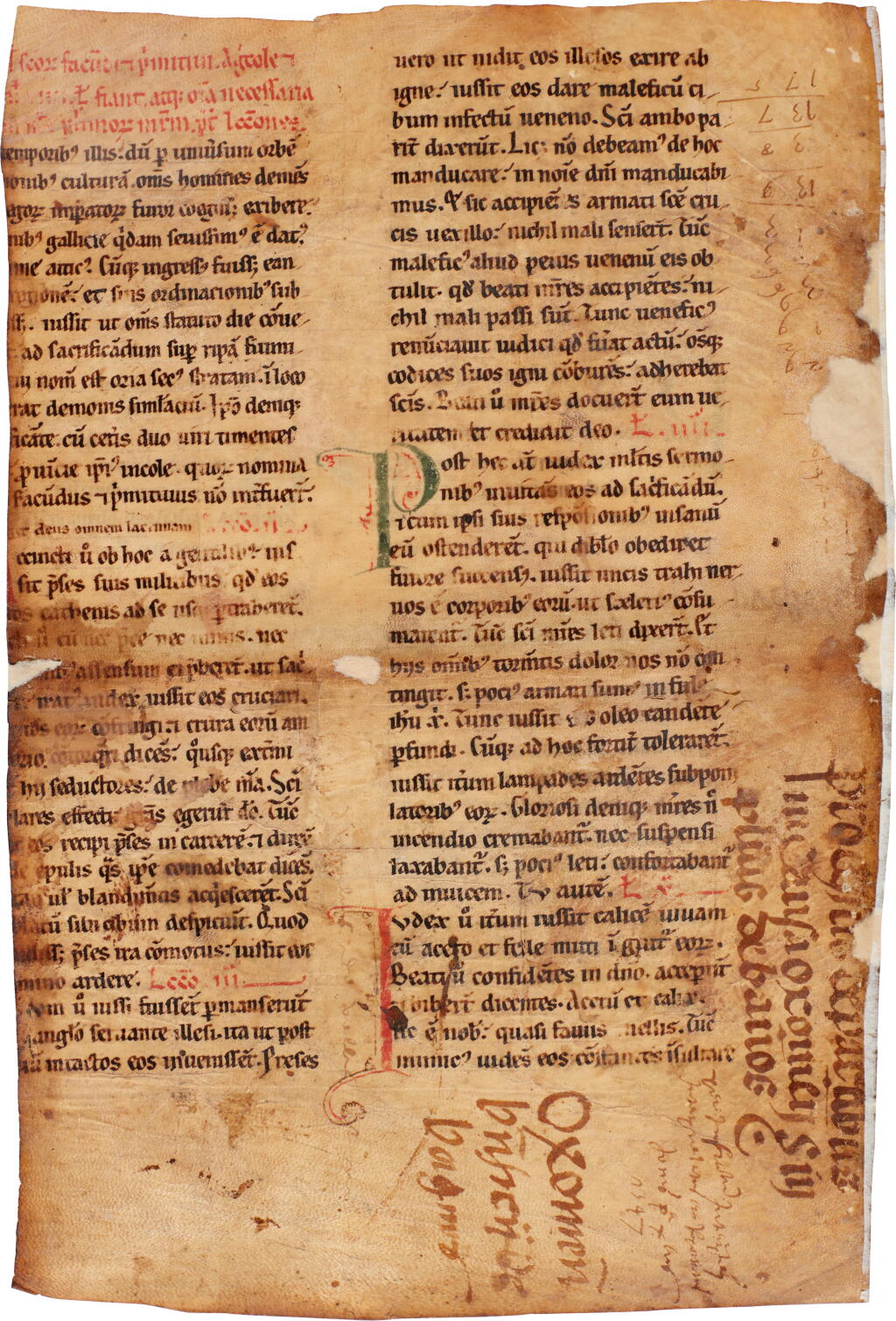
A leaf from a noted Breviary, on vellum, in Latin, (northern Spain or southern France), late 12th century
Lot Closed
July 9, 12:17 PM GMT
Estimate
2,000 - 3,000 GBP
We may charge or debit your saved payment method subject to the terms set out in our Conditions of Business for Buyers.
Read more.Lot Details
Description
A decorated leaf from a noted Breviary
on vellum, in Latin, (northern Spain or southern France), late 12th century, c.442 × 294 mm; 2 columns of 26 lines written in a handsome Romanesque script of two sizes, blind-ruled, staffless diastematic (heightened) neumes, rubrics in red, initials in green with red penwork infill or red with brown infill; used as a wrapper and consequently with a horizontal crease across the middle, some staining, outer margin cropped, modern vellum repairs.
A LARGE, HANDSOME LEAF FROM A MANUSCRIPT PRODUCED IN THE CULTURAL BORDER REGION OF SOUTHERN FRANCE AND NORTHERN SPAIN
PROVENANCE
1. The inclusion of the Feast of St Saturninus, first Bishop and patron saint of Toulouse, suggests that the parent manuscript may have been produced in or near the Diocese of Toulouse. The hymn transmitted here, beginning Post corporeum salvatoris, also occurs in a contemporary late-12th-century manuscript for the use of Marseilles (Paris, Bibliothèque nationale de France, Latin 1090). At the same time, it is found in two manuscripts of Spanish origin: Barcelona, Biblioteca de Catalunya, MS 619, and Toledo, Archivo y Biblioteca Capítulares, 44.1, copied c. 1020–1023 at Sant Sadurní de Tavèrnoles for Abbot Ponç at the royal court of Sancho the Great. The recto, which contains the feasts of the Spanish saints Facundus and Primitivus, hints at a northern Spanish provenance.
2. In the 16th century, the leaf was reused in northern Spain as the wrapper for an account book. Inscriptions on the recto of the leaf (the verso in its bound state) read: Processus de partibus in causa oxomen sin/plius de baños and again Oxomensis beneficii de bagnos; above the second inscription, a different hand has added the date 1 December 1547. These references point to the Diocese of Osma, in northern Spain, within the ecclesiastical province of the Archdiocese of Burgos. Baños is most probably Baños de Valdearados, a town approximately 50 km from Osma. The manuscript evidently served as a wrapper for a document recording benefices granted to the Diocese of Osma by the town of Baños. This is confirmed by an entry in the Index Decisionum of the Diocese of Osma, cited in G. B. Cantalmaggi, Selectanea rerum notabilium ad usum decisionum Sacrae Rotae Romanae (1639), p. 208: Beneficii de Bagnos 27. Ianuarii & 1. Februarii 1548. Put. dec. 94. lib. 3.'
3. Dr Gian Ludovico Mazza, Rome, acquired in 1989 by:
4. Schøyen Collection, MS 254.
COMMENTARY
This large leaf is a fine witness to the use of staffless diastematic neumes (heightened) in the cultural intersection between southern France and northern Spain in the late 12th century. These neumes registered the relative rise and fall of melody without providing the exact pitch on a ruled staff. This notational system belonged to an important early transitional stage in the history of Western musical notation, which preserved not only the text of the liturgy but also traces of its performance, bridging the gap between oral transmission and written codification.
The parent manuscript was likely produced in the rich cultural area between the Pyrenees and southern France. The presence of the Feast of St Saturninus, first Bishop and patron saint of Toulouse, suggests an origin in or around that diocese, while the hymn beginning Post corporeum salvatoris can be found in contemporary manuscripts associated with Marseilles and with Spanish use. The feasts of the Spanish saints Facundus and Primitivus point towards a northern Spanish origin. Later reused in the 16th century as a wrapper for documents connected with the Diocese of Osma, the leaf embodies the long and varied afterlife of medieval manuscripts.
TEXT
The text begins on the verso, as currently bound, with the readings for the Feast of Facundus and Primitivus, Agricola and Vitalis on 27 November: [...] Sanctorum Facundi et Primitivi Agricole & [Vita]lis and concludes on the recto in the Feast of St Saturninus, Bishop of Toulouse (29 November): Apostolica jussione Saturninus vir clar[issimus] cum authoritate pontificali verbi divini se[mina sumens].
SCRIPT AND MUSIC
The text is written in a handsome Romanesque script, a transitional bookhand that developed out of Caroline minuscule, exhibiting aspects of the Gothic minuscule. Over time, the rounded and spacious forms of Caroline writing gradually gave way to narrower, more angular, and more vertical letterforms.
Here, the letters remain broadly oval in aspect, while the minims terminate in slight upward turns of the pen, features Michelle Brown identifies as typical of Continental manuscripts.
LITERATURE
Brown, Michelle. A Guide to Western Historical Scripts from Antiquity to 1600, 1990, pp. 72–73.
Floros, Constantin. The Origins of Western Notation. Revised and translated by Neil Moran. New York: Peter Lang, 2011.