
Property from an English Private Collection
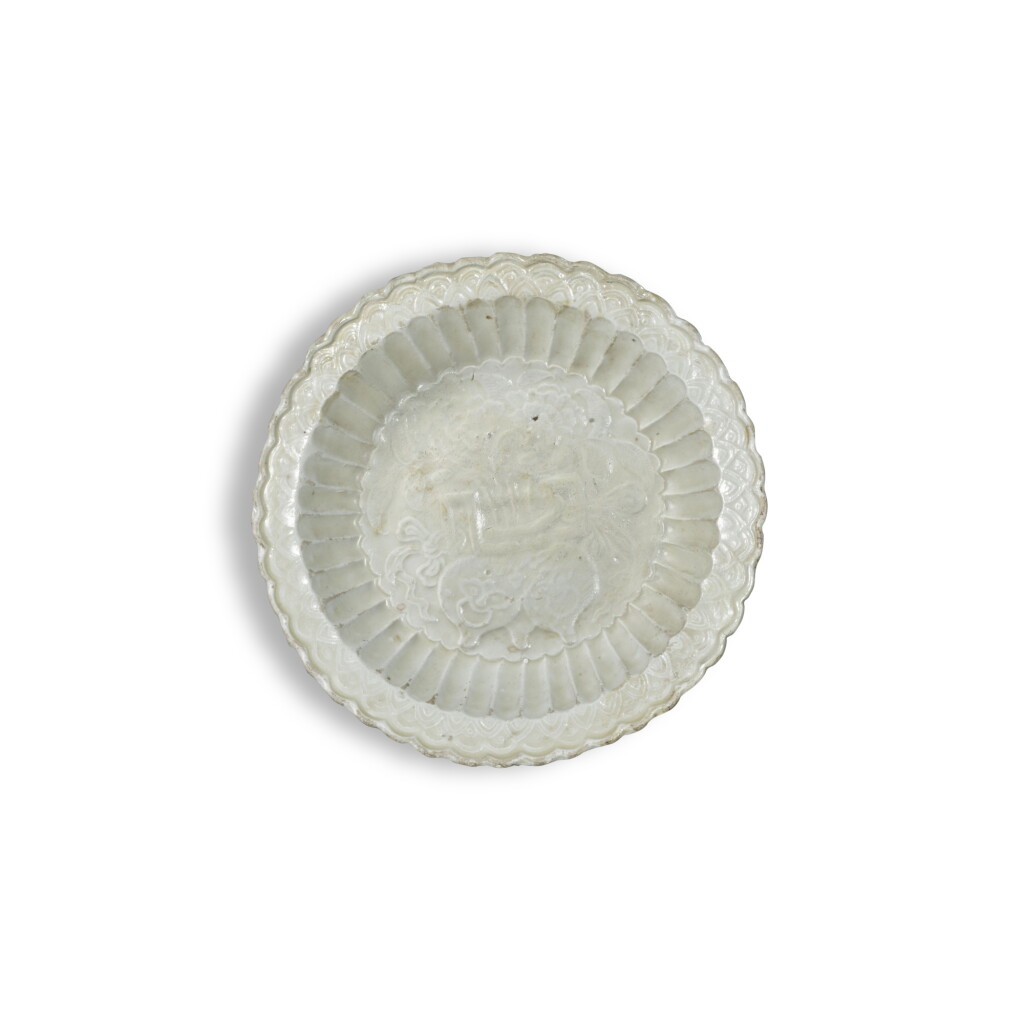
A rare moulded 'Ding' 'flower vessel' dish, Jin dynasty
Lot Closed
May 15, 01:15 PM GMT
Estimate
6,000 - 8,000 GBP
We may charge or debit your saved payment method subject to the terms set out in our Conditions of Business for Buyers.
Read more.Lot Details
Description
Diameter 14.2 cm, 5⅝ in.
Collection of W. Somerset Maugham (1874–1965), acquired before 1939.
Collection of Alan Searle (1905–1985).
Bequeathed to their chauffeur, and thence by descent.
The present dish belongs to a very rare group of vessels produced at the Ding kilns with finely fluted interior sides and flattened lobed rims with a raised edge. Due to their fragility and their being fired upside-down (fashao), very few successfully fired examples of this type survive and are almost all still preserved within the imperial collections. Compare a dish of identical form and design preserved in the Palace Museum, Beijing, in Selection of Ding Ware. The Palace Museum’s Collection and Archaeological Excavation, Beijing, 2012, pl. 120; another slightly larger impressed with a tortoise, crane and flying immortal, pl. 121; and another dish of more generic floral design excavated from a Ding kiln site in Xiheliu, Quyang county, in Ding ci yishu [The art of Ding porcelain], Shijiazhuang, 2002, pl. 150.
Among the most important English writers of the early twentieth century, Somerset Maugham (1874–1965) possessed a particular interest in Chinese works of art. Following a four-month journey to China from 1919 to 1920, Maugham is said to have brought a suitcase of artifacts back to London which, in the following decades, came to fill his residence Villa La Mauresque in the south of France from 1927 until his passing in 1965; see Ray Zhou, ‘Global Modernism Reconsidered: W. Somerset Maugham’s Journey to the East’, PhD Thesis, University of Sydney, 2025, pp 169–170. A portrait of Maugham, at ease in his study at La Mauresque in 1939, depicts the present dish in full view on the author’s desk, evidence of his close personal affection for the piece.