
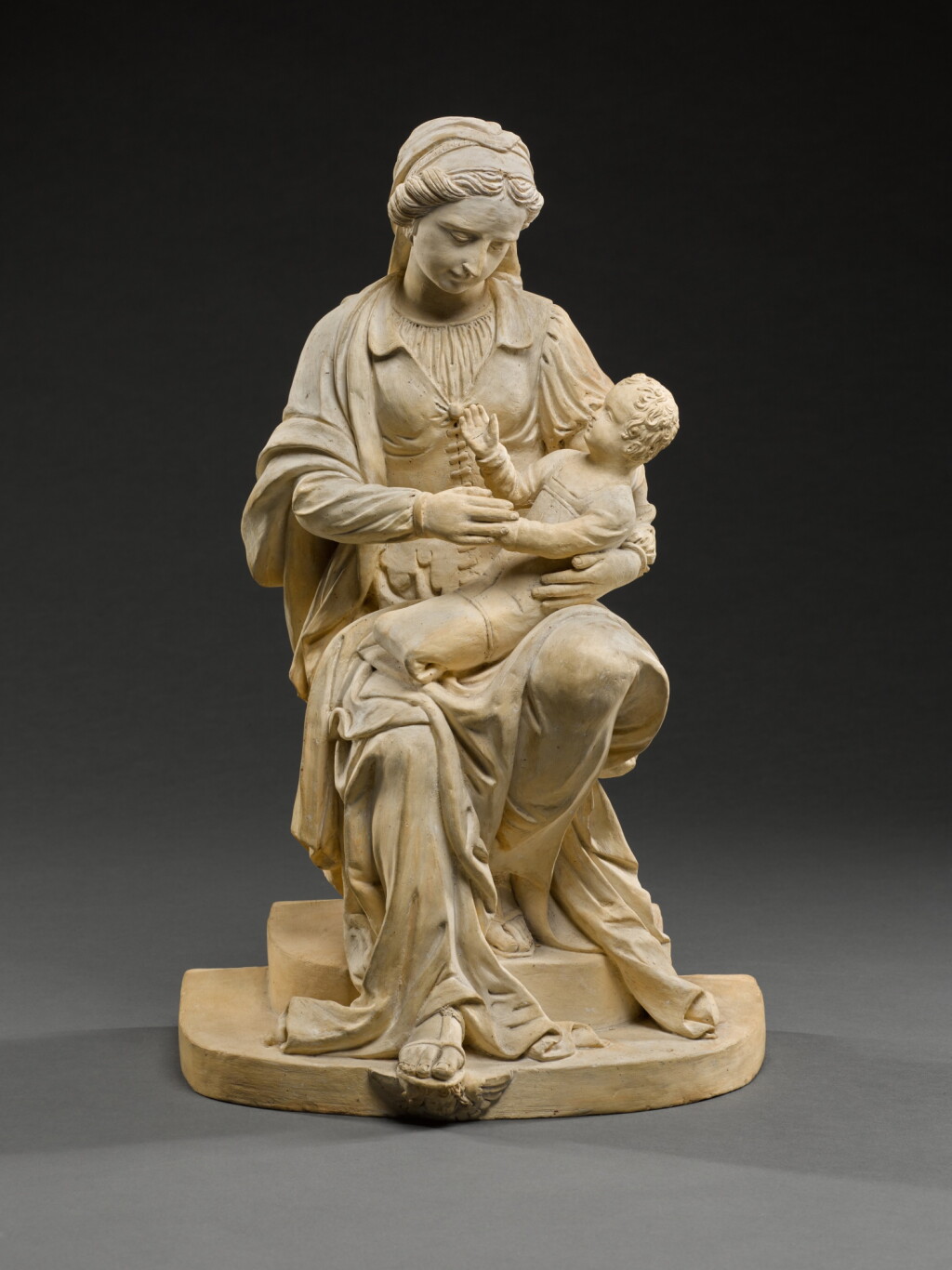
French, Le Mans, 17th century
The Virgin and Child
Auction Closed
June 10, 02:51 PM GMT
Estimate
6,000 - 8,000 GBP
Lot Details
Description
French, Le Mans, 17th century
Follower of Gervais I Delabarre (active 1593-1642)
The Virgin and Child
terracotta
53cm., 20⅞in.
Sale, Sotheby's Paris, 15 June 2021, lot 12
Responding to a growing demand, and to overcome the shortage of stone and wood, the sculptors of the province of Maine turned to the use of terracotta, a material that was readily available locally, in different colours from white to subtle tones of ochre. Taught by Italian sculptors active in the region, local artists mastered a distinctive technique. These sculptures were generally destined for niches, and the modelling to the front is perfectly finished while the back is hollowed out in one or more places.
The emergence of thriving artistic centres in Maine is partly explained by a troubled religious context coupled with destructive events. In addition, the impetus of the Counter-Reformation encouraged a renewal of models and subject matter. The cult of the Virgin was then at its peak and images of her proliferated: the Education of the Virgin, her Marriage, the Annunciation, the Visitation, the Dormition and the Assumption were among the subjects produced in these workshops.
The first workshops to become established in Le Mans at the end of the sixteenth century were characterised by a modified Mannerism. The Virgin and Child by Germain Pilon was the model for a type of representation that would be widely used in the Maine region from 1570, the date it was installed in the Abbaye de la Couture (now Le Mans Cathedral). The most important workshops in the first half of the seventeenth century were those of the Delabarre family, Charles Hoyau and Pierre Biardeau. They were organised in family structures and dominated by dynasties of modellers linked by multiple marriages. The most long-established family business was run by Gervais I Delabarre (circa 1560/1570–1640), who was succeeded by his sons, Gervais II (1603–circa 1650) and Louis (1612–1655), and then by his grandson, François (1629–1688).
Broad planes of drapery envelop the present Virgin, who delicately places her hand on the Christ Child. Her features are incised precisely, with almond-shaped eyes and carefully combed hair. As such, the group is reminiscent of works by Gervais I Delabarre, such as the Seated Virgin nursing the Christ Child in the Musée du Louvre (inv. no. RF 3663).
RELATED LITERATURE
G. Bresc-Bautier, F. Le Boeuf, (eds.), Terre et ciel. La sculpture en terre cuite du Maine (XVIe et XVIIe siècles), Paris, 2003, pp. 97-103; G. Bresc-Bautier, F. Le Boeuf, Belles et inconnues. Sculptures en terre cuite des ateliers du Maine XVIe-XVIIe siècles, Paris, 2002, pp. 10-12; G. Bresc-Bautier, J. Perrin, 'Charles Hoyau, sculpteur du Mans', in Bulletin de la Société d'histoire de l'art français, 1991
You May Also Like


