
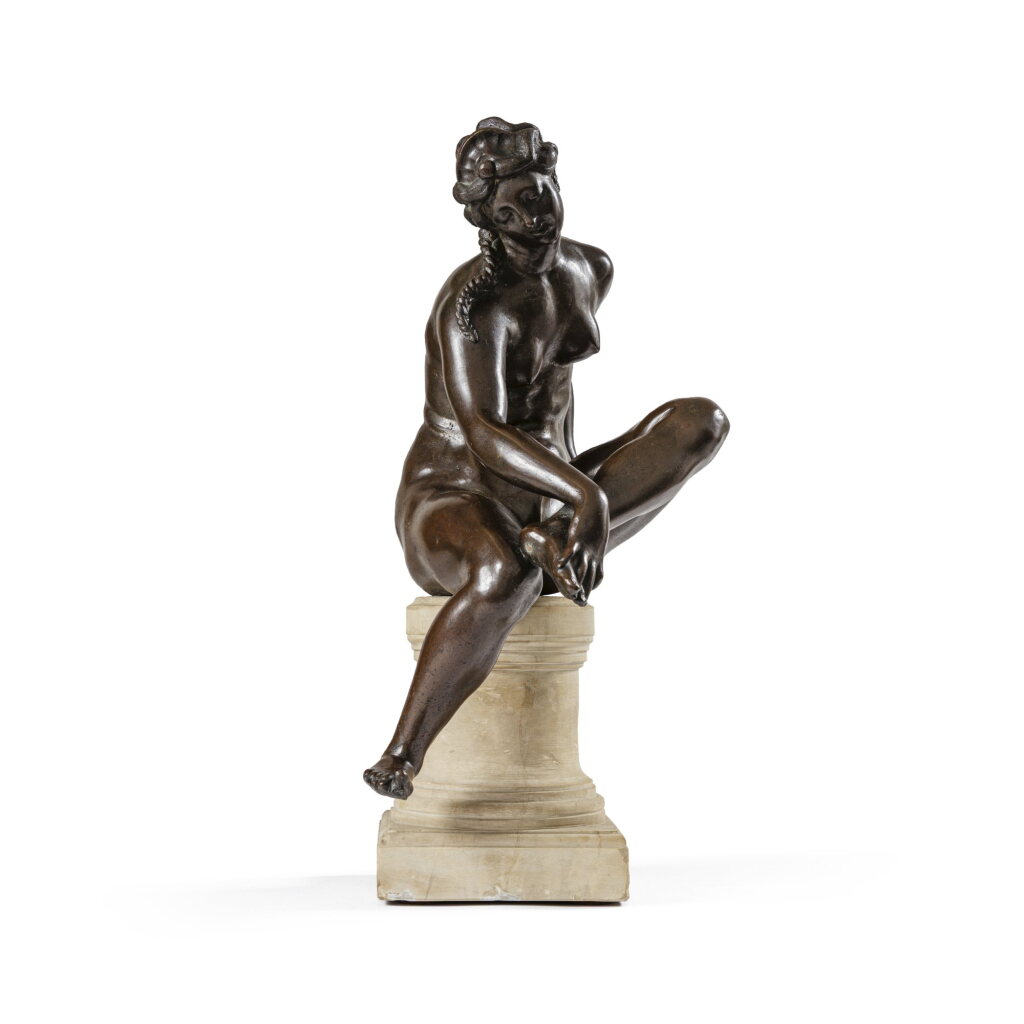
After Adriaen de Vries (circa 1556 - 1626), model probably Augsburg, circa 1597, cast Southern-German, probably Augsburg, mid-17th century
Venus or Nymph washing her foot
Auction Closed
November 5, 02:55 PM GMT
Estimate
15,000 - 20,000 EUR
Lot Details
Description
After Adriaen de Vries (circa 1556 - 1626), model probably Augsburg, circa 1597, cast Southern-German, probably Augsburg, mid-17th century
Venus or Nymph washing her foot
bronze; on a later limestone socle
bronze: 40cm., 15¾in.
46cm., 18⅛in. overall
German aristocratic collection, until expropriated after the Second World War, Schlossbergung Rötha bei Leipzig;
Staatliche Kunstsammlungen, Dresden, Grünes Gewölbe (Green Vault), Dresden, inv. no. 1984/1;
Restituted to the heirs of the above in 2008;
By whom sold, Sotheby’s London, 9 July 2009, lot 107.
J. Menzhausen, W. Klonke, Einführung in das Grüne Gewölbe, Altenbourg, 1977, pp. 58-59, ill. p. 59;
D. Syndram, Das Grüne Gewölbe zu Dresden. Führer durch seine Geschichte und seine Sammlungen, Munich / Berlin 1994, pp. 70-72, ill. p. 72;
U. Berger, V. Krahn, Bronzen der Renaissance und des Barock: Katalog der Sammlung, Sammlungskataloge des Herzog Anton Ulrich-Museums, Brunswick, 1994, p. 241.
The composition of this young woman at her toilette derives from a Hellenistic prototype, known through a Roman copy of the 2nd century AD preserved in Florence (Uffizi Gallery, inv. 1914, no. 19), of which the Paduan Giovanni Paolo Fonduli da Crema (active 1468 - 1484) cast the first bronze reduction (c. 1480 - 1490; Wallace Collection, inv. S72). The distinctly Mannerist torsion of the body in the present Nymph, as well as the movement of her right hand reaching towards her raised left foot, also echoes Giambologna’s marble Bathsheba, executed c. 1571 - 1573 and sometimes also described as a Female Figure or Venus (J. Paul Getty Museum, inv. 82.SA.37). The Florentine master devoted a significant part of his oeuvre to the theme of the toilette, in which the subject depicted often seems to serve little more than as a pretext for the representation of the female nude.
Adriaen de Vries, to whom the present model is now attributed, may have seen Giambologna’s Bathsheba in Florence between 1581 and 1586, or, more probably, in Munich, in the collections of the Duke of Bavaria, to whom it had been presented by Francesco de’ Medici. Indeed, the detail of the braid falling along the Nymph’s right shoulder is probably a direct quotation from Giambologna’s marble. The composition, rooted in the Florentine tradition, also recalls the seated figures precariously balanced on the basin of the Fountain of Neptune by Bartolomeo Ammannati (1511 - 1592), executed c. 1560 - 1574 (Piazza della Signoria, Florence).
Only two other examples of the present model are known: a bronze in Brunswick, described as Venus or Nymph Washing Her Foot (Herzog Anton Ulrich-Museum, inv. Bro 93; H. 40.3 cm), and a lead version in London, of lesser quality and depicting the female figure seated on a bench (Victoria and Albert Museum, inv. A.2-1946; H. 42 cm). According to C. List, the Munich painter Johann Matthias Kager (1575–1634), who had been based in Augsburg since 1602, depicted this model in a drawing dated 1615 (see op. cit., p. 159; whereabout unknown). This document attests to the circulation of the model as early as the first quarter of the 17th century.
Originally from The Hague, Adriaen de Vries was the sculptor of choice of the great courts of northern Europe. He is documented in Giambologna’s workshop in Florence from 1581, where he absorbed Mannerist principles and mastered the art of bronze casting. After a period in Milan with Pompeo Leoni, he worked for Charles Emmanuel I, Duke of Savoy, in Turin, before moving to Prague, where he entered the service of Rudolf II from 1593 onwards. Alongside his duties at the imperial court, he executed important commissions in Augsburg, notably the Mercury and Hercules fountains, and continued to work for Christian IV of Denmark and Albrecht von Wallenstein. Adriaen de Vries was a key figure in the artistic exchanges between Florence and the rest of Europe, particularly in the dissemination of Florentine Mannerism in northern Europe.
A parallel may be drawn between the present Nymph, with its contorted body, and the two allegorical figures flanking the bronze bust of Christian II of Saxony, cast by de Vries around 1603 (Staatliche Kunstsammlungen, Skulpturensammlung, Dresden, inv. H4 001 / 004). It bears an even closer resemblance to one of the figures from the Fountain of Hercules in Augsburg, made between 1597 and 1602. Indeed, it is now generally accepted that it was probably cast from a preparatory study for the Augsburg figure (see F. Scholten, op. cit., pp. 131–132).
An analysis of the composition of the present bronze indicates that the alloy used corresponds to that of the Brunswick statuette. Small points visible on the surface of both bronzes also reveal a comparable arrangement of the metal structure used to hold the core in place during casting. These visual and technical similarities suggest that the two bronzes were probably cast in the same Southern German foundry.
RELATED LITERATURE
L. O. Larsson, Adriaen de Vries, Adrianvs Fries Hagiensis Batavvs 1545 – 1626, Vienna / Munich, 1964, fig. 60; C. List, Kleinbronzen Europas, vom Mittelalter bis zur Gegenwart, Munich, 1983, pp. 158-159; F. Scholten (ed.), Adriaen de Vries 1556 – 1626, exh. cat. Rijksmuseum, Amsterdam, December 1998 – March 1999, Nationalmuseum, Stockholm, April– August 1999, The J. Paul Getty Museum, Los Angeles, October 1999 - January 2000, pp. 131-133.