Property from a French Private Collection (lots 117, 119, 121, 122, 137, 138, 164)
Joos de Momper the Younger
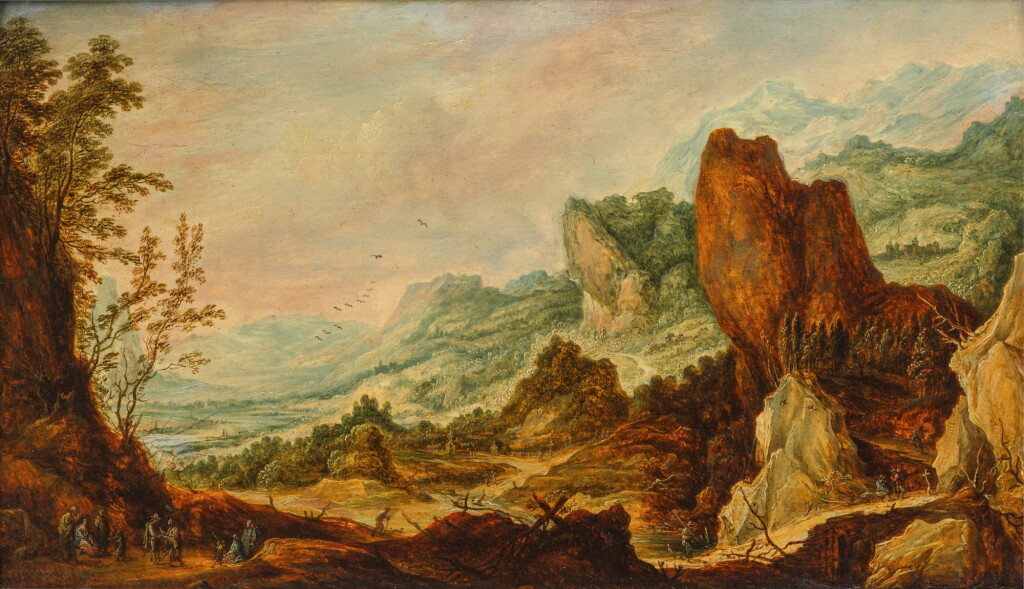
Figures in a rocky landscape
Lot Closed
June 13, 01:17 PM GMT
Estimate
8,000 - 12,000 EUR
We may charge or debit your saved payment method subject to the terms set out in our Conditions of Business for Buyers.
Read more.Lot Details
Description
Joos de Momper the Younger
Antwerp 1564 - 1635
Figures in a rocky landscape
Oil on panel
29 x 51 cm ; 11⅜ by 20⅛ in.
Collection Georges Ryaux, Paris;
His sale, Paris, Palais d'Orsay, 24 October 1979, lot 9.
Paris, Galerie Heim-Gairac, Exposition de paysages flamands, Herri Met de Bles à Jan Brueghel, April-May 1953, no. 34 (as Circle of Joos de Momper, with figures by Julian Teniers, titled Le Défilé).
A Flemish painter known for his landscapes, Joos de Momper the Younger (1564–1635) came from a large family of artists. After training with his father Bartholomeus, he became a master of the Guild of St Luke in Antwerp in 1581, before leaving to study in Italy, where he met Lodewijk Toeput, known as Il Pozzoserrato, and in Paris under Hieronymus Francken. He used many motifs found on his travels in his works and was especially inspired by his crossing of the Alps. He was one of the main exponents of the transition from the imaginary panoramic landscapes of the Flemish late sixteenth century to the more naturalistic approach of the seventeenth century. His works depict landscapes that are often mountainous, initially inspired by the paintings of Pieter Brueghel the Elder and Paul Bril.
As in many paintings by Joos de Momper the Younger, it is possible to see in this Rocky Landscape with Figures an arrangement structured through colour, forming a series of planes and guiding the eye of the viewer. This partitioning helps to create the sense of depth and the composition’s aerial perspective. The foreground, dominated by brown and red tones, is the most detailed and animated, appearing closer and more naturalistic. Figures in colourful clothing walk along the roads that meander between the rocks, the vegetation and a village at the centre of the composition. The intermediate plane, with yellow and green tones, eases the transition between a warm and a cool palette. It features a river and a fortress nestled in dense vegetation, leading the eye towards the back of the landscape. The background, in blue and grey tones, is more sketchily executed, giving an impression of distance and creating a misty atmosphere.
The short, quick strokes of the brush contribute to the realism of the details. The artist has paid particular attention to the foliage and the texture of the pictorial surface. As in Mountain Landscape in the Musée du Louvre (1620–1630, Paris, Musée du Louvre, MNR 418) and Landscape with Elijah Fed by the Raven (1600, London, The Schorr Collection, SRR6370641), we see motifs inspired by Alpine landscapes on Momper’s European travels. As was common practice in Antwerp in the seventeenth century, the figures in his works were often painted by collaborators. An inscription on the back of the panel suggests that in this case it was Juliaen Teniers (1572–1615).