Property from an Important Private Collection, Colorado
Agustín Cárdenas
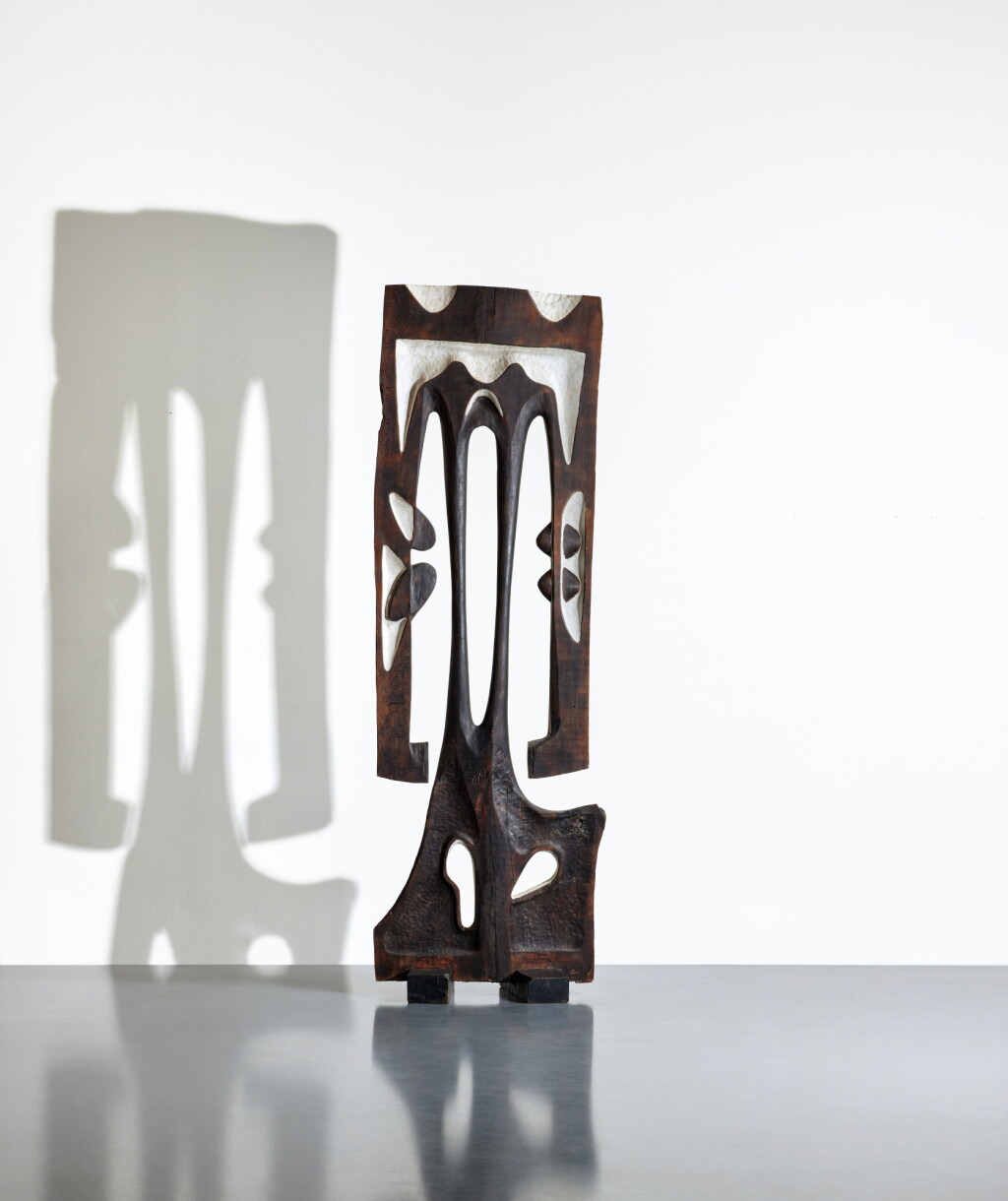
Mon ombre après minuit
Auction Closed
November 21, 01:55 AM GMT
Estimate
300,000 - 500,000 USD
Lot Details
Description
Property from an Important Private Collection, Colorado
Agustín Cárdenas
(1927 - 2001)
Mon ombre aprés minuit
incised with the artist’s signature and date 63 (lower center)
paint on found wood
95 by 30 by 4 in. 241.3 by 76.2 by 10.2 cm.
Executed in 1963.
Haim Chanin Fine Arts, New York (acquired by 2002)
Christie’s, New York, 18 November 2010, lot 15
Acquired at the above sale by the present owner
Milan, Galleria del Credito Valtellinese and Paris, Couvent des Cordeliers, Cárdenas, Sculture, 1947-1997, 1997, no. 12, pp. 118-19, illustrated
New York, Haim Chanin Fine Arts, Agustín Cárdenas: Desire and Grace, 2002, p. 20, illustrated
Barcelona, Oriol Galeria d’Art, Agustín Cárdenas, 2006, no. 5, pp. 40 and 111, illustrated
José Pierre, La Sculpture de Cárdenas, Brussels, 1971, no. 66, 96 and 132, p. 118, illustrated
Mon ombre après minuit – an imposing vertical carved wood sculpture from 1963 by Agustín Cárdenas, stands at the convergence of form and symbolic resonance within the artist’s oeuvre. At nearly eight feet tall, the slender but monumental silhouette immediately asserts itself as both corporeal and totemic: its elongated frame evokes the human figure, yet the abstraction of its contours suggest a metaphysical presence beyond the anthropomorphic.
The painted wooden surface adds a dimension to the sculpture’s effect, permitting a play of light and shadow to animate its carved hollows. Through the subtle patterned coloring, Cárdenas introduces an interplay of presence and absence, substance and silhouette—an echo of the work’s title, ‘My shadow after midnight’, evoking the realm of the unconscious, or the doubled self.
For Agustín Cárdenas, as for fellow Cuban-artist Wifredo Lam, the encounter with West African culture in postwar Europe marked a defining moment in his artistic development. Though the spiritual and ritual presence of Africa was embedded in Cuban life through religious groups such as Santería and Palo Monte, few tangible visual traces of its sculptural traditions survived the colonial era.
A descendant of African slaves from Senegal and the Congo, Cárdenas spent his childhood in Matanzas, a sugar-producing province east of Havana. At sixteen years old, Cárdenas was enrolled at the San Alejandro Academy of Fine Arts, where he studied from 1943 to 1949. Cárdenas received an artistic academic education based on interwar European models; during that formative period, Cárdenas encountered the sculptural idiom of the international avant-garde through reproductions of works by then renowned European sculptors Constantin Brancusi, Jean Arp and Henry Moore. Cárdenas first encountered a Dogon totem through a printed image in Cuba; but only after his arrival in Paris did he experience firsthand the spiritual force of African art, which profoundly shaped his search for a dynamic, sculptural language.
Cardenas arrived in Paris in Christmas of 1955, with a grant from the Cuban government. In his eyes, Paris remained the center of the world for creativity, one where he had to fight to earn his place. It was in Paris, he said himself, where he became aware of his ‘Négritude’ as interpreted by Aimé Césaire and Léopold Sédar Sengho. It was during these years that “he discovered the art of his ancestors, the magic of the tribal societies that he had inherited” (Pierre, Jose. “La sculpture de Cárdenas”, Brussels, La Connaissance, 1971). Here, he was also quickly welcomed into surrealist circles, which were fascinated by his exoticism and his sensual vitality.
It was only after leaving Cuba that both Lam and Cárdenas came into direct contact with the material cultures that had so profoundly shaped the modernist imagination. In mid-century Havana, no public collections held examples of African or Oceanic art, and it was in Europe—through access to ethnographic museums and private collections—that they first encountered these works firsthand. For Cárdenas, gaining access to these materials “provided not only encounters with the material culture of their African origins but also a more nuanced grasp of the formal sources of European modernist art,” revealing how non-Western aesthetics had quietly underpinned the avant-garde’s visual language (Power, Susan L. “Agustín Cárdenas: Sculpting the ‘Memory of the Future’.” Journal of Surrealism and the Americas, vol. 11, no. 2, 2020, pp. 98-119).
Although Cárdenas had faced racial prejudice in pre-revolutionary Havana, his move to Paris brought him into a cosmopolitan intellectual climate that united artists and writers from across the former French Caribbean and African colonies. There, the Négritude movement offered a framework for articulating a modern Black consciousness grounded in pride of origin and cultural synthesis. The Surrealists, who sought in non-Western art an antidote to Western rationalism, found ideological kinship with these Afro-Caribbean and African thinkers. Within this dynamic exchange, Cárdenas developed a heightened awareness of his heritage and its place within the universal modern project, translating these ideas into sculpture that fused ancestral resonance with formal innovation.
Mon ombre après minuit demonstrates Cárdenas’s distinctive synthesis of influences and experiences in the years prior to creating this work: the purity of line and vertical thrust reminiscent of Constantin Brancusi; the abstraction and internal rhythm of African sculptural traditions; and the Surrealist openness to dream and explore the hidden self. Executed during his mature Paris years, this work reflects this exploration of myth as well as his willingness to experiment with paint– an engagement with sculptural abstraction that keeps suggestion of the figurative form.
As Léopold Sédar Senghor reflected, “We accepted Surrealism as a means, but not as an end, as an ally, and not as a master.” In this atmosphere of dialogue and cultural reclamation, Cárdenas developed what José Pierre would describe as a “vital upward impulse,” transforming his inherited symbolism into a modern sculptural language of ascension and renewal. (Pierre, José. La sculpture de Cárdenas. Brussels: La Connaissance, 1971.)
You May Also Like