Property from an East Coast Collection
Norman Lewis
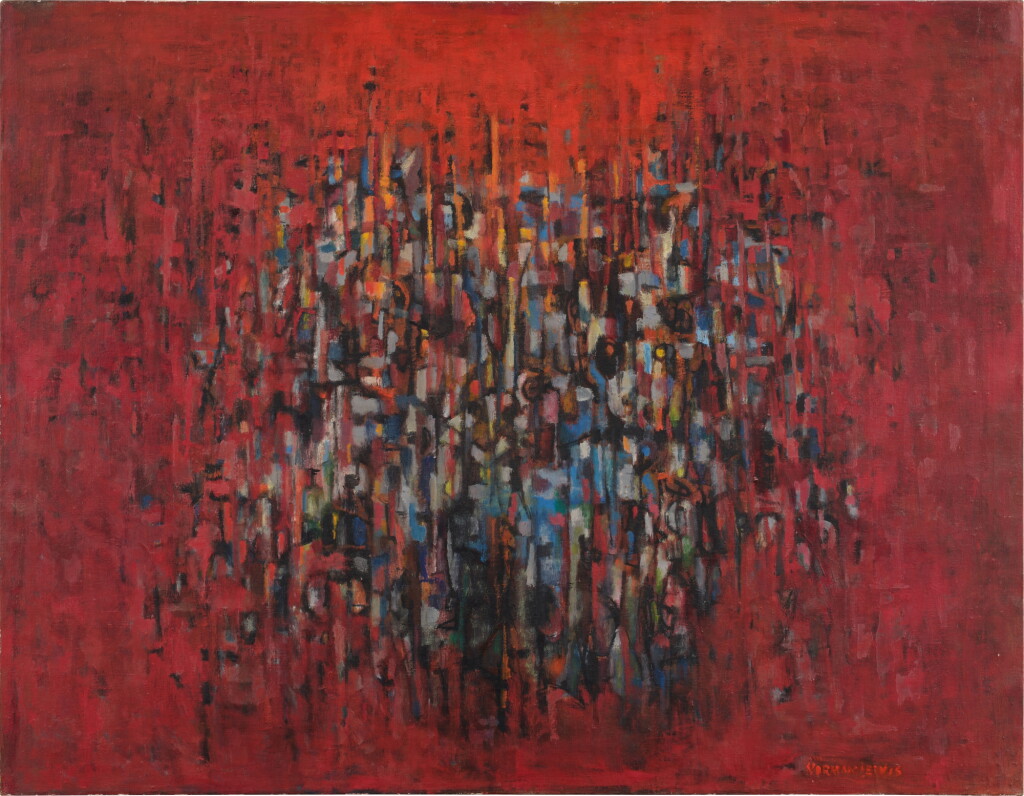
Gathering
Auction Closed
November 21, 01:55 AM GMT
Estimate
1,000,000 - 1,500,000 USD
Lot Details
Description
Property from an East Coast Collection
Norman Lewis
(1909 - 1979)
Gathering
signed (lower right)
oil on canvas
42 by 54 in. 106.7 by 137.2 cm.
Executed in 1956.
Private Collection, Syracuse (acquired directly from the artist as a gift circa 1956)
Thence by descent to the present owner
Simultaneously deeply personal and inherently political, Norman Lewis’ Gathering is a daring achievement of Postwar painting, uniquely articulating his cultural and social imperatives into a potent abstract language. Held in a single private collection for nearly seventy years, this work is an exuberant, daring, and precise realization of the artist’s deeply nuanced practice, executed the same year Lewis represented the United States at the Venice Biennale and the year after Lewis won the Carnegie International Exhibition’s award, competing against giants such as Richard Diebenkorn, Joan Miró, Fernand Léger, Willem de Kooning, Franz Kline, Philip Guston, Jackson Pollock, and Ad Reinhardt. A seminal figure of the Abstract Expressionist movement, Lewis fused stylistic innovation with social consciousness, his works resonating both politically and emotionally. Gathering of 1956 stands at a pivotal moment in Lewis’ career: before the overtly political imagery of the 1960s and after his recognition as a key voice within the downtown Abstract Expressionist scene of Studio 35. By technically accomplishing the trace of form while sustaining delicate abstraction, this work is a rare fusion that captures Lewis at his most conceptually courageous.
Born and raised in Harlem in the early twentieth century, Lewis absorbed many influences from African art, Japanese prints, jazz, and the tutelage of sculptor Augusta Savage. Lewis initially painted in the Social Realist style, the chosen political aesthetic of the Civil Rights Movement and popular among his Harlem peers, until he moved downtown and embraced the emerging Abstract Expressionist movement. He became the only African American artist present at the historic 1950 Session at Studio 35. In 1963, Lewis co-founded Spiral, an artistic coalition of landmark Black artists engaging with the visual identity of the Civil Rights Movement. Even while exhibited in the Willard Gallery, Lewis was driving taxis, working as a traffic analyst, and even gambling to pay his downtown rent — twice what his white counterparts paid. Despite being an active participant in Abstract Expressionist circles and a contributor to the movement’s intellectual core, Lewis was historically undervalued in the story of Modern Abstract Expressionism.
Lewis pioneered a new manifestation of Abstract Expressionism by producing works that provided an expression of enduring forms rather than a record of a fleeting moment of action. His social activism informed and deepened his theoretical and formal experimentation. Disillusioned by Social Realism and its limits as a catalyst for political change, Lewis rejected the prescriptive view that “all art is propaganda for or against the race.” (W.E.B. Du Bois quoted in: Jeffrey Stewart, “Beyond Category: Before Afrofuturism There Was Norman Lewis” in: Exh. Cat. Philadelphia, Pennsylvania Academy of the Fine Arts, Procession: The Art of Norman Lewis, 2015, p. 162) He rooted his activism in technical, iterative experimentation rather than didactic imagery. Lewis suffuses the canon with works such as Gathering that recall the power of traversing the space between artistic periods, balancing abstraction and form, impression and expression, where color and atmosphere carry moral gravitas without narrative literalism. The courage to pursue such artistic and political nuance in a period of intense division underscores the lasting wisdom that emanates from Lewis’ abstract works.
While working with his contemporaries to promote the capacity of a new style to speak to a Postwar American identity, Lewis independently pursued an additional social and political vision. For him, the style was a reordering of meaning, an attempt to employ a pictorial language which flattened figurative hierarchy and invited a unique, democratic way of seeing. “There is a profound loneliness at the center of his artistic quest for equality and community; a sense of community that the Abstract Expressionist artists promised, but for Lewis they could not deliver.” (Jeffrey Stewart, “Beyond Category: Before Afrofuturism There Was Norman Lewis” in: Exh. Cat. Philadelphia, Pennsylvania Academy of the Fine Arts, Procession: The Art of Norman Lewis, 2015, p. 171) That loneliness forms the emotional heart of his work. Gathering, while formal and rigorous, is charged with a rare intimacy, an emotional current akin to the work of Vincent van Gogh — who Lewis fondly honored by signing many of his works “Norman,” echoing Van Gogh’s humble signature, “Vincent.” Knowing the solitude Lewis endured in sacrificing the camaraderie of Harlem’s Social Realist artists to pursue abstraction allows us to feel the depth of his emotional and artistic risk. “I feel very inept so that I would rather make my mistakes alone,” Lewis once confessed, capturing both his isolation and his conviction. (The artist quoted in: Henri Ghent, “Oral history interview with Norman Lewis,” Archives of American Art, Smithsonian Institution, July 1968 (online)) In this way, his loneliness transcends the immediate bravado of the action painters, offering instead an inward search, the melancholy of a man between worlds.
For Lewis, artistic experimentation mirrored the iterative trials of the Civil Rights Movement itself. Each new social justice message demanded a new medium; each new era of his career required a reimagined visual language. From works on paper to acrylic on canvas, from clothing to sculpture, from portraiture to pure abstraction, Lewis consistently reformatted both himself and his message, translating his activism into ever more refined forms of expression. “Lewis, in other words, was a visionary, and exploring his art is more than a lesson in art history — it is a journey into another way of seeing the possibility that, through art, we might find a new approach to being productively alive.” (Jeffrey Stewart, “Beyond Category: Before Afrofuturism There Was Norman Lewis” in: Exh. Cat. Philadelphia, Pennsylvania Academy of the Fine Arts, Procession: The Art of Norman Lewis, 2015, p. 162) Lewis distilled his message anew each time, all the more poignant in the isolating context from which this visionary Expressionist broke old and new rules.
You May Also Like