
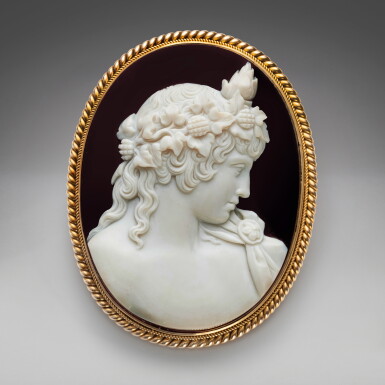
Antonio Vergé (active 19th century), Italian, Rome, dated 1869, After the Antique
Cameo with the Braschi Antinous
Auction Closed
February 7, 08:37 PM GMT
Estimate
6,000 - 8,000 USD
Lot Details
Description
Antonio Vergé (active 19th century)
Italian, Rome, dated 1869
After the Antique
Cameo with the Braschi Antinous
signed on reverse F. Vergé / fece nel 1869 Roma
stone, gold
height: 64 mm
width: 50 mm
This beautiful cameo is carved after the monumental statue of Antinous, the Braschi Antinous, in the Musei Vaticani in Rome. It is signed by the 19th-century Roman gem engraver Antonio Vergé who, according to Lucia Pirzio Biroli Stefanelli, is recorded as having made cameos for Fortunato Pio Castellani, the founder the celebrated Roman firm of goldsmiths. According to Lucia Pirzio Biroli Stefanelli, the elder Castellani supplied other contemporary jewelers with engraved gems and, in 1838, made a shipment of cameos to the French jeweler Alfred Megassier, which included cameos depicting a bacchante, Night, Flora, and Jupiter by Vergé.1 Like many Roman gem engravers of the period, Vergé catered to visiting wealthy European and American tourists in search of souvenirs for their travels in Italy. The image of the Braschi Antinous would undoubtedly have appealed to such a clientele, given the prominent placement of the monumental marble original opposite enormous porphyry bath of Nero in the Sala Rotonda in the Vatican. However, Vergé did not confine his talents purely to engraving gems with classical or allegorical subjects, since he is recorded as having made a portrait of Pope Pius IX for Castellani in 1847.2
Celebrated throughout history for his good looks, Antinous has subsequently become a symbol of same sex love. Relatively little is known about Antinous’ life, aside from the fact that Hadrian toured Asia Minor in AD 123 and may have been introduced to the youth at that time. Antinous was in Hadrian’s retinue by AD 130 and is recorded in a poem by the Alexandrian Greek Pankrates who describes the Emperor vanquishing of the Marousian Lion in the Libyan desert. Shortly after this event, Antinous tragically drowned in the Nile in mysterious circumstances. Many theories have surrounded his death, including forced suicide by jealous courtiers and ritual sacrifice, though Hadrian maintained it was an accident. Whatever the explanation behind his death, at 19 Antinous was becoming a man, and so his relationship with the Emperor was untenable. Same sex relationships in ancient Rome were governed by an unspoken moral code of dominance and subservience; there could be no suggestion that the Emperor was submissive to his lover. The effect of Antinous’ death was profound, Hadrian established a city in Egypt, Antinoopolis, in honour of the youth, and encouraged the dissemination of his image across the Empire.
Antinous was a favorite subject of gem engravers throughout history. The famous Marlborough Antinous, a 2nd-century AD intaglio engraved on black chalcedony, is one of the treasures of the Getty villa (inv. no. 2019.13.17), whilst, in the 18th century, Nathaniel Marchant (1739-1818) engraved a carnelian with an intaglio of Antinous for Lord Algernon Percy, later 1st Earl of Beverley (today in the collection of the Duke of Northumberland at Alnwick Castle, see Scarisbrick et al).3
1L. Pirzio Biroli Stefanelli, 'Jewels with Cameos and Intaglios the Castellani and Roman Gem Carvers' in S. Weber Soros and S. Walker (eds.), Castellani and Italian Archaeological Jewelry, exh. cat. Bard Graduate Center for Studies in Decorative Arts, Design and Culture, New York, 2004, pp. 103-128
2Ibid.
3D. Scarisbrick, C. Wagner and J. Boardman, The Guy Ladrière Collection of Gems and Rings, London, 2016.