Property from a California Private Collection
Quiringh Gerritsz. van Brekelenkam
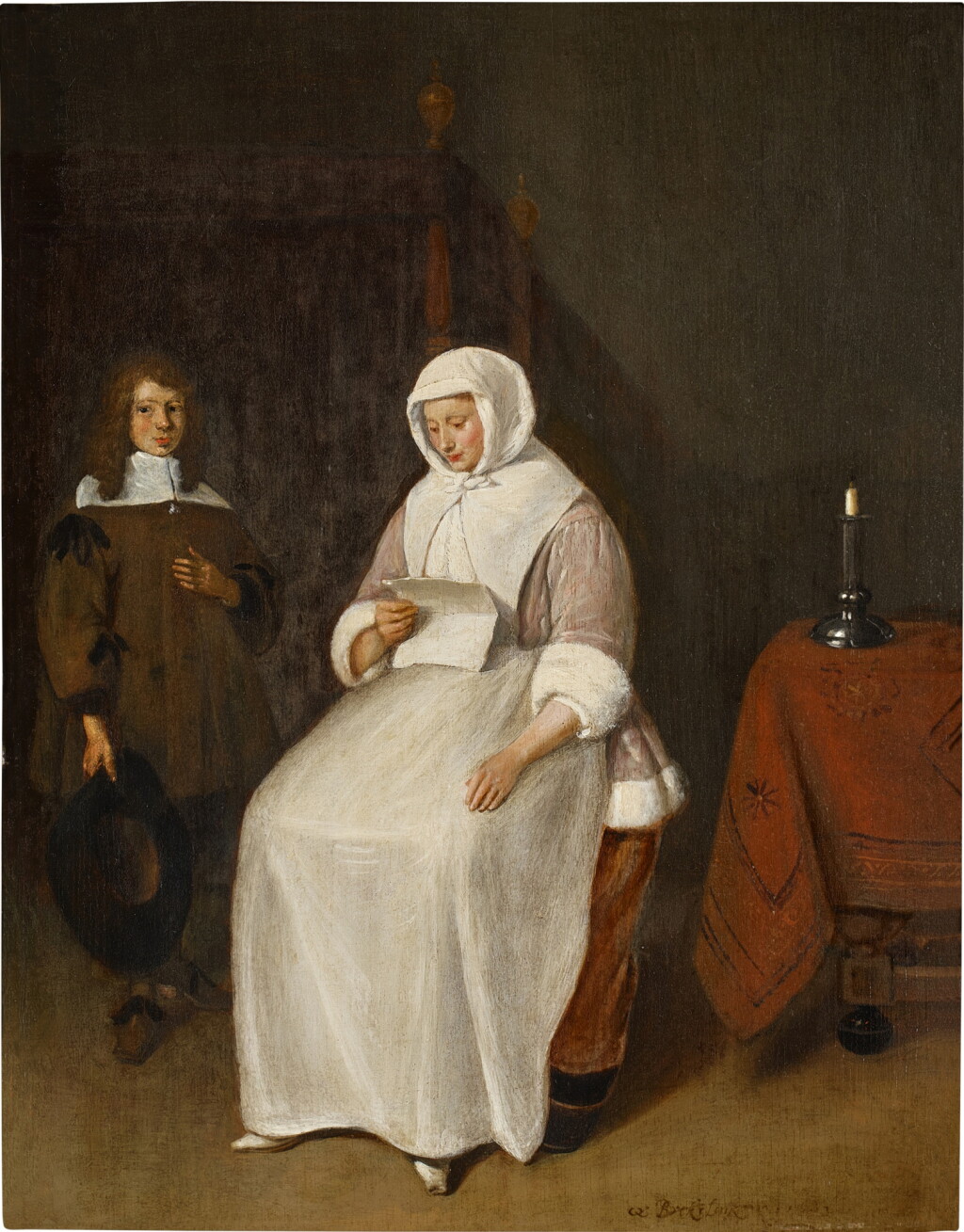
Woman Reading a Letter
Auction Closed
May 22, 04:37 PM GMT
Estimate
8,000 - 12,000 USD
Lot Details
Description
Property from a California Private Collection
Quiringh Gerritsz. van Brekelenkam
Zwammerdam 1622 - 1668 Leiden
Woman Reading a Letter
signed and dated lower right: Q. Brekelenkam 1662
oil on panel
panel: 16 ¼ by 12 ⅜ in.; 41.3 by 31.4 cm
framed: 22 by 18 ½ in.; 55.9 by 47.0 cm
Jan Schouten, Delft;
His estate sale, Amsterdam, S.J. Mak van Waay, 12-14 April 1938, lot 4;
Where acquired by "Minke";
With D.A. Hoogendijk & Co., Amsterdam (according to label on verso);
Anonymous sale, London, Sotheby’s, 21 March 1973, lot 58;
Where acquired by Galerie Sanct Lucas, Vienna;
Private collection, South Germany, until 2012;
Thence acquired by the present collector.
A. Lasius, Quiringh van Brekelenkam, Doornspijk 1992, pp. 49, 142, cat. no. 213, reproduced pl. 69;
P.C. Sutton, L. Vergara, and A.J. Adams, Love Letters: Dutch Genre Paintings in the Age of Vermeer, exhibition catalogue, London 2003, p. 31, reproduced fig. 32.
Signed and dated 1662, this panel belongs to a group of refined interiors from Brekelenkam’s later years, in which he increasingly embraced the themes of courtship, communication, and genteel quietude that also preoccupied his contemporaries such as Gerard ter Borch, Gabriel Metsu, and Johannes Vermeer.
The composition presents a young woman absorbed in the act of reading a letter, presumably from a suitor or distant loved one, while a young messenger stands silently nearby. The woman’s fur-trimmed jacket, satin shoes, and crisply starched linen coif underscore her status and refinement, while the dwindling flame of the candlestick on the side table and draped four-poster bed in the background evoke an atmosphere of intimacy and domestic comfort.
The composition’s spatial clarity, emotional restraint, and understated elegance reveal the influence of Gerard ter Borch, whose Lady Reading a Letter with a Messenger (Lyon, Musée des Beaux Arts, inv. no. A109) bears striking formal and thematic similarities. Here, too, the figures occupy a stage-like interior in which furnishings recede into the background, directing attention to the moment of private reflection.
A likely pupil of Gerrit Dou in Leiden, Brekelenkam helped found the Guild of Saint Luke in 1648 and remained a dues-paying member until 1667. Though he appears to have supplemented his income through trade—obtaining a license to sell beer and brandy in the 1650s—his artistic production remained steady.