Leonard A. Lauder, Collector
Untitled #4
Auction Closed
November 19, 12:41 AM GMT
Estimate
2,000,000 - 3,000,000 USD
Lot Details
Description
Leonard A. Lauder, Collector
Agnes Martin
(1912 - 2004)
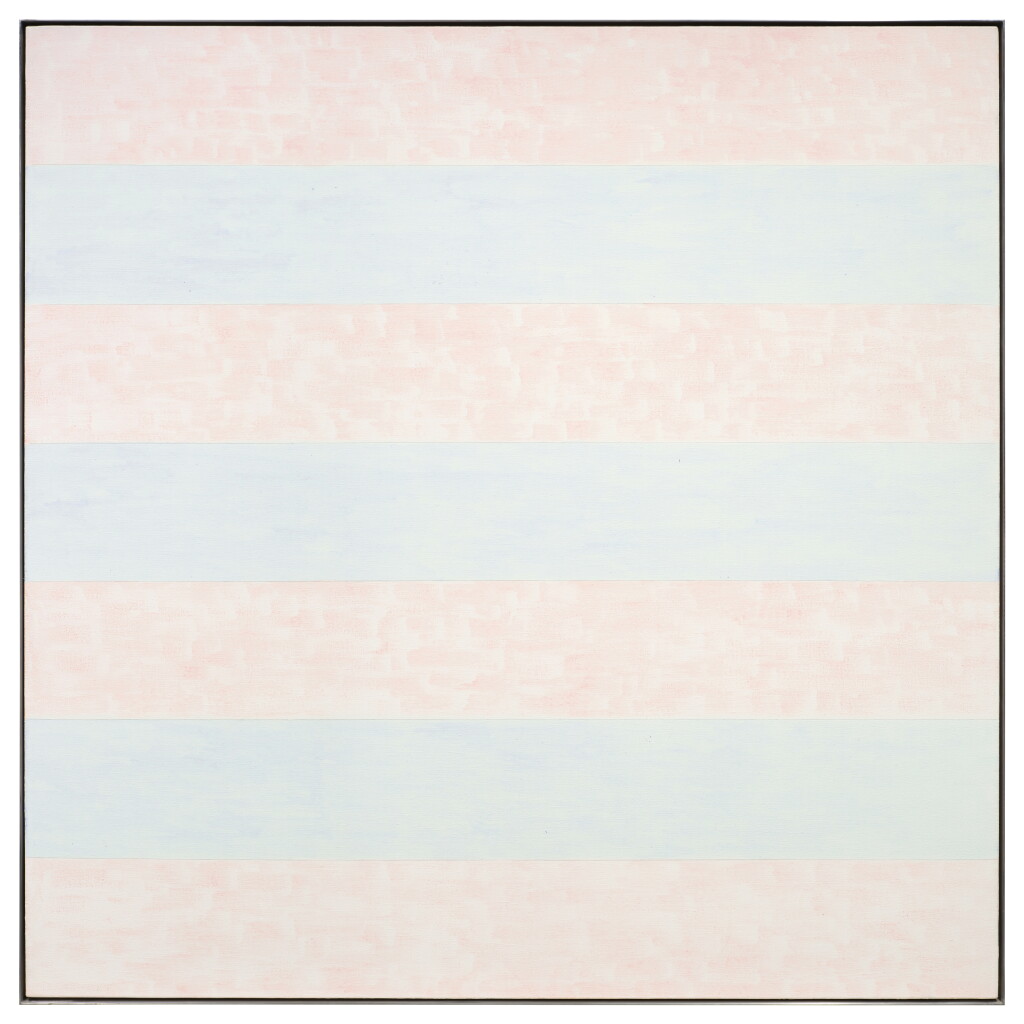
Untitled #4
signed a. martin and dated 1995 (on the reverse)
acrylic and graphite on canvas
60 by 60 in. 152.4 by 152.4 cm.
Executed in 1995.
PaceWildenstein, New York
Acquired from the above in May 1996 by the present owner
Los Angeles, PaceWildenstein, Agnes Martin: New Paintings, 1996
New York, Whitney Museum of American Art, Lovely Life: The Recent Work of Agnes Martin, 2000
London, Tate Modern; Dusseldorf, Kunstsammlung Nordrhein-Westfalen; Los Angeles County Museum of Art and New York, Solomon R. Guggenheim Museum, Agnes Martin, 2015-17 (New York only)
Tiffany Bell, ed., Agnes Martin: Catalogue Raisonné: Paintings, New York 2017 - ongoing, no. 1995.004, illustrated in color, online (accessed 13 October 2025)
Tiffany Bell, "Agnes Martin, Untitled #4, 1995," Solomon R. Guggenheim Museum, 3 October 2016 (audio commentary) (online)
The colors of Untitled #4, mesmerize the eye, not the least because they defy precise categorization. Here, the palest of blues, bordering on white, and a dusty pink with hints of terracotta subtly fluctuate in tone, depending upon the light in which the work is seen. Such is the magic of this painting by Agnes Martin, which belongs to a series that the artist executed in 1995, late in her life, while living in New Mexico. Through her mastery of painterly technique and purity of line, Martin’s compositions, such as Untitled #4, transport the viewer into an atemporal, spiritual realm, as she intended. “It’s not the paintings that are important,” Martin espoused. “It’s the response made to them that’s important. That is the reality in art, the response made by the observer” (Agnes Martin quoted in: Suzan Campbell, “Oral history interview with Agnes Martin, 1989 May 15,” Smithsonian Archives of American Art, 15 May 1989 (audio transcript) (online)).
Martin’s development as an artist was largely defined by two contrasting, yet complementary, environs: the bustling metropolis and creative energy of mid-century New York City and the peaceful solitude and incomparable majesty of the New Mexican landscape. In 1957, while she was living and painting in the desert plains of Taos, New Mexico, Martin’s early abstractions caught the attention of the dealer Betty Parsons, who persuaded Martin to relocate to New York City and join her roster of artists. Martin settled in “Coenties Slip” alongside Robert Indiana, Ellsworth Kelly, Barnett Newman, and Lenore Tawney. By the early 1960s she made an artistic breakthrough with her now iconic grid paintings (lot 12). Yet after a decade, she abruptly left the city, beginning a five-year hiatus from painting.
In 1972, Martin resumed her practice in New Mexico, where she was inspired by the expansive landscapes of her new surroundings. As Nancy Princenthal writes, “Of the work that emerged after Martin’s retreat from painting, it could be said that the urban grid gave way, gradually but conclusively, to a rural vision of open expanses and to sunlit shades of desert, rock, and sky (although, as always, she would resist such associations to the landscape). It could also be said that drawing had given way to painting as the work’s disciplinary basis” (Nancy Princenthal, Agnes Martin: Her Art and Life, New York, 2015, p. 224).
Her works of this period consist of wider registers that evoke the panoramic vistas and palette of the desert plateau and distant mountains—the blue sky, yellow fields, and reddish earth. Executed in 1995, Untitled #4 was rendered following the artist’s move from Galisteo to Taos, where she would reside for the remainder of her life. There she pursued more liberated brushwork and a more intuitive compositional system. The specific group of paintings from 1995 delight in alternating bands of blue and red hues, and their lighter tonal variants, such as the whitish blue and soft pink of Untitled #4; Martin may have chosen these two hues in response to the brilliant transitions of the sky from day to dusk in New Mexico. The delicate irregularities of Martin’s surfaces, beginning with her uneven application of the priming coat, help capture the nuances of the sky and the desert light—neither fixed nor solid, but always in transition.
The present work was first exhibited in 1996 at PaceWildenstein; other paintings from this series and exhibition, all rendered in a 5x5’ square format, are held at the San Francisco Museum of Modern Art, the Toledo Museum of Art, as well as in important private collections. Untitled #4 was previously seen at the Breuer building in Lovely Life: The Recent Work of Agnes Martin in the fall of 2000 and was most recently exhibited in Martin’s landmark traveling retrospective at the Solomon R. Guggenheim Museum in New York in 2017 (see fig. 3).
You May Also Like