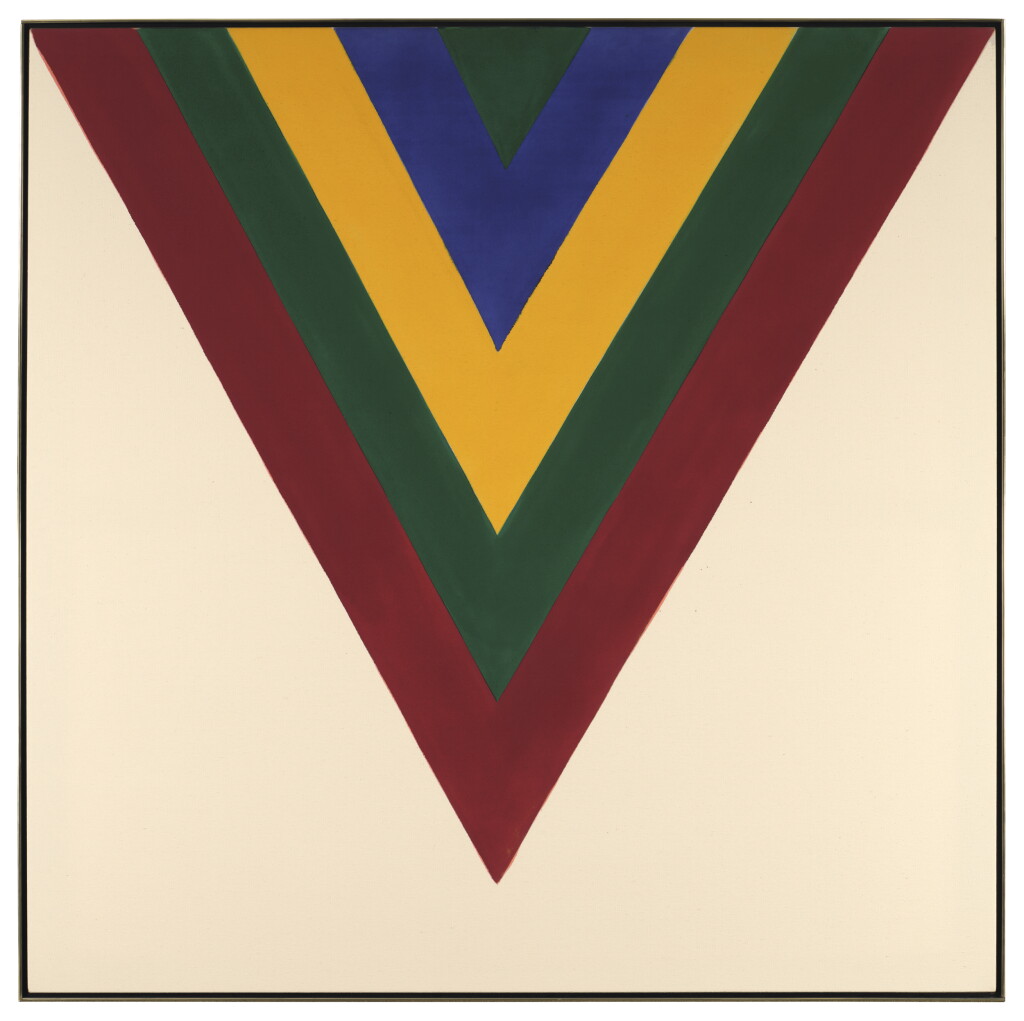
View full screen - View 1 of Lot 16. Plus 10.

Leonard A. Lauder, Collector

Kenneth Noland

Plus 10

Auction Closed

November 19, 12:41 AM GMT

Estimate

1,200,000 - 1,800,000 USD

Lot Details

Description

Leonard A. Lauder, Collector 

Kenneth Noland

(1924 - 2010)


Plus 10

signed Kenneth Noland, titled and dated 1964 (on the overlap); signed Kenneth Noland and dated 1.1964 (on the reverse)

acrylic on canvas

69 ½ by 69 ½ in.  176.5 by 176.5 cm.

Executed in 1964.


The present work is recorded in The Kenneth Noland Foundation archive under the identification no. D2-N0635.

David Mirvish Gallery, Toronto

Mildred and Dr. Joseph Gosman, Toledo (acquired from the above in 1965)

Christie's, New York, 10 November 1982, lot 30 (consigned by the above)

Estée Lauder Company, New York (acquired at the above sale)

Acquired from the above in November 1995 by the present owner

Toronto, David Mirvish Gallery, Kenneth Noland, 1965

Toledo Museum of Art, Toledo Collectors of Modern Art, 1969, n.p., illustrated (titled Plus Ten)

University of Pittsburgh, The Gosman Collection, 1969, no. 37, n.p., illustrated (titled Plus Ten)

Madison, University of Wisconsin, Elvehjem Art Center, 19th and 20th Century Art from the Collections of Alumni and Friends, 1970, no. 122, pp. 14-15; and p. 102, illustrated (titled Plus Ten)

Ann Arbor, The University of Michigan Museum of Art, The Gosman Collection, 1972, no. 25, p. 28, illustrated in color; p. 42 (titled Plus Ten)

John Russell, Meanings of Modern Art: The Great Divide 1950-70, New York, 1975, no. 39, pp. 38, illustrated

Rosalind E. Krauss, "On Frontality," Artforum, vol. 6, no. 9, May 1968, p. 41, illustrated

Spanning nearly six feet in both directions, Plus 10 is paradigmatic of Kenneth Noland’s chevron paintings and his formal, technical, and theoretical treatment of color: the singular focus that drove his decades-long practice. Executed in 1964, the present work marks a critical turn in Noland’s development as he continued to experiment with different geometric formats in an attempt to afford the interaction of contiguous colors the greatest primacy possible. He began with the circle canvases in 1956, followed by the famed targets or concentric circles in 1958, through to the lesser-known cat’s eyes of the early 1960s. Largely initiated in 1962, the chevrons marked his advance from circular and elliptical forms and thus involved a set of new, more structured relationships between figure, ground, and optical movement resulting from the assertive, directional movement of the “V” shape. They were also insistently frontal. Now the raw canvas on either side of the central image could be read as the literal ground of the painting or as the illusion of infinite background space.


Though Noland worked in series, his various, ever-permutating configurations of bullseyes, chevrons, stripes and diamond-shaped canvases were not always discrete bodies of work with finite beginnings and ends. In fact, the chevron format would prove so effective that Noland would revisit it in the 1980s, those later versions differentiated by their more pastose application of paint. In 1962-63, Noland worked on the chevrons and concentric circles simultaneously and both largely shared symmetry as a governing principle.


“The early chevrons, tied at three points to the picture’s perimeter,” Kensworth Moffett notes in his monograph on the artist, “could appear rigid and static, a bit over-structured—an effect that Noland tried to mitigate somewhat by raising the chevrons and letting the lowermost point swing free of the bottom edge” (Kensworth Moffett, Kenneth Noland, New York, 1977, p. 60). Plus 10 dates from this moment in which Noland liberated the apex of the chevron, freeing it from the previous rigidity. In the same year, 1964, the artist also produced his first asymmetric chevrons and soon adopted the use of shaped canvases—all consistent with Noland’s propensity for experimentation.


The chevron form inevitably had certain associations. It was a common military insignia, for example, and Noland had served in the US Air Force for four years during World War II. (The GI Bill funded his subsequent art education). Nonetheless, Noland aimed to disassociate his painting from such symbolism and largely succeeded. “In Noland’s hands,” Karen Wilkin writes, “the orchestration and placement of colors have become, almost for the first time in the history of Western art, independently expressive elements, removed from even the most tenuous connection with any preexisting image. The powerful associative qualities of color harmonies, like evocative sounds or scents, are made the carriers of profound emotions, but they are completely detached from any specific reference, from anecdote or symbol” (Karen Wilkin, Kenneth Noland, New York, 1990, p. 7).


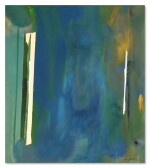
After the war Noland had returned to his native North Carolina to study under Josef Albers and Ilya Bolotowsky in 1946-48 at Black Mountain College. Albers’ color theory left a deep impression, as did Bolotowsky’s geometric abstraction. In 1953, Noland visited Helen Frankenthaler in her New York studio with Clement Greenberg and Morris Louis. There he was introduced to her revolutionary soak-stain technique, in which different thinned paints were poured onto raw canvas on the floor and then made to blur and blend (see fig. 1). Noland and Louis would become central figures in what was later termed the Washington Color School. While Louis would go on to develop his own methods of pouring and tilting, Noland began working with rollers to more precisely administer his application of pigment and used tape to delineate the edges of the bands. With such exactitude, Noland distanced himself from remnants of gesture, forcing the emotive and luminous properties of color to derive from its autonomous, optical qualities alone. In Plus 10 for example, Noland exploited the theory of complementary colors (those on opposite sides of the color wheel), juxtaposing bands of red and green and then blue and yellow, to mutually enhance their vibrancy and intensity.


“Noland’s search of the ideal Platonic form,” Diane Waldman observed on the occasion of Noland’s landmark career retrospective at the Solomon R. Guggenheim Museum, “has crystallized into an art in which color and form are held in perfect equilibrium. The spare geometry of his form heightens the emotional impact of his color. The rational and the felt, distilled form and sensuous color intermesh to create a magic presence. His space is color. His color is space. Color is all” (Diane Waldman quoted in: Exh. Cat., New York, The Solomon R. Guggenheim Museum, Kenneth Noland: A Retrospective, 1977, p. 36).


In pristine condition, Plus 10 stands not only as a testament to Noland’s vision but also that of Leonard A. Lauder, who hung the work in his office at 767 Fifth Avenue. Prior to its three decade-long tenure in the Lauder collection, the work was owned by prominent Ohio collector Dr. Joseph A. Gosman, from whom Lauder also acquired his Joseph Cornell box, Untitled (Green Parrot Hotel Voyager) (lot 114). Noland’s chevrons are prized by international institutions and are housed in prominent museums around the world, including the Solomon R. Guggenheim Museum, New York; the Museum of Modern Art, New York; and the Centre Georges Pompidou, Paris. The power of Plus 10 attests to Noland’s artistic legacy. It is a spectacularly engineered balance of color and form that defines his style of abstraction—one that shaped the course of American art for decades to follow.