Leonard A. Lauder, Collector
Edvard Munch
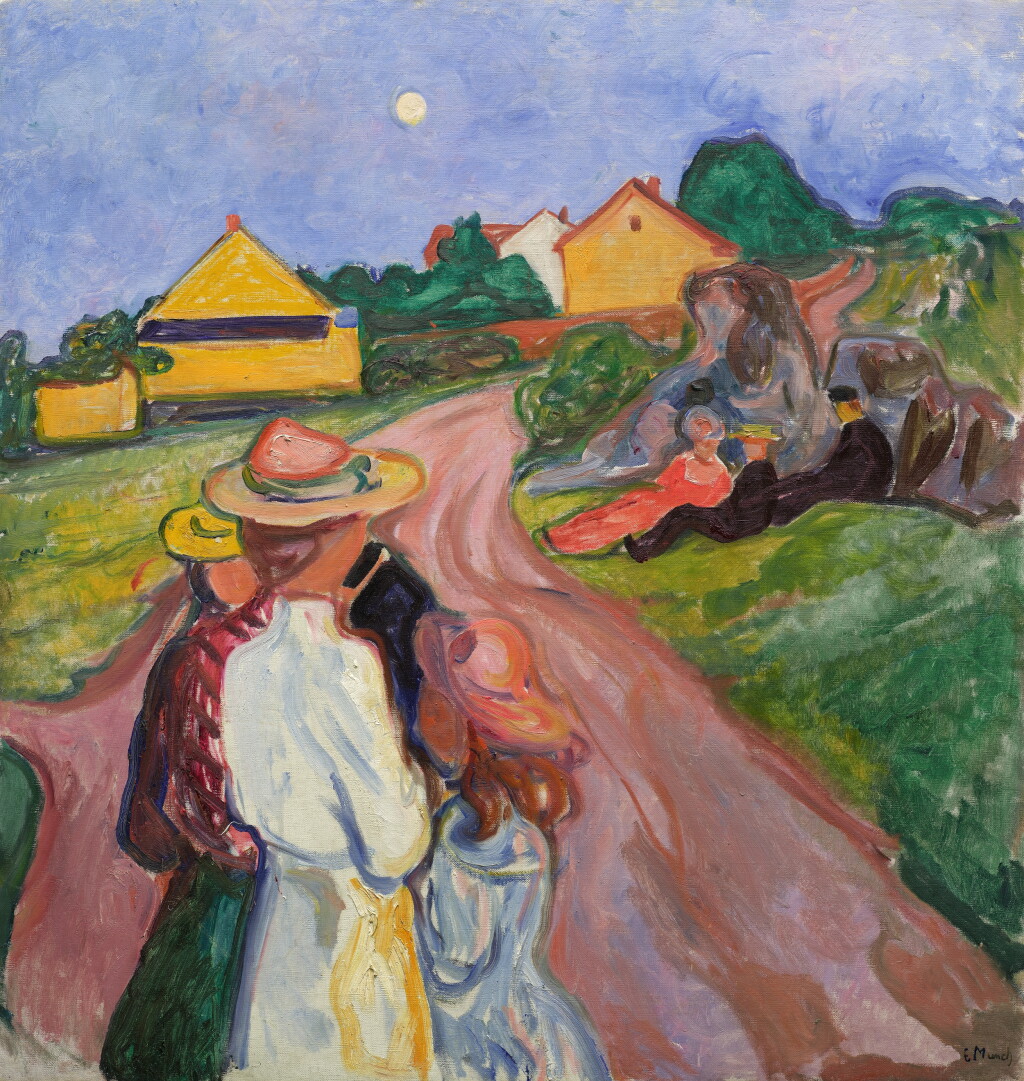
Sankthansnatt (Midsummer Night)
Auction Closed
November 19, 12:41 AM GMT
Estimate
20,000,000 - 30,000,000 USD
Lot Details
Description
Leonard A. Lauder, Collector
Edvard Munch
(1863 - 1944)
Sankthansnatt (Midsummer Night)
signed E. Munch (lower right)
oil on canvas
41 ⅜ by 39 ¼ in. 105 by 99.8 cm.
Executed circa 1901-03.
Anton Fredrik Klaveness II, Oslo (acquired by 1916)
Anton Fredrik Klaveness III, Oslo (acquired by descent from the above)
Estée and Joseph Lauder, Palm Beach (acquired from the above through Hirschl & Adler Galleries on 19 October 1976)
Thence by descent to the present owner
Kristiania, Blomqvists Lokale, Edvard Munchs udstilling, 1903, no. 17 (titled Sancthansnat)
Berlin, Paul Cassirer, Edvard Munch, Phillip Klein, August Gaul, 1903
Berlin, Paul Cassirer, 1903
Vienna, XIX. Ausstellung der Vereinigung Bildender Künstler Österreichs Secession (Vienna Secession), 1904, no. 40, p. 15 (titled St. Johannisnacht)
Kristiania, Dioramalokalet, Edvard Munch udstilling, 1904, no. 69 (titled Sankthansnat)
Prague, Galerie Mánes, Edvard Munch, 1905, no. 110 (titled V noci Svatojanské)
Kristiania, Dioramalokalet, Edvard Munch udstilling, 1911, no. 38, p. 2 (titled Sommernat (Aasgaardstrand))
Frankfurt, Steinernes Haus, Edvard Munch, 1962-63, no. 27, n.p., illustrated (titled Johannisnacht and with incorrect dimensions)
New York, The Solomon R. Guggenheim Museum, Edvard Munch, 1965-66, no. 34, p. 58, illustrated (dated 1901-02 and with incorrect dimensions)
Kamakura, Kanagawa Prefectural Modern Art Museum; Nagoya, Aichi Prefectural Art Museum; Kobe, Hyogo Prefectural Modern Art Museum; Kyoto, National Museum of Modern Art, Edvard Munch, 1970-71, no. 20, p. 75, illustrated; p. 133 (dated 1901-02)
Oslo, Munch-museet, Edvard Munch og den Tsekkiske Kunst, 1971, no. 110, p. 86, illustrated (dated 1901-02 and with incorrect dimensions)
New York, Neue Galerie, Munch and Expressionism, 2016, no. 41, p. 40 and 223; p. 187, illustrated in color
“Edvard Munch, XV. udstilling i S V U Manes, februar-mars 1905,” Pokroková revue, vol. I, 1905, p. 115
Volné Směry Umělecký Měsíčník. vol. XVII, 1913, p. 202, illustrated (titled Večer)
“Art: The Black Angels,” Time, 4 January 1963, illustrated in color
Edvard Munch and Gustav Schiefler, Briefwechsel, vol. 1, Hamburg, 1987, appendix II, p. 490 (titled Asgaardstrand (Picnic)); p. 492 (titled Johannisnacht), pl. 94, p. 509, illustrated (installed in the galleries of Commetersche Kunsthandlung, January 1906)
Gerd Woll, Edvard Munch, Complete Paintings, Catalogue Raisonné, London, 2009, vol. II, no. 489, p. 531, illustrated in color (with incorrect dimensions); vol. IV, p. 1606; p. 1608, illustrated (installed in the galleries of Commetersche Kunsthandlung, January 1906); p. 1664
Bernhard Echte, Walter Feilchenfeldt and Mitarbeit Petra Cordioli, eds., Kunstsalon Paul Cassirer, Die Ausstellungen 1901-05, «Man steht da und staunt», vol. II, Wädenswil, 2011, p. 254 (titled
Landschafts-u. Dorfszene in nordischer Sommernacht); p. 370, illustrated in color (titled Johannisnacht); p. 391 (titled Strohhutmädel auf der Straße)
Hans-Martin Frydenberg Flaatten, Måneskinn i Åsgårdstrand: Edvard Munch, Oslo, 2013, fig. 104, p. 155, illustrated in color; p. 274 (with incorrect dimensions)
Sankthansnatt (Midsummer Night)
Reinhold Heller
Sankthansnatt (Midsummer Night) numbers among Edvard Munch’s most sensuously beautiful paintings. It is one of several images depicting a curved dirt road bathed in the transformative light of Norwegian midsummer in the fishing village of Åsgårdstrand, on the banks of the Oslofjord. With its undulating shoreline, white clapboard houses and picket fences, grand linden trees and nearby forests, this picturesque locale became a popular destination in the 1880s, especially among Norway’s artists.
Munch first visited Åsgårdstrand during the summer of 1885 while staying in nearby Borre where he entered into a fateful liaison with Milly Thaulow, a married woman. The stylized meander of the Åsgårdstrand shoreline would later become the setting for his symbolic scenes of love and jealousy in The Frieze of Life, largely inspired by Munch’s illicit romance with Milly. After returning repeatedly he bought a fisherman’s hut in 1898 as his summer studio. Thereafter he frequently depicted the streets and piers of Åsgårdstrand itself, without injecting the overtly symbolic imagery of his Frieze and other works of the 1890s.
In contrast with Munch’s most celebrated work, The Scream, that projects brooding anxiety through harsh, almost unmodulated, undulating striations of red and yellow sunset, Midsummer Night evokes tranquility. Its never-quite-setting sun allows the moon to appear as an intensely yellow disk in a sky of softly muted blue and that gently suffuses the scene. Fundamentally, Midsummer Night is the antithesis of The Scream (see fig. 1) in mood and meaning as it reveals Munch as master of an ethereal but almost tactile, fragile illumination.
The gentle and calm scene contrasts sharply with Munch’s life at this point. For him, the turn of the century was marked by extreme emotional and psychological turmoil as well as recurrent illness, exasperated by alcohol dependence. He moved, as he put it, from one “nerve-sanatorium” to another, from Norway to Germany and back again, to Paris, Rome and Switzerland. He got into a fistfight with another artist and isolated himself from his prior Norwegian friends. Underlying this was his tumultuous relationship with Mathilde “Tulla” Larsen (see fig. 2).
They met in 1898, initiating a passionate romance that was soon marked by mutual recrimination, notably as Munch rejected notions of a traditional marriage. Later he observed, “And so there remains my work, my art, for which I sacrificed my happiness—that is, what others call happiness—prosperity, a wife, children… Her happiness depended on my destruction” (Edvard Munch, Manuscript T2776, cited in Reinhold Heller, Munch: His Life and Work, London and Chicago, 1984, p. 174). The relationship came to a violent end in September 1902 when, during an alcohol-fueled argument, Munch’s pistol accidentally went off, shooting out a knuckle of his left hand. He fled to Germany initially but resumed his pattern of spending summers in Åsgårdstrand the following June. Deleterious aftereffects of the Munch-Larsen relationship would continue for years, finally the artist signed himself into a sanitorium in Copenhagen in 1908 to seek relief and cure.
The years of romantic conflict and recurring illness around 1900 were also marked, in stark contrast, by major successes in Munch’s career. He exhibited regularly in Norway, France, Belgium and Germany. In the spring of 1902, his ambitious project devoted to “the life of the modern soul”—the series of twenty-two paintings he later identified as The Frieze of Life—was featured at the Berlin Secession. Influential critics, notably in Germany, hailed him as prophet of a new art. That perception was developed adamantly in a generously illustrated monograph, Edvard Munch und die Kunst der Zukunft (Edvard Munch and the Art of the Future) published in 1902 by Dr. Max Linde, one of an increasing number of German patrons who collected his works and commissioned portraits.
An unprecedented period of artistic and financial success promised what Munch felt to be “new life, new hope.” This optimism of success remained tarnished, however, by the threat to his creativity that he perceived in Tulla Larsen’s persistent baleful presence and her expressed desire for marriage, culminating in the gunshot incident.
Feeling pursued by Tulla Larsen and persecuted by her Norwegian friends, beginning in 1901 Munch sought solace and inspiration in Åsgårdstrand. His Frieze of Life had been completed that winter with The Dance of Life (see fig. 3), his view of the triple stages—attraction, consummation and sorrow—of a romantic relationship. He focused next on mood-filled landscapes and portraits. His majestic painting of the Book Family, from early summer 1901, fuses these themes. The portrait presents an older woman, a younger woman and a young girl, all dressed elegantly but somberly in funereal black (see fig. 4). Now in the guise of a group portrait, this is also Munch’s perception of the three phases of women’s lives—innocent youth, maternal maturity and old age. Much like the stylized nearby shoreline in The Frieze of Life, the road into Åsgårdstrand was translated into an iconic leitmotif in a group of paintings glowing with nocturnal midsummer light.
This group includes five paintings, in addition to the Book Family portrait (Woll 486-89 and 491). None of them is inscribed with the exact date of creation. The Book Family appears in a photograph from early 1902 of Munch’s Berlin studio, so surely dates from the summer of 1901. The five Summer Night paintings were painted no earlier than summer 1901 (see figs. 5-7) while the appearance of young girls in the foreground of several links them to the multiple Four Girls in Åsgårdstrand compositions painted in 1902-03 (Woll 544, 564 and 565; see figs. 8 and 9).
Munch did not habitually paint scenes while at the sites and times depicted. Considering his habits at the time, conceivably he may not even have been in Åsgårdstrand while painting them once he had fixed the images in his mind. He was not an Impressionist who sought to capture a scene sur le motif, the artist’s eye serving as the sole screen. Following his dictum of “I paint, not what I see, but what I saw,” Munch injected his emotions into images perceived and shaped by memory. “The way one sees is also dependent on one’s emotional state and how one generally feels,” Munch observed. “This is why a motif can be seen in so many ways, and it is what makes art so interesting” (Edvard Munch, Manuscript MM T 2781, 1932, Munch Museum, Oslo).
Early in the 1890s, Munch realized that his paintings interacted visually and conceptually. The Frieze of Life resulted, but other multi-image “friezes” and projects continued to absorb him for the remainder of his life. The five summer night paintings of 1901-03 might well be considered side-by-side as a polyptych in which Midsummer Night is the central anchor, flanked on left and right by the others. It is the tallest among them and the only one not a horizontally oriented rectangle. Nearly square in format, its physical dimensions distinguish the painting from the others. Munch employed a square format in several Åsgårdstrand images, such as his variations of the “Girls on a Bridge” theme during 1901-03, further suggesting possible combinations, pairings or “decorative friezes,” to use his terminology (see fig. 10). The concept “decorative” was widely applied at the time to paintings rejecting post-Renaissance spatial illusions of depth and instead accenting surface cohesion. With its elimination of directional dominance—the four sides being equal—the square was often used by Gustav Klimt and the artists of the Vienna Secession around 1900 as an organizing element in painting, design and architecture (see fig. 11). Indeed, they employed its abstracted form as the very emblem of the artists’ group. Exhibiting there and having Viennese patrons, Munch may well have been aware of the Secession’s fascination with the square. Its neutral shape emphasized the non-illusionistic color, internal balance and coherence that Munch and others pioneered as the key principles of Modernism.
While in revolutionary rebellion against long-established norms, Munch also entered into conversation with them and with Norwegian cultural customs. The evening before the feast of St. John, June 23, coincides with the Summer Solstice, celebrated since Viking times as the sun reaches its annual height in “The Land of the Midnight Sun.” Nocturnal darkness does not come, and sky and earth remain illuminated with a soft, gentle blue. Around 1900, stemningsmåleri—mood painting—became a popular genre in Norwegian painting, literature and music. Harald Sohlberg, Munch’s contemporary, developed an oeuvre that explored and synthesized the transformative blue light of Norwegian midsummer nights. Munch’s fascination with the midnight glow has its first major manifestation in the painting that introduces his Frieze of Life paintings in 1893. Summer Night. The Voice (Woll 394) depicts a young woman clothed in traditional virginal white leaning forward, arms behind her back, and wide-eyed as if in expectation of a kiss from a suitor only she sees (see fig. 12). The setting is a pine forest through whose trunks the waters of the fjord fuse with a blue sky as a bright yellow moon breaks into the gloaming.
Munch avoided the overt eroticism of Summer Night’s Dream when he returned to the theme nearly a decade later in Midsummer Night. The gentler blue of the sky finds subtle unifying echoes throughout the landscape and cluster of young women in the foreground without becoming an overpowering veil.
Munch’s palette and approach to landscape altered significantly as he turned away from the Frieze of Life. Greater nuance and diversity of colors replaced the stylizations of his 1890s Symbolist works conjoined with a greater attention to the details and tones of nature. His determination to use color, form and structure to transmit psychological truths and emotional states remained unabated, however. Midsummer Night establishes visual tension through the perspectival organization of the foreground figures and another group reclining in the grass further along the road. Munch enhances that tension by turning the largest foreground figure, in white, towards the other group where a woman in red reclines along with the men. The traditional European color associations—white for innocence, red for passion and black for mourning or sorrow—that Munch used in The Dance of Life reappear here more subtly, in ways less overtly symbolic.
Intense observation colored by emotion and memory characterizes the painting. Masterfully captured is the moon as a bright yellow disk in the pregnant blue of the sky while the pattern of houses and the white dress of the foreground echo and amplify its bright intrusion. The pink road curving into the picture’s space rather than the piercing diagonals of The Scream here creates a unifying central embrace for the composition. With its exaggerated perspective indicative of pictorial depth, its largely unmodified color and sweeping, rapid strokes of deeper color create an exquisite interplay between illusion and pictorial flatness, between illusion and the visible signs of its own making.
One of the masterpieces of this pivotal moment in Munch’s career, Midsummer Night combines deeply complex yet economical artistic means with psychological insight and biographical reference. On the very cusp of a new century, the painting points powerfully to both past and future.
Reinhold Heller is Professor Emeritus of Art History at the University of Chicago.
You May Also Like